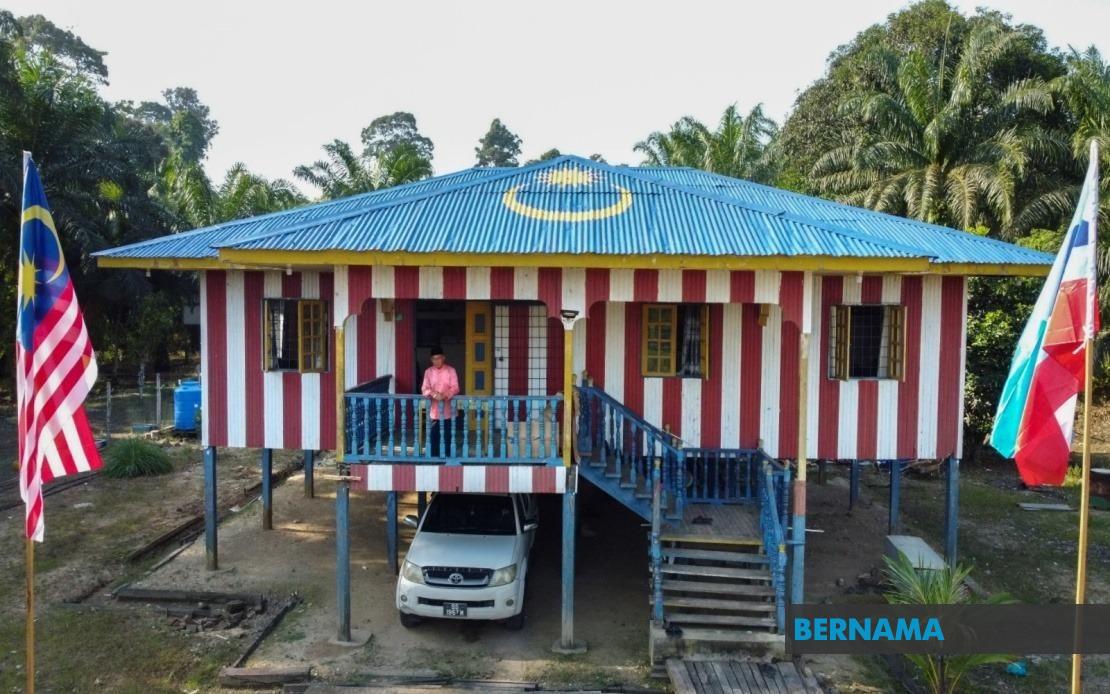
In the quiet neighbourhood of Batu 15 along Jalan Labuk in Sandakan, a weathered wooden house has been reborn as an unlikely monument to national pride. Teratak Gemilang, the residence of 68-year-old businessman Mohd Halikin Angga, stands out dramatically against its surroundings with walls painted in bold red and white stripes, a deep-blue roof crowned with a golden crescent moon and 14-pointed star, and Malaysian flags positioned prominently throughout the compound. What began two decades ago as a personal expression of love for the nation has evolved into a beloved landmark that draws visitors, particularly during National Month, making it a striking reminder of how individual commitment to patriotism can leave a visible imprint on a community.
Mohd Halikin's decision to paint his house in 2004 emerged from a combination of deep affection for Malaysia and respect for his parents' generation. Having witnessed their experiences during the colonial era, he felt a responsibility to maintain and celebrate the independence they had lived to see. A particularly poignant trigger for his project came from observing the fate of Malaysian flags during and after National Day celebrations. The sight of flags being dismantled once festivities ended troubled him, but what genuinely distressed him was witnessing flags blown away by wind, lost from vehicles, or left abandoned on the ground. These small indignities to the national symbol crystallised his determination to create something permanent, a house that would stand as a continuous celebration of Malaysian identity rather than a temporary seasonal display.
The visual transformation of Teratak Gemilang reflects meticulous attention to detail. The deep-blue roof serves as a striking foundation, its carefully painted crescent moon and 14-pointed star mirroring the central symbols of the Jalur Gemilang. The red and white striped walls mirror the flag's design while the compound displays multiple Malaysian flags in constant view. Yet this is far more than a superficial patriotic gesture. Stepping through the entrance, visitors encounter a carefully curated mini gallery that functions as a living history lesson. The living room walls showcase a chronological progression of portraits depicting every prime minister from Tunku Abdul Rahman Putra Al-Haj through to the current office-holder, alongside images of the Yang di-Pertuan Agong and the Yang di-Pertua Negeri Sabah.
Among Mohd Halikin's most treasured possessions is a historic photograph that captures a pivotal moment in Malaysia's formation: Tunku Abdul Rahman meeting 20 North Borneo leaders in 1961 to discuss the birth of the Malaysian nation. The discovery of this photograph demonstrates the deeply personal nature of his patriotism. While performing Umrah in 2005, he encountered the image in a newspaper during his flight, recognising its historical significance immediately. With remarkable presence of mind, he requested permission from the cabin crew to preserve and later frame this documentation of a critical juncture in Malaysia's political development. For Mohd Halikin, such artefacts represent far more than memorabilia; they are tangible connections to the sacrifices and vision of previous generations.
His commitment to honouring national leadership extends into his private family life in unexpected ways. Among his seven children, three bear names deliberately chosen to reflect prominent Malaysian statesmen. His eldest son carries the name of Tun Dr Mahathir Mohamad, while his second son is named after Tun Abdullah Ahmad Badawi. His daughter, Nur Zahirah, was named in tribute to the 13th Raja Permaisuri Agong. For Mohd Halikin, this naming practice transcends mere convention. He articulates a philosophy in which names function as vessels of hope and memory, designed to ensure that future generations maintain awareness of the contributions and legacies of those who shaped the nation. In his view, personal nomenclature becomes a form of intergenerational transmission, anchoring younger family members to historical continuity.
Over the past two decades, Teratak Gemilang has transcended the private sphere to become a public point of interest. Visitors regularly pause to photograph the distinctive house, particularly during National Month when patriotic sentiment runs highest throughout the country. This spontaneous tourism reflects how Mohd Halikin's personal endeavour has resonated with broader community values. The house has become a visual shorthand for Malaysian patriotism, a concrete expression of national pride that requires no interpretation or explanation. In an era when public displays of national identity often feel politically fraught or institutionally mandated, Teratak Gemilang represents something refreshingly uncomplicated: one individual's determination to celebrate the nation he loves.
Mohd Halikin has made clear his intention to maintain Teratak Gemilang in its current patriotic appearance indefinitely. This commitment to permanence distinguishes his gesture from temporary seasonal decorations. By keeping the house painted in Jalur Gemilang colours year-round, he ensures that the spirit of love for Malaysia remains present and visible regardless of the calendar. His decision reflects a broader conviction that patriotism should not be confined to official holidays or government campaigns, but rather should permeate everyday life and maintain constant visibility within communities.
Looking toward 2026 and the upcoming Malaysia Day and National Day celebrations, Mohd Halikin envisions Teratak Gemilang playing a renewed role in strengthening communal bonds. Sabah's diverse multiracial population provides an essential context for understanding his aspirations. In a state where communities representing multiple ethnic backgrounds and religious traditions coexist, national symbols take on heightened significance as expressions of shared identity that transcend particular group allegiances. Mohd Halikin hopes his home will serve as a focal point for celebrating this unity, using the national colours and imagery to reinforce connection rather than division among Sabah's various communities.
The story of Teratak Gemilang offers several layers of meaning for Malaysian society more broadly. It demonstrates how individual civic engagement can generate community value without requiring institutional support or government sponsorship. It illustrates how personal memory, family heritage, and national identity can interweave productively. It shows that patriotism need not be abstract or performative; it can find expression through concrete, visible, sustained commitment. For Sandakan residents and visitors to the town, the house stands as evidence that love of country can be lived authentically through daily choices and creative expression. In an increasingly globalised and sometimes fragmented world, Teratak Gemilang represents something increasingly rare: a deeply sincere, artfully executed, and publicly generous expression of national belonging.

