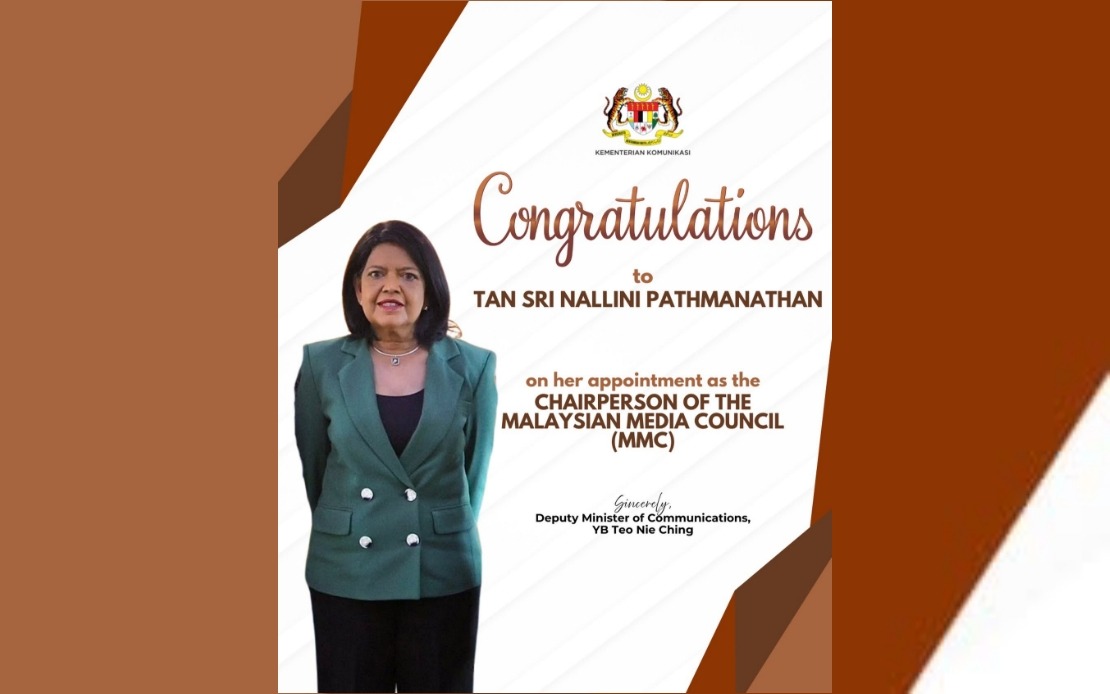
Tan Sri Nallini Pathmanathan, a former Federal Court judge, has been appointed chairperson of the Malaysian Media Council (MMC), the nation's new self-regulatory body created under the Malaysian Media Council Act 2025. Deputy Communications Minister Teo Nie Ching has publicly endorsed the appointment, particularly citing Nallini's distinguished judicial legacy on matters concerning press freedom and constitutional interpretation. The MMC Board unanimously approved Nallini's leadership at a meeting held on May 26, marking a significant milestone for media governance in Malaysia.
Teo's endorsement reflects confidence in Nallini's approach to balancing regulatory oversight with editorial independence. In her statement, Teo highlighted several key judgments that reveal Nallini's interpretative philosophy. Most notably, Teo referenced a narrow 4-3 split decision on Malaysian citizenship law where Nallini authored a dissenting opinion advocating for a purposive and compassionate reading of constitutional provisions. The case centred on citizenship entitlements for children born to Malaysian fathers and foreign mothers, and Nallini's dissent underscored her willingness to challenge orthodox interpretations when fundamental rights hang in the balance.
Another pivotal decision that Teo emphasised involved an online news portal facing potential liability for user-generated comments. Nallini's dissenting judgment in that case rejected the argument that news outlets should be held accountable for remarks posted by subscribers, a ruling that carries profound implications for digital media platforms navigating the blurred line between moderation and culpability. This judgment demonstrates Nallini's grasp of contemporary challenges facing the media landscape as technology reshapes how news is distributed and discussed.
The appointment arrives after decades of sustained advocacy for media self-regulation in Malaysia. The MMC represents the culmination of roughly five decades of petitions, policy discussions, and industry dialogues. Self-regulation offers a theoretically distinct alternative to direct government control, allowing the media sector to establish and enforce professional standards without state apparatus involvement. This distinction matters profoundly in Southeast Asia, where press freedom concerns remain elevated and where the boundary between regulation and censorship is often contested.
Teo's framing of the council's purpose reveals the delicate philosophical terrain that the MMC must navigate. She emphasised that journalists occupy a unique constitutional position as democracy's fourth estate, which means that any governmental intervention in media affairs carries the inherent risk of being perceived—or actually functioning—as oppression. This reasoning underpins the self-regulatory model: only an industry-led body without state control can plausibly claim independence and avoid the legitimacy problems that plague state-mandated oversight.
The timing of Nallini's appointment and the establishment of the MMC itself reflect Malaysia's broader evolution in media governance. The creation of a formal self-regulatory council had become increasingly necessary as digital platforms proliferated and traditional boundaries between publishers and platforms dissolved. The council must develop coherent standards for emerging media formats while maintaining relevance to traditional newsrooms, all without descending into either toothless advisory status or de facto censorship by industry consensus.
Nallini's judicial background positions her to understand the constitutional foundations underlying media rights and freedoms. Her dissenting opinions reveal a judge inclined toward progressive interpretations of foundational law, particularly when individual dignity and constitutional protections are at stake. Such a temperament may prove valuable as the MMC confronts difficult questions about balancing media freedom with other societal interests, including privacy, national security, and public decency.
For Malaysian newsrooms and digital publishers, Nallini's leadership signals a potential openness to nuanced thinking about contemporary media challenges. Rather than applying rigid rules, her jurisprudence suggests an inclination toward understanding context and intent. This approach could foster a self-regulatory environment where publication decisions are evaluated with sophistication rather than mechanical rule application. However, it also raises questions about consistency and predictability—critical elements for any regulatory body seeking industry buy-in.
The broader significance of the MMC for Southeast Asia lies in its potential to model effective self-regulation in a region where press freedom concerns periodically attract international scrutiny. If the council succeeds in maintaining genuine independence while commanding respect within the industry, it could offer a template for other nations wrestling with media governance. Conversely, if it becomes captured by dominant media interests or fails to address legitimate complaints, it risks discrediting the entire self-regulatory concept and inviting renewed calls for statutory intervention.
Teo's public backing also carries political weight, as it signals government support for the council's independence during its foundational phase. This institutional legitimacy matters when the MMC must occasionally enforce standards against powerful media organisations or navigate complaints that implicate political figures. The challenge will be maintaining that government confidence while simultaneously demonstrating genuine independence from political interference—a balance that has historically proven difficult for self-regulatory bodies worldwide.
Looking ahead, the MMC must establish credibility through transparent processes, consistent decision-making, and demonstrated commitment to both media freedom and ethical journalism standards. Nallini's appointment suggests the council will prioritise thoughtful jurisprudence over rigid formalism, which may appeal to serious journalists but risks appearing arbitrary to those on the receiving end of enforcement actions. The coming months will reveal whether self-regulation can genuinely succeed in Malaysia's dynamic and occasionally contentious media environment.