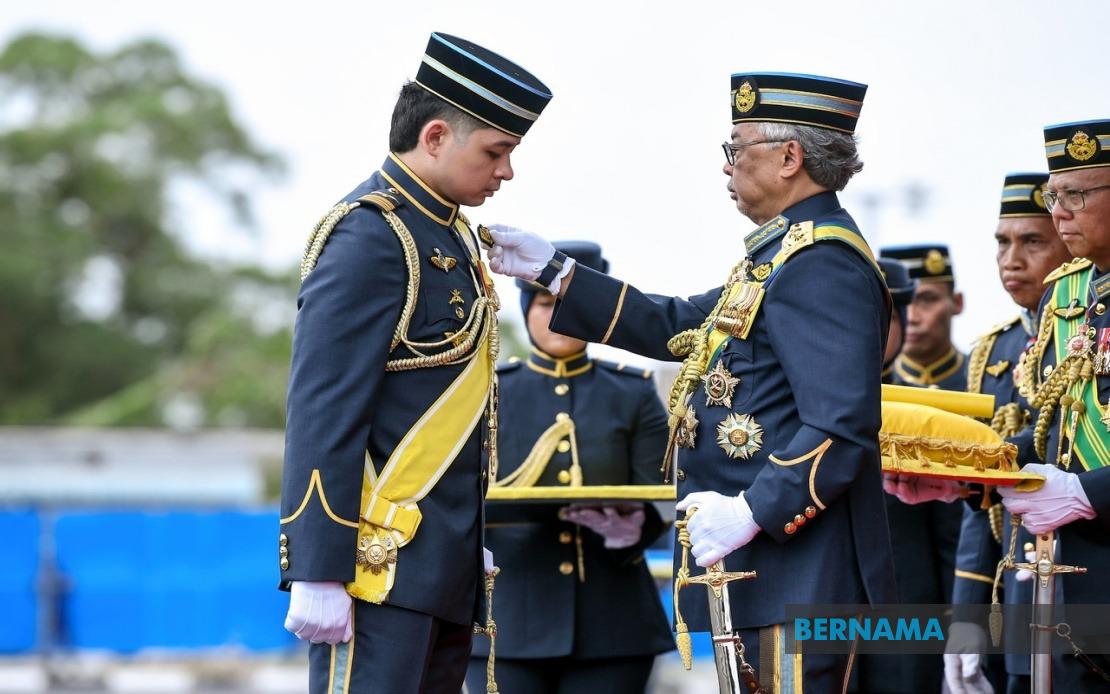
The Tengku Mahkota of Pahang, Tengku Hassanal Ibrahim Alam Shah Ibni Al-Sultan Abdullah Ri'ayatuddin Al-Mustafa Billah Shah, has etched his name into Malaysian military history by becoming the first member of the royal family to complete the Basic Helicopter Flying Course at the Royal Malaysian Air Force (RMAF) Air College in Alor Setar. The milestone represents a significant moment for both the Pahang royal household and the nation's military establishment, underscoring the royal family's continued commitment to the armed forces and national defence.
The formal recognition came on August 15 when the Sultan of Pahang, Al-Sultan Abdullah Ri'ayatuddin Al-Mustafa Billah Shah—who serves as Colonel-in-Chief of the RMAF—presided over the 2026 Flying Wings Presentation Parade at the KTU Parade Ground. The event saw flying wings conferred upon 40 individuals in total, with the Tengku Mahkota joining 39 other Malaysian Armed Forces graduates who had successfully navigated their respective training programmes. This cohort comprised 37 young pilots and two weapon systems officers drawn from all three services of the MAF.
The training curriculum that the Tengku Mahkota completed was rigorous and comprehensive. His participation in the 67(A)/26 Basic Helicopter Flying Course spanned from June 2 to July 31, utilising the EC120B Colibri helicopter—a modern, twin-turbine aircraft favoured for advanced training environments. Throughout this period, he successfully completed and excelled in multiple critical flying assessments, including the Basic Handling Test, Instrument Flying Test, Final Navigation Test, and Final Handling Test. Each evaluation measures different competencies essential for safe and effective helicopter operations.
The broader ceremony acknowledged graduates from four distinct flying courses operating within the RMAF training framework. Beyond the Tengku Mahkota's helicopter programme, these included the standard 67/25 Basic Helicopter Flying Course, the 87/25 Basic Flying Course for fixed-wing aircraft, and the 01/25 Basic Weapon Systems Officer Course. This diversity reflects the RMAF's comprehensive approach to pilot development and the growing technical sophistication required of modern air force personnel.
Recognising exceptional performance, the parade also presented six awards to the year's most accomplished graduates across multiple dimensions. These distinctions were awarded on the basis of flying proficiency, academic achievement, personal discipline, and demonstrated leadership qualities. Such recognition reinforces institutional values within the air force and sets standards for excellence that motivate future cohorts.
Air Force Chief General Tan Sri Muhamad Norazlan Aris delivered remarks that contextualised the achievement within broader military and national concerns. He attributed the success of all graduates, including the Tengku Mahkota, to a combination of personal perseverance, fighting spirit, mental resilience, and the high levels of discipline inculcated throughout their training. These qualities, he suggested, form the backbone of professional military excellence and remain essential as Malaysia navigates increasingly complex security environments in Southeast Asia.
The general also highlighted an often-overlooked dimension of military training: the critical role played by family support systems. He acknowledged that parents and family members sustain graduates throughout demanding courses through prayer, encouragement, and emotional reinforcement. This perspective recognises that military achievement extends beyond individual effort to encompass broader family and social networks that sustain personnel through challenging preparation periods.
Crucially, General Tan Sri Muhamad Norazlan Aris reframed the significance of the flying wings ceremony itself. Rather than treating it as a culmination, he characterised the awarding of wings as a commencement—a threshold into greater responsibilities and heightened expectations. The symbolism of wings worn on a uniform thus transcends individual accomplishment, instead carrying institutional trust and national hopes. This rhetorical move situates new pilots within a continuum of service extending beyond their initial qualification.
For Malaysia's defence establishment, the Tengku Mahkota's graduation holds particular resonance. The participation of high-ranking royalty in military training programmes demonstrates tangible support for the armed forces at the highest societal levels. It signals that the monarchy views air force development as a priority worthy of personal engagement, potentially enhancing recruitment and morale across the service. In a regional context where several nations have faced air force modernisation challenges, Malaysia's ability to train advanced pilots effectively remains strategically significant.
The EC120B Colibri helicopters utilised in the Tengku Mahkota's course represent modern aviation technology that enhances operational capability. These aircraft provide trainers and students with sophisticated systems while remaining accessible for learning purposes. The investment in such platforms reflects Malaysia's commitment to maintaining a professional, internationally-standard air force despite budgetary constraints that affect many developing nations' military establishments.
The completion of this training milestone also carries implications for succession planning within the Pahang royal household. As the heir apparent, the Tengku Mahkota's demonstrated capability in technical, demanding environments may influence perceptions of his readiness for future leadership roles. His willingness to undergo rigorous military training alongside non-royal personnel underscores personal commitment to meritocratic standards and shared national service values.
Looking forward, the integration of royal personnel into mainstream military training programmes could strengthen institutional bonds between the monarchy and the armed forces. Such participation, if continued, normalises direct royal engagement with military modernisation and operational excellence, potentially elevating public discourse around defence readiness and security priorities. The Tengku Mahkota's achievement thus transcends personal accomplishment to represent a subtle but meaningful evolution in how Malaysia's elite engages with its defence establishment.

