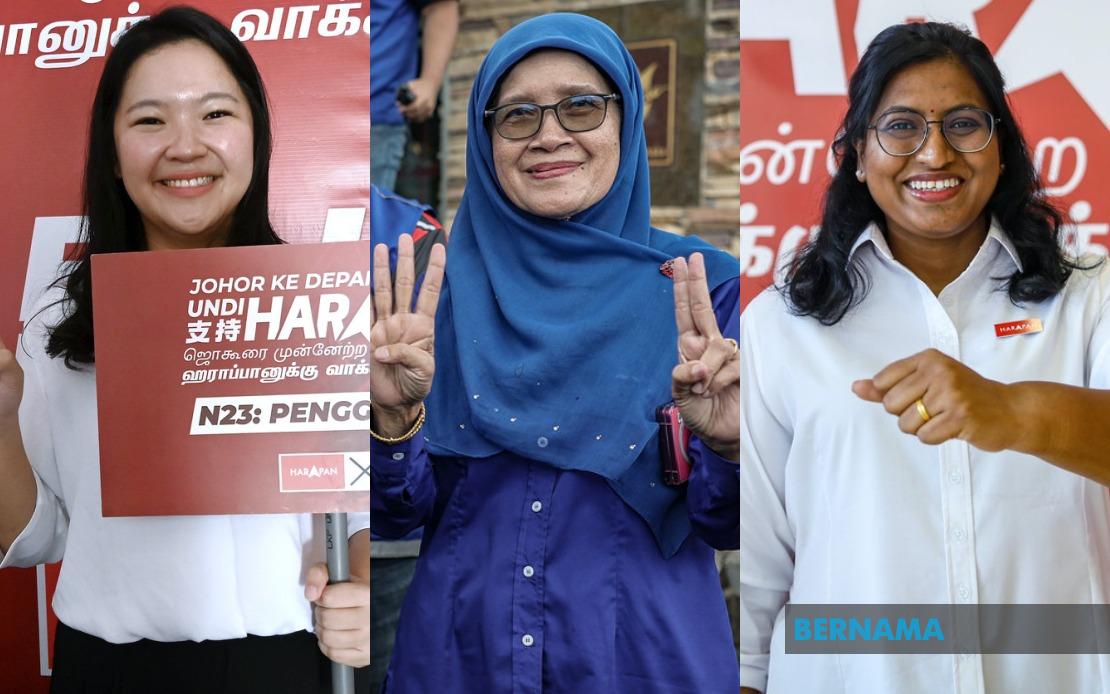
Women candidates have secured ten seats in the 16th Johor State Election, a result that offers a mixed picture of female representation in the state's political arena. The breakdown reveals seven winners from Barisan Nasional and three from Pakatan Harapan, underscoring the persistent dominance of coalition politics in determining electoral outcomes for women candidates across the peninsula's southern state.
The seven BN women who successfully captured their constituencies represent a diverse cross-section of the ruling coalition's electoral base. Nadhirah Afiqah Abdull Rahim, leading the Ledang Puteri UMNO division, secured the Serom seat in her maiden electoral outing with a commanding majority of 9,406 votes, defeating both Perikatan Nasional and PH challengers. Her successful debut suggests that party machinery and grassroots organisation, particularly at the women's wing level, continue to drive electoral performance in the state.
The victory margin in Parit Raja underscores an important trend for BN's female representatives. Nor Rashidah Ramli garnered 19,572 votes to win by 13,576 votes, a substantial increase from the 4,219-vote majority achieved in the previous 2022 Johor state election in the same constituency. This swing suggests either successful consolidation of voter confidence or effective counter-mobilisation against opposition politics in this particular district. Similarly, Norlizah Noh's resounding 16,344-vote majority in Johor Lama demonstrated the incumbent advantage remains potent, particularly when facing fragmented opposition in three-cornered contests.
Landslide victories in several BN-held seats underscored the coalition's electoral strength among female voters. Fauziah Misri captured Penawar with a 15,776-vote majority, while Chan San San achieved a notable upset in Johor Jaya, traditionally regarded as a Democratic Action Party stronghold. Chan's 35,971-vote tally and victory over multiple opposition contenders suggests that BN's campaign messaging resonated effectively in urban and semi-urban constituencies where Chinese voters predominate. Hasrunizah Hassan's successful defence of Pulai Sebatang by 13,590 votes, an improvement of 6,325 votes compared to 2022, reinforces patterns of strengthening support for ruling coalition women representatives across diverse demographic zones. Alwiyah Talib completed a hat-trick of electoral victories in Endau, securing her third term with a 3,041-vote margin despite facing competition from four candidates representing different political factions.
The three Pakatan Harapan women candidates who won their seats navigated a more challenging electoral environment but managed to retain or capture important urban and suburban constituencies. Felicia Poh Rui Ling, at merely 28 years old, recorded her maiden victory in Penggaram by defeating her BN rival by 4,137 votes in a direct confrontation. Poh's success carries particular significance as younger women candidates break through into state-level politics, potentially reshaping generational dynamics within opposition politics. Chu Poh Yee retained the Mengkibol seat for the coalition with a 4,213-vote majority against her BN contender, while lawyer Kartiyaini Jeyapalan secured her traditional PH bastion in Skudai with an impressive 15,280-vote margin despite facing a four-way contest that included candidates from smaller political parties.
The overall context reveals that female candidates remain significantly underrepresented in Malaysian electoral politics despite their demonstrated electoral viability. The 34 women candidates who contested accounted for only approximately 20 per cent of the total field, compared with 138 male candidates. This disparity reflects persistent structural barriers to women's political candidacy, including gatekeeping by party machinery, funding limitations, and prevailing cultural attitudes regarding women in elected office. The fact that women won roughly 29 per cent of the seats they contested suggests their conversion rate outpaces their representation in the candidate pool, indicating that voters generally support capable female representatives when presented with such options.
Barisan Nasional's dominant performance in the election, securing 48 of 56 seats with only eight falling to Pakatan Harapan, shaped the overall composition of female representation in the state assembly. Women will occupy approximately 18 per cent of the 56-member chamber following these results. The ruling coalition's advantage in female representation reflects its broader organisational capacity and resource advantages, including established women's wings such as Puteri UMNO that serve important candidate development and mobilisation functions. PH's smaller gains underscore the opposition coalition's narrower resource base and potentially more competitive selection processes that may disadvantage female candidates despite stated commitment to gender parity.
The electoral geography of female success reveals important patterns about voter behaviour across different constituencies. Women candidates succeeded in both rural and urban settings, traditional coalition strongholds and opposition-leaning districts, suggesting that gender alone does not determine electoral outcomes. Instead, incumbency advantage, campaign effectiveness, intra-party dynamics, and local issues appear to matter significantly. The victories of BN women in substantial numbers indicate that the ruling coalition has cultivated sufficient party loyalty and ground organisation to translate candidate diversity into electoral gains, while PH's female representatives succeeded primarily in retaining established opposition constituencies rather than expanding the coalition's footprint.
For Malaysian and Southeast Asian observers, the Johor results highlight both progress and persistent limitations regarding women's political representation. While ten women winning state assembly seats demonstrates that female candidates can succeed in competitive electoral environments, their representation remains far below demographic parity. The overrepresentation of BN women among victors reflects not necessarily superior candidate quality but rather the coalition's incumbent institutional advantages, party discipline mechanisms, and voter confidence built through long-term governance. Moving forward, achieving substantive gender balance in state legislatures will require deliberate efforts by political parties to recruit, fund, and promote female candidates beyond token representation, and by voters to prioritise candidate competence and policy positions over entrenched party voting patterns.

