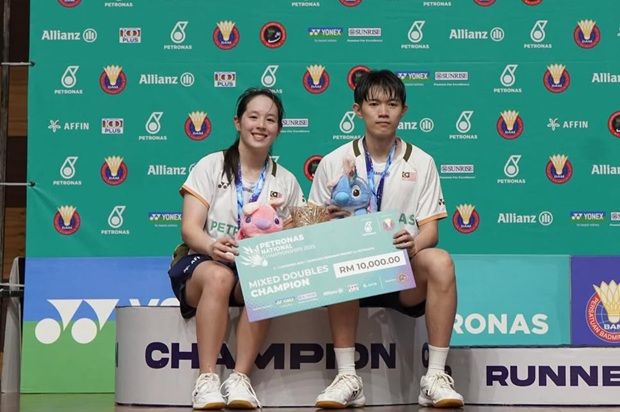
Clarissa San is about to experience the most significant moment of her badminton career when she competes at the Japan Open next week, but the 20-year-old mixed doubles shuttler is determined to let nerves take a back seat. Her newly minted partnership with Chen Tang Jie, formed in the wake of her original partner Toh Ee Wei's anterior cruciate ligament injury, has provided an unexpected yet stabilising force as she prepares for one of the sport's premier events on the BWF World Tour calendar.
Ee Wei's sudden absence from competition has thrust Clarissa into an unfamiliar situation. The injured player is currently undertaking a lengthy rehabilitation programme in Melbourne, leaving a gap in Malaysia's mixed doubles contingent. The decision to pair Clarissa with Tang Jie creates a partnership spanning different experience levels, yet both players appear genuinely energised by the arrangement. For Clarissa, the opportunity to compete alongside an established name at such a prestigious tournament represents a significant leap in her career trajectory.
The partnership's foundation rests on emotional support as much as tactical preparation. Tang Jie and mixed doubles head coach Nova Widianto have made a deliberate effort to manage Clarissa's anxiety about stepping into the spotlight. Their consistent messaging—that she should embrace the moment rather than be consumed by apprehension—addresses what many recognise as the most common obstacle for younger players making their debut at elite tournaments. This psychological scaffolding may prove as important as any technical refinement they introduce during their limited preparation time.
Cliarissa has opened up about her relationship with Tang Jie, describing him in distinctly familial terms. His role transcends the conventional partnership dynamic; she perceives him as both mentor and older brother figure, someone who guides rather than simply plays alongside her. When mistakes occur during play, which they inevitably will against world-class opposition, she trusts that Tang Jie will respond constructively. This interpersonal dimension creates an environment where learning can flourish even amid the pressure of high-stakes competition.
Her approach to the Japan Open demonstrates maturity unusual for a player making her debut at this level. Rather than harbouring ambitious targets of deep tournament runs or prestigious victories, Clarissa has anchored her goals in process-oriented objectives. She intends to transfer the refinements she has been developing during training directly onto the court, essentially treating the tournament as an extended learning exercise. This mindset insulates her from the devastation that can accompany unrealistic expectations in elite sport.
Cliarissa and Tang Jie open their campaign against Taiwan's Yang Po-hsuan and Hu Ling-fang, an encounter that will immediately test whether the newly formed partnership can execute under competitive pressure. The Selangor-born player acknowledges that she remains a work in progress technically and tactically, yet frames this self-awareness not as deficiency but as opportunity. She views the next three or four tournaments scheduled with Tang Jie as a development sequence, with the Japan Open serving as the inaugural chapter.
The Malaysia badminton contingent at the Japan Open extends beyond the Tang Jie-Clarissa pairing. Jimmy Wong and Cheng Su Yin will contest the opening round against Japan's Yuichi Shimogami and Sayaka Hobara, while independent pair Goh Soon Huat and Shevon Lai Jemie face Americans Chen Zhi Yi and Francesca Corbett. The most challenging assignment falls to Wong Tien Ci and Lim Chiew Sien, who confront China's fifth-seeded combination of Guo Xinwa and Chen Fanghui.
The wider context of Malaysian badminton's mixed doubles health is worth considering. The loss of Ee Wei to injury, coupled with Clarissa's maiden appearance at this level, highlights both the fragility of elite sports careers and the necessity of developing depth within the national system. Clarissa's emergence, should she capitalise on this opportunity, could alleviate some concerns about long-term sustainability in this category. Her pairing with Tang Jie thus becomes significant not merely as a tournament match-up but as a succession indicator within Malaysian badminton.
Clarissa's explicit acknowledgment that she remains inexperienced at this tournament level, combined with her resolution to remain composed and absorb every lesson available, suggests a player mentally equipped to handle early-career setbacks without surrendering to despair. The Japan Open will deliver its inevitable challenges—powerful opposition, crowd pressure, and high-speed tactical exchanges—yet her grounded perspective may enable her to extract value even from defeat.
As the tournament approaches, the symbiosis between Tang Jie's experience and Clarissa's hunger appears promising. Whether they advance far in the draw or encounter early obstacles, the partnership has already achieved something intangible but significant: instilling in a young player the confidence that she belongs on badminton's grandest stage. In a sport where mental fortitude often determines outcomes, Tang Jie's presence as steady guide may prove her greatest asset this week.

