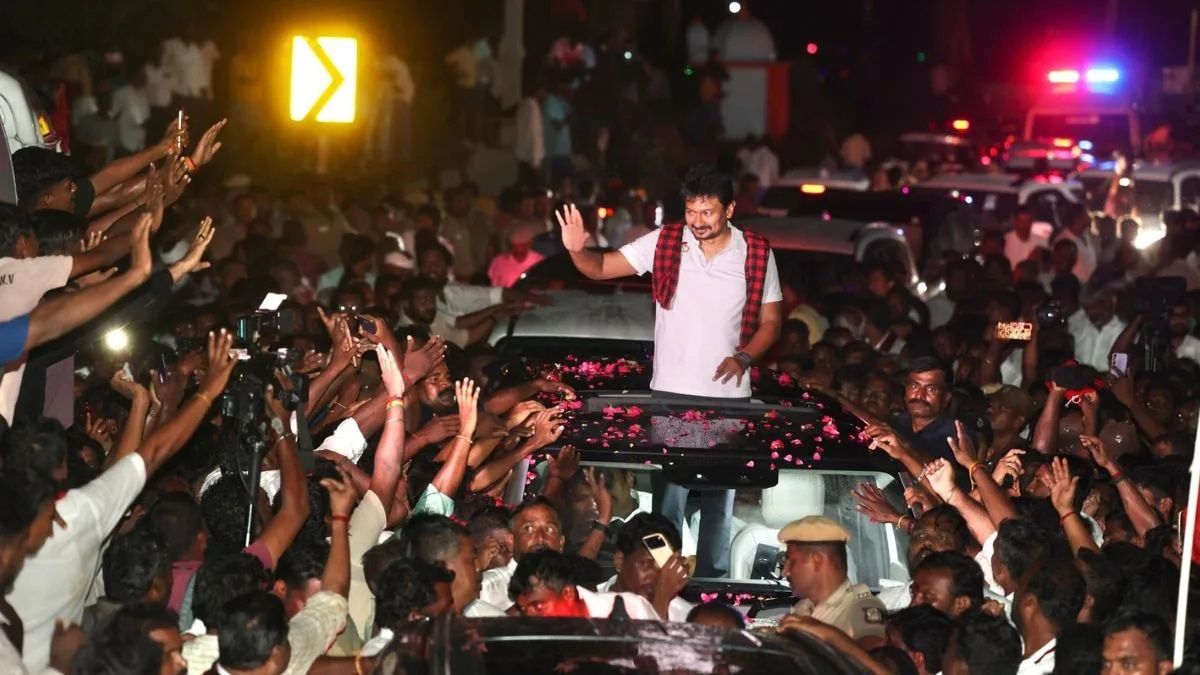
Udhayanidhi Stalin, the Leader of Opposition in Tamil Nadu, walked free on station bail late Tuesday evening after undergoing prolonged interrogation by police investigating allegations that his recent remarks carried offensive overtones directed at actress Trisha Krishnan. The release came after the former deputy chief minister spent several hours at Sengipatti police station, where hundreds of DMK party supporters had congregated outside the gates in a show of solidarity, their presence serving as a stark visual reminder of the deepening political tensions gripping the state.
The episode unfolded during a DMK-organised farmers' protest in Thanjavur district, where Stalin had been delivering remarks critical of Chief Minister Vijay's handling of the contentious Cauvery water-sharing dispute and his government's position on the proposed Mekedatu dam project in Karnataka. The inflammatory moment occurred when someone in the crowd called out the name of Trisha, a prominent Tamil cinema actress who has been publicly perceived as maintaining close ties with CM Vijay. Observers noted that Stalin paused, smiled, and then made a cryptic statement: "Wherever water comes, whether it comes or not, water should come there." The comment's deliberate ambiguity and the contextual circumstances surrounding its delivery led opponents to interpret the words as containing a double entendre with sexual connotations.
The ruling TVK government responded swiftly to the remark, positioning it as a flagrant act of misogyny. Party officials characterised Stalin's words as constituting verbal harassment and an inappropriate objectification of a woman, framing the matter not merely as a political dispute but as a serious issue of gender-based abuse. The ruling coalition filed a formal police complaint and escalated the matter by approaching the National Commission for Women, a move designed to demonstrate governmental seriousness while simultaneously amplifying the narrative that the opposition leader had crossed an ethical line. This strategic escalation transformed what might have been dismissed as tasteless political theatre into an institutional matter requiring formal investigation.
Statin's arrest from his Chennai residence on Wednesday morning sent shockwaves through the state's political landscape, coming at a particularly sensitive moment in Tamil Nadu's governance. The development underscores the increasingly fraught relationship between the DMK, which has traditionally positioned itself as a custodian of Dravidian values and social justice, and the newly ascendent TVK government. For Stalin, the personal implications are significant given his family's political legacy—his father M.K. Stalin led the DMK and served as chief minister before losing power—and the symbolism of a former deputy chief minister facing arrest carries substantial weight within the state's political ecosystem.
Following his release, Stalin addressed gathered media personnel and dismissed the allegations entirely, insisting that his words contained no malicious intent whatsoever. He reframed his arrest as a deliberate diversion tactic orchestrated by CM Vijay's administration to distract public attention from substantive governance issues and policy failures. Stalin maintained that his statement was singular in meaning and that attributing multiple interpretations to his words represented a distortion of his actual position. In his statement, he expressed contempt for what he characterised as the current government, describing it not as a legitimate governing body but as a "circus," a rhetorical flourish designed to delegitimise the TVK administration before his supporters gathered outside the police station.
The incident illuminates deeper fault lines in contemporary Tamil Nadu politics, where state politics has become increasingly volatile and personalised. The dispute cannot be understood in isolation from the broader context of CM Vijay's ascent to power through his TVK, which emerged as a significant political force after the actor-turned-politician's entry into electoral politics. The DMK, historically dominant in Tamil Nadu's political sphere, found itself displaced from power, creating resentment and contributing to the combustible environment in which such incidents occur. Stalin's position as opposition leader places him at the forefront of challenging the TVK government's policies, but also exposes him to greater scrutiny and potential legal jeopardy.
The Cauvery water dispute, which provided the original context for Stalin's protest remarks, remains one of Tamil Nadu's most contentious political issues. The state's agricultural economy depends heavily on water from the Mekedatu project area, and any Karnataka initiative that threatens water flows generates intense political mobilisation across party lines. Stalin's effort to weaponise the Cauvery issue against CM Vijay represents standard opposition politics, yet the manner in which his remarks were framed demonstrates how allegations concerning women's dignity can become tools in political conflict. This dynamic raises uncomfortable questions about the weaponisation of gender-based grievances for political advantage.
The DMK supporters' massive turnout at the police station reflected party mobilisation and indicated broader concerns within the party hierarchy about the potential implications of Stalin's arrest. The optics of the opposition leader being detained while criticising government policy struck many DMK cadres as evidence of authoritarian governance patterns, reinforcing narrative frameworks that the DMK has consistently promoted regarding the TVK government's democratic credentials. The triumphant reception accorded to Stalin upon his release, complete with slogans against CM Vijay and chanting supporters, transformed the police station into a political theatre where the arrest narrative was recast as governmental tyranny.
For Malaysian observers and Southeast Asian analysts watching Tamil Nadu's political evolution, the incident offers instructive lessons about how personalised electoral politics, combined with regional party competition and acute resource disputes, can generate volatile confrontations. Tamil Nadu's sophisticated political culture and democratic institutions managed the situation through existing legal frameworks, with bail being granted relatively quickly, suggesting that institutional safeguards functioned as intended. However, the willingness of ruling parties to deploy legal mechanisms against opposition figures, combined with the capacity of opposition leaders to mobilise supporters through political mobilisation, demonstrates the intensity of electoral competition in the region and the premium placed on controlling narrative power.
The investigation remains ongoing, with potential legal proceedings ahead that could extend this controversy. Whether the case progresses further or gradually recedes from public attention will depend on multiple factors, including judicial decisions, political calculations by both the DMK and TVK regarding the benefits and costs of sustained conflict over this particular incident, and broader shifts in Tamil Nadu's political landscape. Meanwhile, the case has become emblematic of a particular moment in Tamil Nadu politics—one marked by intense personalised conflict, rapid political realignment following CM Vijay's electoral success, and the complex intersection of gender-based grievances with partisan political contestation.

