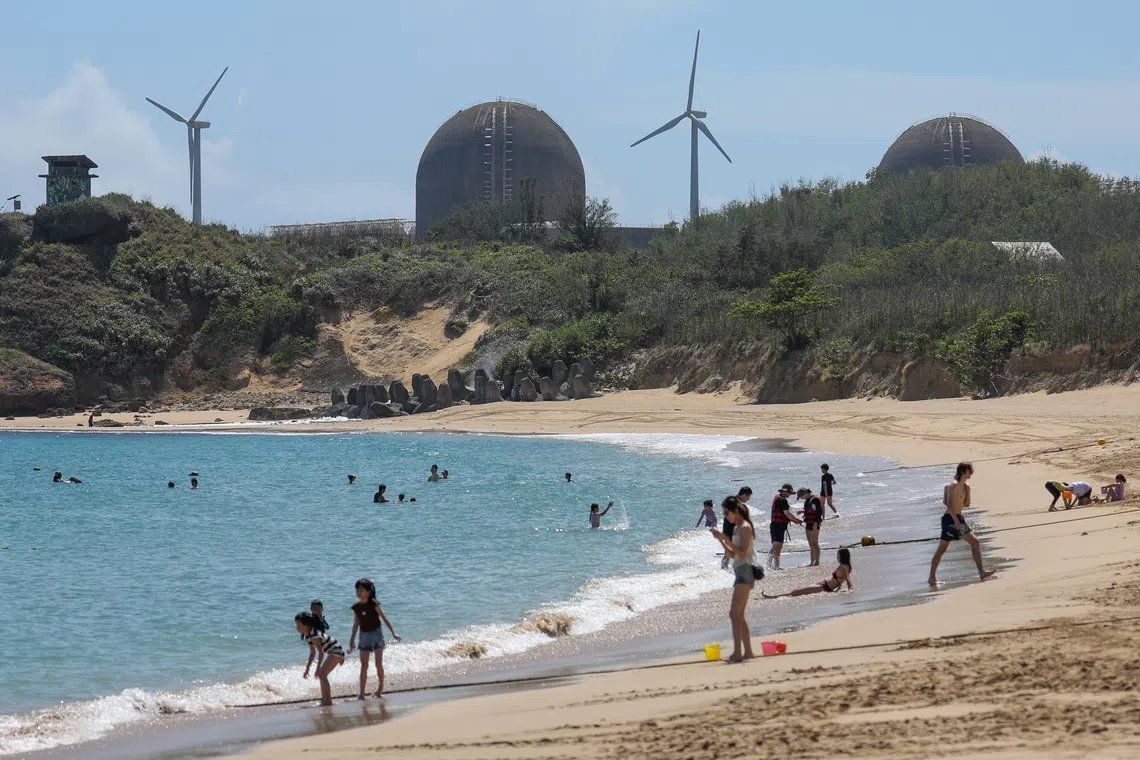
Taiwan faces another pivotal choice on nuclear energy next month, as voters prepare for the November 28 "nine-in-one" local elections that will determine the island's county magistrates, city mayors, and other regional officials. The concurrent referendum on whether to scrap the government's "Nuclear-Free Homeland" policy represents far more than a technical debate about energy infrastructure. Instead, it exemplifies how Taiwan's political landscape has increasingly weaponised direct democracy, with opposition parties strategically deploying referendums to energise their electoral base during campaigns when attention and participation run highest.
The timing and frequency of these nuclear referendums reveal the deeper strategic calculations at play. This will be the fourth referendum on Taiwan's nuclear policy within just eight years, with the previous vote occurring merely twelve months ago in August 2025. The fact that the government, in the intervening year, has faced genuine energy challenges—including global oil supply disruptions following the closure of the Strait of Hormuz and surging power demand from the artificial intelligence boom—provides superficially legitimate grounds for revisiting the issue. Yet experts argue that such policy substance takes a backseat to more immediate political considerations that motivate the opposition Kuomintang and Taiwan People's Party to pursue these measures.
The mechanics of Taiwan's referendum system itself has transformed how political actors approach direct democracy. A 2017 reform fundamentally altered the approval threshold, lowering barriers that had previously prevented popular initiatives from reaching voters. Before that revision, referendums required 50 per cent turnout to achieve validity—a stringent requirement that caused former president Chen Shui-bian's 2004 cross-strait relations referendums to fail despite commanding overwhelming majority support. The new rules represent a dramatic reversal: a referendum now passes if "Yes" votes exceed "No" votes and valid affirmative votes represent at least 25 per cent of the electorate, a far more achievable target that has unleashed a surge in referendum activity.
This year exemplifies how opposition parties exploit the lowered threshold as an electoral tool. Three separate referendum proposals were submitted to Taiwan's Central Election Commission, but only the nuclear energy measure gained approval. The commission rejected two other initiatives—one proposing caning as punishment for serious crimes, and another seeking to redirect traffic fine revenue toward road safety and public transport subsidies. The rejection of the caning proposal on human rights grounds might appear to represent principled gatekeeping, yet political scientists note that the KMT had strategically promoted the caning referendum partly for its capacity to mobilise socially conservative voters who typically favour opposition candidates.
The correlation between referendum timing and electoral advantage has clear historical precedent. In the 2018 local elections, when Taiwan held ten national referendums on the same day as regional voting, the opposition KMT achieved exceptionally strong performance. Political analysts attribute this success partly to elevated turnout among conservative voters energised by the contentious referendum questions. Senior research fellow Qi Dongtao from the East Asian Institute at the National University of Singapore argues that "this electoral consideration is probably at least as important as the policy substance of the referendums themselves," highlighting how opposition parties consciously deploy direct democracy mechanisms to boost participation among their base in close local races.
Beyond simple turnout effects, opposition parties employ referendums as platforms for broader messaging strategies. Political scientist Chong Ja Ian from NUS notes that the KMT increasingly uses crime-related referendums to position itself as tough on law and order, frequently invoking Singapore as a rhetorical reference point. In Taiwanese political discourse, Singapore represents both effective governance and prosperity—qualities the opposition claims to champion while accusing the ruling Democratic Progressive Party of failing to deliver. By proposing measures like caning, the KMT communicates to voters that it supports stronger enforcement but is being blocked by DPP-dominated national institutions.
Taiwan's overreliance on referendums has drawn criticism from constitutional experts who warn that the island's practice diverges sharply from international norms. Associate professor Lin Jia-he from National Chengchi University's College of Law points out that Switzerland, often cited as the gold standard for direct democracy, typically allows three to five years between a referendum proposal and the final vote, enabling genuine deliberation by government agencies and the public. Taiwan's compressed timeline for the November referendum—announced on August 28 and scheduled for a vote just three months later—provides insufficient opportunity for citizens to engage with complex energy policy questions involving diverse technical and economic considerations.
The proliferation of referendums has fundamentally transformed Taiwan's understanding of what direct democracy should accomplish. Rather than serving as a mechanism for resolving genuinely divisive questions where popular authorisation seems essential, referendums have increasingly become just another arena for partisan competition. Qi Dongtao emphasises that "when political parties are motivated to propose highly contentious issues to attract attention and mobilise supporters, referendums can transform from an instrument of direct democracy into another weapon in party competition." This corruption of democratic purpose undermines the legitimacy of direct democracy itself.
Public sentiment increasingly reflects this disillusionment with Taiwan's referendum culture. Sean Chang, a 39-year-old public relations professional from Taipei, epitomises growing voter fatigue. Though he participated in the 2018 local elections featuring ten concurrent referendums, Chang has become convinced that referendums have devolved into "a tool for each political party to manipulate public opinion." The constant stream of referendum campaigns has exhausted rather than energised many voters; Chang admits to eventually abandoning his attempt to assess every issue from multiple perspectives and simply disengaging from the process entirely.
The November 28 elections will determine which of Taiwan's 11,051 local public officials will serve in the coming years, with campaigns traditionally focusing on parochial domestic concerns. Yet Taiwan observers view these local elections as a crucial bellwether for national politics, particularly given that presidential elections must occur by 2028. How voters respond to both the referendum on nuclear policy and the broader local election campaign will provide important signals about the political direction of the island, including whether citizens retain confidence in the mechanisms of direct democracy or whether they increasingly view referendums as expressions of partisan calculation rather than genuine popular will.

