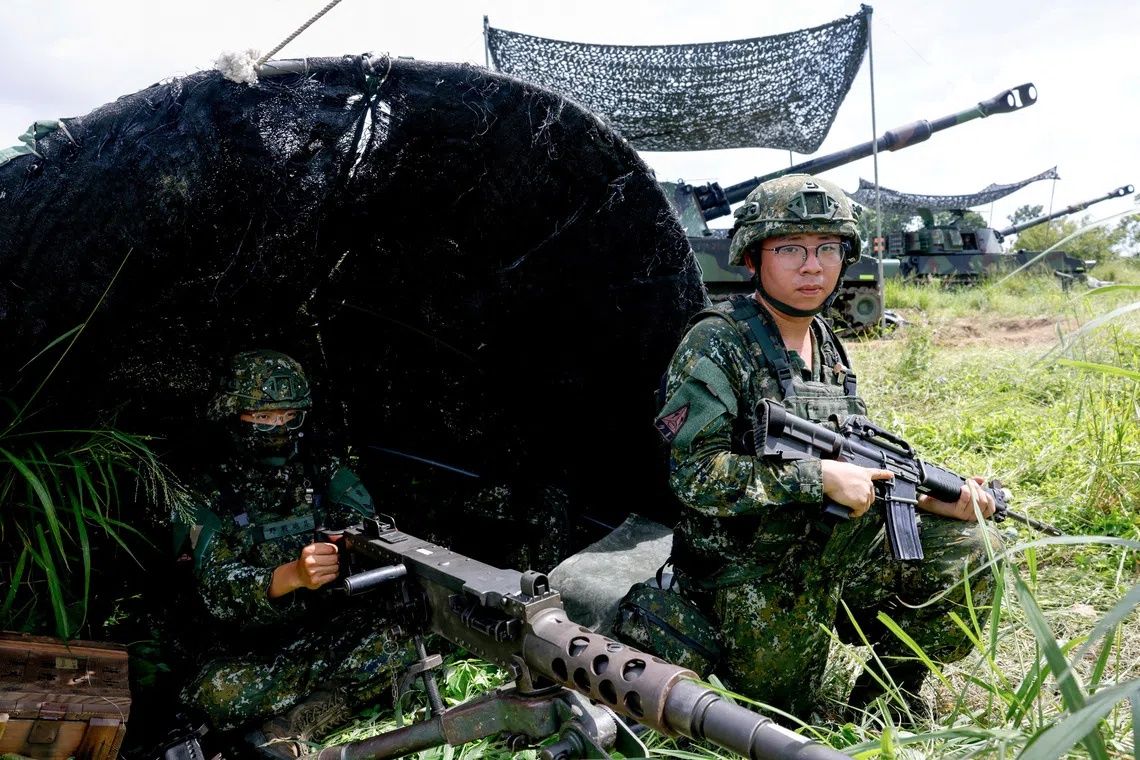
Taiwan commenced a ten-day military exercise on Wednesday that marks a significant evolution in how the self-governing island prepares its armed forces for potential conflict. The Han Kuang drills, which began with orders issued from an underground command centre in Taipei, represent the most comprehensive test of Taiwan's wartime readiness since the exercises began in 1984, with authorities implementing unprecedented measures including the deliberate throttling of mobile internet speeds across the island. The exercise engages more than 20,000 troops alongside approximately 5,000 reservists and introduces operational practices modelled directly on United States military doctrine, signalling Taiwan's determination to modernise its defence posture at a time of heightened cross-strait tensions.
The central aim of this year's Han Kuang drills centres on testing whether military commanders can think dynamically when enemy actions depart from anticipated scenarios. Rather than following scripted responses to predetermined threats, field commanders will face deliberately constructed surprises designed to force rapid reassessment and revised orders. This philosophical shift away from classroom-style exercises reflects accumulated criticism that Taiwan's past drills, while technically sound, operated within artificial constraints that bore limited resemblance to the fog and friction of actual warfare. Officials involved in planning the exercise emphasise that Taiwan is moving deliberately toward "real field environment" conditions, abandoning the comfortable predictability that characterised earlier iterations.
Among the procedural innovations incorporated into this year's drills is the adoption of "backbriefing," a technique widely used in American military operations. Under this system, junior officers receiving orders must immediately restate the mission objectives and operational intent back to their commanders before proceeding with execution. This additional step may appear bureaucratic on the surface, yet it serves a critical function: ensuring that communication across military hierarchies remains sharp and that no gaps open between what senior commanders intend and what subordinates understand. The emphasis on synchronising "commanders and subordinates on operational intent" reflects recognition that breakdowns in understanding have historically contributed to military miscalculations and friendly casualties.
The temporary restrictions on internet bandwidth introduced during the drills address a scenario that defence planners consider among the most destabilising prospects in wartime. Taiwan's population and economy depend substantially on digital connectivity, yet in a military confrontation, adversaries would likely target communications infrastructure as a priority objective. By deliberately degrading mobile internet speeds during the exercise, Taiwan seeks to understand how civilians and non-military organisations would respond to severe bandwidth constraints. This component transforms the drills beyond purely military dimensions, involving the broader population in imagining and practising adaptation to wartime conditions. Such civilian-inclusive planning reflects lessons learned from countries that have experienced modern conflicts and underscores Taiwan's understanding that contemporary warfare encompasses far more than conventional military engagement.
Defence officials characterise this year's drills as explicitly testing Taiwan's vulnerability to rapid command decapitation. China's military doctrine emphasises the importance of neutralising enemy leadership and control structures early in any conflict, targeting command centres, major ports, logistics nodes, and defence manufacturing facilities. The Han Kuang exercise incorporates multiple simulations aimed at demonstrating that Taiwan's military apparatus can function effectively even after suffering strikes against these traditionally critical nodes. The planned relocation of a major arsenal and the mobilisation of civilian factories underscore Taiwan's strategy of distributed resilience, ensuring that military production capacity cannot be entirely eliminated through strikes against a single location.
Naval dimensions feature prominently in the exercise design, with Taiwan conducting escort operations off its Pacific coastline at a moment when regional anxieties about supply line vulnerability have intensified. Taiwan's prosperity and security rest substantially on maritime commerce flowing through waters surrounding the island, yet Beijing has demonstrated increasing capability to project military power throughout the region. The drills simulate scenarios in which Taiwan's allies might struggle to maintain logistical support across contested waters, forcing Taiwan's navy to protect vital shipping routes independently. This particular focus reflects strategic clarity about the geographic constraints within which Taiwan must operate and the centrality of naval power to any extended conflict scenario.
The introduction of an "embedded reporter" mechanism signals Taiwan's recognition that information warfare constitutes an integral dimension of modern military conflict. During the exercise, journalists will observe and report on frontline military operations while also assessing how Taiwan's military counters disinformation and enemy propaganda narratives. This embedded approach acknowledges that civilian populations require accurate, credible information during crises, and that military credibility depends partly on transparent communication rather than information monopolies. Taiwan's experience with Chinese disinformation campaigns targeting recent elections has underscored the vulnerability of democracies to sophisticated information operations, making media coordination during hypothetical military crises a legitimate planning concern.
Defence officials involved in planning the exercise articulate a broader vision extending beyond tactical military considerations. One senior official described the drills' ultimate purpose as testing how "our entire population, the Republic of China as a whole—especially our citizens—should face war." This formulation shifts the conceptual frame from military-centric preparation toward whole-of-society readiness. Taiwan's government appears to be signalling that wartime survival would depend not merely on military victory but on civilian population resilience, maintenance of basic governance functions amid cascading crises, and collective psychological preparedness for sustained conflict. The integration of resilience exercises testing government continuity across earthquake scenarios and military invasion reflects this comprehensive approach.
The timing and scope of Taiwan's evolving exercise regime must be understood against the backdrop of escalating cross-strait military activity. China's defence ministry, characteristically, declined to comment on the exercises, yet Beijing's demonstrated interest in rehearsing potential military operations against Taiwan has become increasingly visible in unilateral drills and provocative flights through the Taiwan Strait. Taiwan's authorities frame their expanded and more realistic exercises partly as responses to this intensifying pressure, suggesting that Beijing's military assertiveness has shortened reaction times and narrowed the margin for learning through peacetime exercises. The shift toward more dynamic, scenario-based training rather than choreographed rehearsals reflects strategic adaptation to this more contested security environment.
The geographical implications extend throughout Southeast Asia and beyond. Taiwan's military readiness patterns influence strategic calculations among neighbouring countries managing relationships with both Beijing and Washington, while Japan and the Philippines face their own security implications should Taiwan become embroiled in conflict. The evolution of Taiwan's defence preparations thus constitutes a regional matter of substantial significance. For Malaysia and other Southeast Asian nations, Taiwan's military modernisation and enhanced readiness contribute to broader patterns of arms acquisition and military planning throughout the region, potentially influencing defence spending priorities and strategic alignments that shape the regional balance of power.

