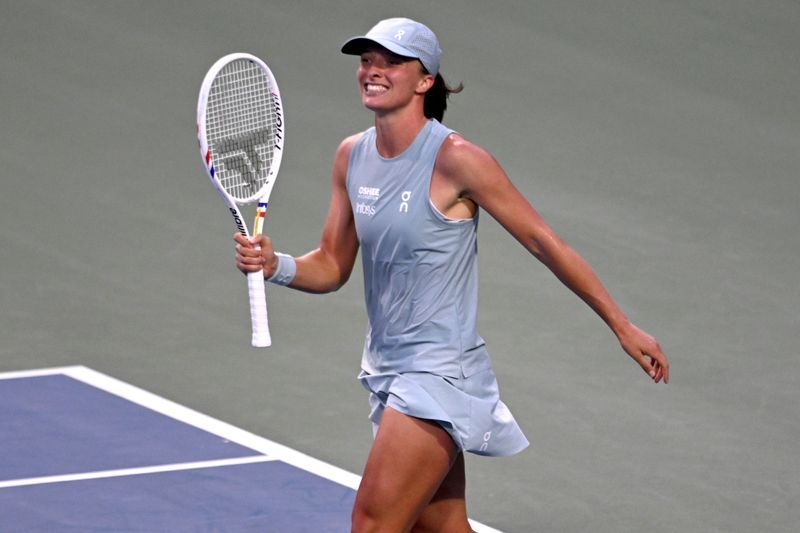
Polish tennis champion Iga Swiatek delivered a masterclass in controlled aggression at the Canadian Open in Toronto on Monday, dispatching Russian opponent Diana Shnaider 6-2 6-1 to advance into the semi-finals. The commanding performance, completed in just 68 minutes, offers a timely confidence boost as Swiatek prepares for the U.S. Open at Flushing Meadows, the year's final Grand Slam tournament where she previously triumphed in 2022.
Swiatek's comprehensive victory demonstrated the kind of dominant baseline play that once established her as the world's premier hard-court operator. Against Shnaider, she combined consistently crisp striking with superior court positioning to neutralise her opponent's competitive threats almost entirely. The seventh seed's tactical execution left little room for the Russian to establish any rhythm, forcing her into a defensive posture from which recovery proved impossible. This level of performance starkly contrasts with the inconsistency that has plagued Swiatek's season to date.
The opening set revealed the gulf in class between the two players with brutal clarity. Swiatek capitalised on Shnaider's mounting errors, breaking serve twice whilst the Russian accumulated 12 unforced mistakes in the set alone. By the time Swiatek reached 5-2, Shnaider's confidence appeared entirely depleted. Another wayward forehand from the Russian enabled Swiatek to seal the set without further ceremony, having never been seriously threatened.
If the first set established Swiatek's dominance, the second set confirmed it utterly. The Polish champion continued to dictate proceedings from the baseline, maintaining relentless pressure that prevented Shnaider from constructing any meaningful offensive opportunities. Remarkably, Swiatek did not face a single break point throughout the entire match, a statistic that underscores her complete control of the contest. She engineered a second break to establish a commanding 5-1 lead, sealed with a precisely angled crosscourt forehand that barely cleared the sideline before clipping the line for a winner. When Shnaider sent a final forehand long on match point, the outcome had been decided decisively.
Swiatek's progression to her first WTA 1000 semi-final of the season arrives at a moment when her year-long struggles required urgent reversal. The 23-year-old's campaign has been marked by significant setbacks at the sport's highest level. She failed to progress beyond the quarter-finals at any Grand Slam tournament, a disappointing return for a competitor of her credentials and ambitions. Most strikingly, she suffered elimination in Miami's second round at the hands of compatriot Magda Linette, a defeat that exposed deeper issues within her game and prompted drastic action.
That loss in Miami catalysed a coaching overhaul. Swiatek terminated her working relationship with Wim Fissette, replacing him with Francisco Roig in an attempt to rediscover the form that secured her first Grand Slam title at the French Open in 2022. The coaching change reflects Swiatek's determination to address recurring patterns of inconsistency and mental fragility that have undermined her performance at crucial moments throughout the season.
Her struggles have extended into the most prestigious tournaments on the calendar. At Wimbledon, Swiatek arrived as defending champion, yet was unceremoniously eliminated in the third round by Australian teenager Alexandra Eala. The defeat represented a humbling experience for someone positioned as a title contender and suggested that her technical issues ran deeper than mere confidence fluctuations. However, Monday's display against Shnaider suggests that Roig's influence may already be producing tangible improvements in her approach and execution.
Swiatek will face either Ekaterina Alexandrova of Russia or ninth-seeded Elina Svitolina of Ukraine in the semi-finals, a match that was scheduled for later Monday. Both opponents present different tactical challenges, though Swiatek's performance against Shnaider suggests she possesses sufficient technical tools and mental resources to overcome either candidate. A progression to the final would represent a significant step towards rehabilitation of her season.
For Malaysian and Southeast Asian tennis followers, Swiatek's resurgence carries broader significance. Her revival reinforces how quickly elite players can regain competitive footing following systematic coaching intervention. Moreover, her path to the Canadian Open semi-finals demonstrates that setbacks, even substantial ones against unseeded opponents, need not define a season's trajectory. As the tennis calendar approaches its concluding Grand Slam at Flushing Meadows, Swiatek's Toronto performance will have sharpened her preparation considerably and injected optimism into what has otherwise proved a frustrating campaign.

