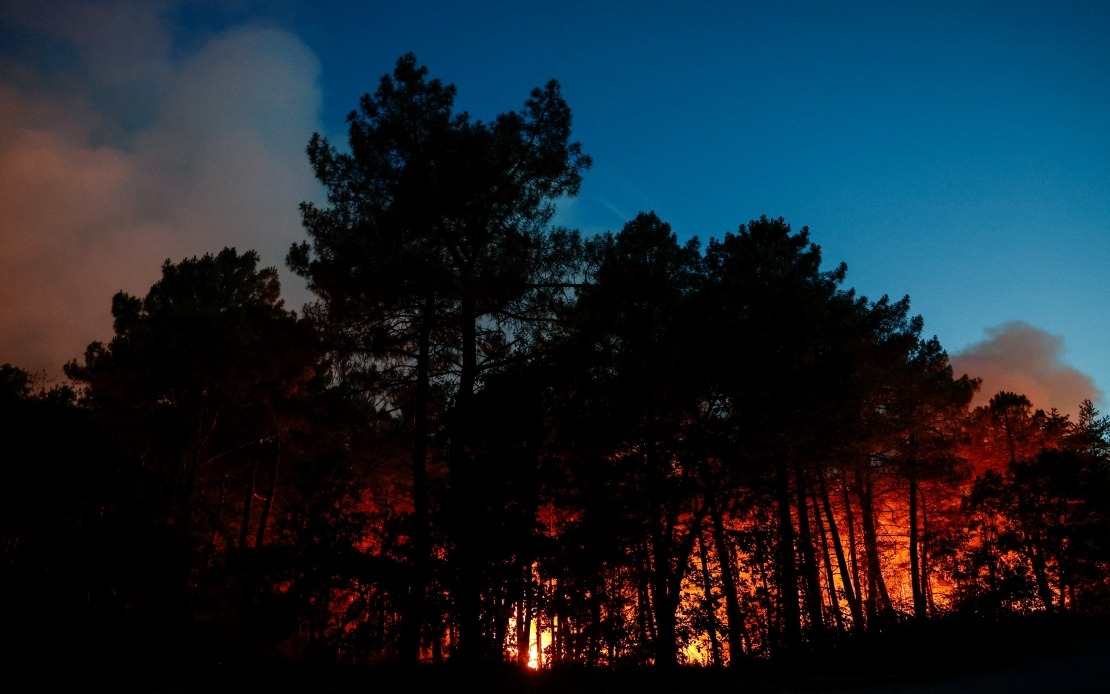
France is confronting one of its most significant woodland disasters in recent memory as a sprawling wildfire continues to ravage the Fontainebleau forest, located south of Paris. On Monday, approximately 400 firefighters were mobilised to contain the blaze, which had already consumed roughly 800 hectares of forest by the time emergency responders established a co-ordinated response. The fire erupted late Sunday evening near a major motorway, and its rapid expansion has raised serious questions about its origins, with senior government officials now pointing towards the possibility of deliberate arson rather than accidental ignition.
The scale of this environmental emergency has prompted French Interior Minister Laurent Nuñez to personally visit the affected zone, where he made public statements suggesting criminal intent. Multiple fire outbreaks detected within a concentrated radius of just 1,000 metres have formed the evidentiary basis for suspicions of intentional fire-setting, a pattern that would be highly unlikely in naturally-occurring woodland fires. The gendarmerie has subsequently opened a formal investigation, signalling that prosecutors are treating this as a potential crime rather than a simple natural disaster. Such allegations carry significant weight given France's traditional position as a nation with relatively well-controlled forest management, particularly in regions proximate to major urban centres.
The evacuation of more than 1,000 individuals, comprising both permanent residents and holidaymakers, underscores the immediate threat posed by the advancing flames. The mayor of Le Vaudoué, a village situated on the forest's periphery, provided particularly vivid testimony to media outlets, describing a towering wall of fire that moved with alarming velocity across the landscape and began consuming residential structures at the settlement's outer edge. Such imagery resonates with concerns about climate vulnerability that have become increasingly prominent across Europe, particularly in Mediterranean and continental regions where summer temperatures have been steadily rising.
Fontainebleau holds exceptional historical and ecological significance beyond its immediate surroundings. The forest serves as custodian to the magnificent Château de Fontainebleau, a royal residence steeped in French cultural heritage spanning centuries. Beyond its architectural treasures, the woodland itself constitutes one of Western Europe's largest unbroken forested expanses, supporting diverse fauna and flora that have been shaped by centuries of human stewardship and natural succession. The destruction of such a resource represents not merely an environmental setback but a potential blow to France's natural patrimony and recreational landscape.
Coordinating the response has required deployment of cutting-edge aerial resources that would normally be reserved for the most critical scenarios. Two water-bombing aircraft have been brought into active service, drawing their loads directly from the Seine river, as the Seine-et-Marne department co-ordinates logistics from regional command centres. This technological intervention reflects both the severity of the situation and the capacity of French emergency services to mobilise substantial resources when threats reach critical thresholds.
The broader context of this emergency becomes apparent when examining France's meteorological situation during the summer months. The nation has already experienced its third major heatwave of 2023, creating conditions of exceptional dryness and elevated temperatures that transform forests into tinderboxes awaiting ignition. The national weather service, Météo-France, responded to these dangerous atmospheric conditions by placing 37 departments under its most severe red heat alert level at the beginning of the week, indicating that the Fontainebleau fire represents merely the most visible manifestation of a country-wide crisis.
French government spokeswoman Maud Bregeon characterised the situation using the term "exceptional," a designation that carries particular weight in French administrative discourse, signalling deployment of extraordinary measures and resource mobilisation. She emphasised that all available firefighting assets were being channelled towards suppression efforts, an assertion that reflects both the gravity officials perceive and the recognition that conventional responses may prove insufficient. Her comment regarding the relative rarity of such large-scale conflagrations in northern France underscores how climate change is altering traditional fire risk patterns, pushing what were once southern European phenomena into regions historically considered safer from such threats.
Simultaneously, France's firefighting apparatus is stretched across multiple active fire zones throughout the country, as elevated temperatures and prolonged dry conditions have created widespread combustion risks. This dispersal of resources, while necessary for addressing the full spectrum of emerging threats, naturally complicates the response to any individual fire, as personnel and equipment must be apportioned across numerous competing demands. The situation illustrates how climate-related emergencies increasingly strain institutional capacity, forcing difficult triage decisions about resource allocation.
For Malaysian and Southeast Asian observers, the Fontainebleau incident offers instructive parallels regarding wildfire management and the climate vulnerabilities increasingly affecting developed nations. Malaysia and Indonesia have long grappled with transboundary haze and forest fire crises, particularly during El Niño years when regional drought conditions intensify. The French experience demonstrates that even wealthy, technologically advanced societies with sophisticated emergency infrastructures face escalating challenges from climate-influenced fire activity. The prospect that this calamity resulted from deliberate arson also raises questions about security vulnerabilities during periods of environmental stress, when public resources are stretched thin and malicious actors might perceive opportunity.
The investigation into potential arson will prove consequential not only for establishing accountability but for informing prevention strategies going forward. If multiple separate fires were indeed ignited through human agency, French authorities will need to address both the immediate perpetrators and the systemic vulnerabilities that allowed such incidents to occur and spread so catastrophically. Enhanced surveillance, community engagement, and targeted patrols in vulnerable forest zones may become necessary adaptations to a landscape where both climate change and deliberate threats converge.

