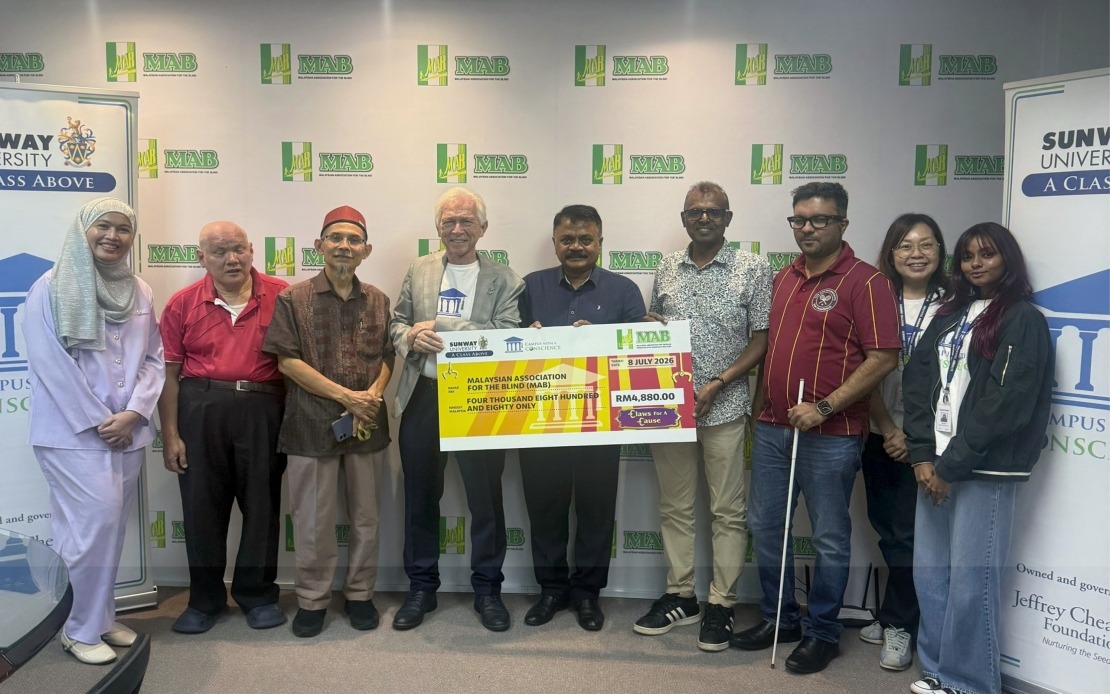
Sunway University has successfully mobilised its student and staff community to support a significant charitable cause, generating RM4,880 in donations for the Malaysian Association for the Blind through an innovative week-long campus activation. The fundraising effort, christened "Claws For A Cause," leveraged a claw machine gaming experience as its central mechanism, transforming ordinary recreational activity into a vehicle for social impact and community contribution.
The campaign operated as part of Sunway University's broader Campus With A Conscience programme, which aims to embed social responsibility into campus culture and foster institutional commitment to community welfare. By partnering with Space Panda, an entertainment company specialising in experiential gaming activities, the university demonstrated how cross-sector collaboration can amplify charitable outreach beyond traditional fundraising methods. The integration of gaming elements proved particularly effective at driving participation from younger demographics, who engaged with the cause through an accessible and enjoyable format that simultaneously contributed to a worthy charity.
Professor Sibrandes Poppema, the university's President and Vice-Chancellor, underscored the institutional significance of such initiatives, framing them within the university's broader mission architecture. He articulated how Sunway University positions itself as a fifth-generation institution that transcends conventional academic boundaries, integrating community engagement, research innovation, and social impact as co-equal pillars alongside educational delivery. This positioning reflects evolving expectations within Malaysia's higher education sector, where universities increasingly face pressure to demonstrate tangible social value and community contribution as evidence of institutional legitimacy and purpose.
The initiative carries particular relevance given Malaysia's ongoing challenges in supporting individuals with visual impairments and the critical role that charitable organisations like MAB play in providing rehabilitation services, employment assistance, and advocacy for the blind community. With limited government funding traditionally allocated to specialised disability services, organisations such as MAB rely heavily on philanthropic support and community fundraising to sustain and expand their programmes. Campus-based initiatives like this one thus represent an important supplementary funding stream that enables these organisations to maintain service delivery capacity.
Space Panda's participation in the campaign reflects broader corporate social responsibility trends within Malaysia's entertainment and leisure sectors, where companies increasingly seek opportunities to align commercial activities with social good. Marcus, the company's representative, articulated a philosophy emphasising the multiplicative effect of seemingly modest individual contributions when aggregated through collective participation. This messaging resonates with contemporary corporate values positioning businesses as stakeholders in social development rather than purely profit-maximising entities, though critics note such partnerships occasionally risk functioning as reputation-management exercises with limited substantive social impact.
The campaign's design merits particular attention as a case study in effective fundraising mechanics. By reducing the barrier to participation—requiring only that individuals engage with an enjoyable gaming experience—organisers maximised participation breadth while ensuring funds flowed entirely to the charitable beneficiary. This contrasts with traditional fundraising models that often absorb significant portions of proceeds through operational costs or intermediary expenses. The gamification element also generated what marketing practitioners term "earned media," as participating students and staff likely shared their involvement through social networks, extending the campaign's awareness reach beyond the immediate campus constituency.
The participation of both university personnel and students in the initiative underscores how institutional communities can be mobilised around charitable causes when engagement mechanisms prove sufficiently accessible and enjoyable. For many student participants, particularly those in their first years of tertiary education, involvement in structured community engagement activities contributes to the development of lifelong philanthropic habits and social consciousness. Universities thus function as incubation sites for civic values and charitable engagement patterns that extend far beyond graduation.
For Malaysian higher education institutions seeking to enhance community engagement metrics and demonstrate institutional social responsibility, the Sunway University model offers practical insights into activation mechanics that work. The combination of experiential entertainment, clear charitable beneficiary identification, accessible participation mechanisms, and corporate partnership created conditions for successful outcome achievement. The relatively modest financial target—RM4,880—proved achievable through week-long campus activation, suggesting similar campaigns could be replicated across Malaysia's university sector with comparable outcomes.
The Malaysian Association for the Blind, as the benefiting organisation, represents one of several disability-focused NGOs operating within Malaysia's charitable landscape. Such organisations operate within a constrained funding environment where annual budgets often depend significantly on unpredictable philanthropic flows rather than sustained government appropriations. Initiatives generating even modest fundraising totals provide meaningful operational flexibility, whether directed toward programme expansion, service delivery enhancement, or advocacy activities supporting the broader blind and visually impaired community.
Moving forward, the success of this inaugural campaign suggests potential for institutionalisation and expansion within Sunway University's annual calendar of community engagement activities. Successful fundraising initiatives frequently become recurring institutional traditions, building year-on-year awareness and engagement as student cohorts discover and participate in established campaigns. Should the university adopt "Claws For A Cause" as an annual feature, cumulative impact over a five-to-ten-year horizon could generate substantial aggregate support for MAB and signal sustained institutional commitment to visual impairment support within Malaysian society.

