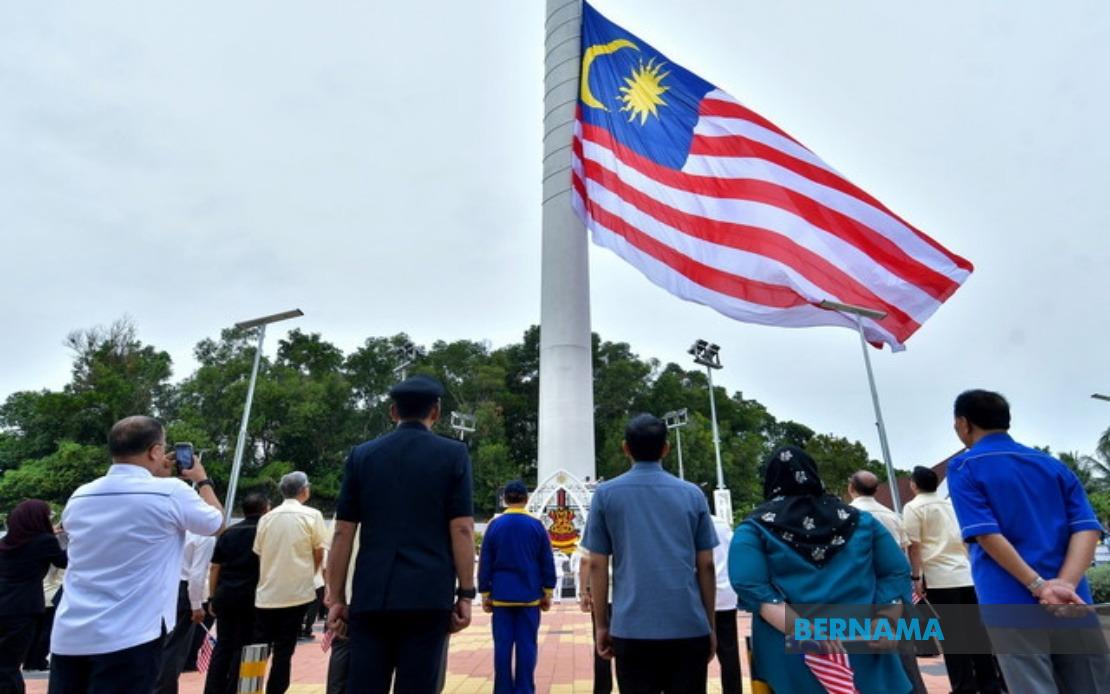
The Sultan of Selangor, Sultan Sharafuddin Idris Shah, has delivered a pointed message about national identity during Malaysia's Independence Month celebrations, asserting that the Jalur Gemilang transcends its ceremonial role to embody the very essence of shared citizenship. Speaking at a flag-hoisting ceremony at Dataran Selangor on August 26, the Ruler sought to reframe how Malaysians understand their national symbol, arguing that despite the nation's rich tapestry of languages, beliefs, political ideologies and cultural backgrounds, the flag represents something far more fundamental: a common bond that unites every citizen.
The Sultan's intervention comes as the country observes National Day celebrations spanning from August 26 to September 17, culminating in Malaysia Day. His consent to raise the Jalur Gemilang at Dataran Selangor for this extended period reflects the traditional emphasis placed on visual displays of patriotism during this period. However, the Ruler's accompanying statement reveals a deeper preoccupation with the substance rather than the symbolism of national unity. The monarchy's role in articulating this vision is particularly significant in Malaysia's constitutional framework, where the institution serves as a custodian of national cohesion and moral authority.
Sultan Sharafuddin explicitly challenged the notion that patriotism can be adequately expressed through the mere multiplication of flags across the country. While thousands of Jalur Gemilang will undoubtedly adorn buildings, vehicles and public spaces throughout the month, the Ruler emphasised that this material abundance masks a more formidable challenge: constructing a society where citizens of all backgrounds genuinely experience inclusion, recognition and belonging. This distinction between performative nationalism and substantive unity carries particular resonance in Malaysia, where periodic communal tensions and political polarisation periodically threaten social fabric.
The educational dimension of the Sultan's message appears deliberately targeted at Malaysia's younger generation. By calling for curricula that foster respect across religious, ethnic and cultural lines, the Ruler indicated that national unity cannot rely solely on institutional leadership but must be cultivated from formative years. This approach acknowledges that Malaysia's multi-ethnic, multi-religious composition requires continuous reinforcement of inclusive values if successive generations are to inherit and sustain a cohesive nation. The emphasis on youth education also implicitly recognises that generational attitudes toward diversity and coexistence remain malleable and therefore subject to positive influence.
Crucially, Sultan Sharafuddin directed criticism toward political and civic leaders, exhorting them to model the very virtues of moderation, tolerance and compassion they expect from the broader public. The Ruler's implicit warning against weaponising political, racial or religious differences for electoral advantage or factional gain suggests awareness that elite-driven polarisation represents one of the most significant threats to national cohesion. This admonition carries particular weight given Malaysia's parliamentary democracy, where political competition frequently intersects with ethnic and religious identity, creating potent constituencies for divisive messaging.
The Sultan articulated a powerful symbolic framework by noting that the Jalur Gemilang has never discriminated between Malays, Chinese, Indians, Kadazan-Dusuns, Ibans or other ethnic groups, nor between adherents of Islam, Buddhism, Christianity, Hinduism or other faiths. This statement inverts the typical hierarchy of identity claims in Malaysian political discourse, asserting that the flag's neutrality on matters of ethnicity and religion positions it as a meta-symbol transcending these particularistic identities. By emphasising what the flag does not do—make distinctions based on ethnicity or faith—the Ruler underscored the irreducibility of Malaysian citizenship to any single demographic category.
The timing and venue of this address merit consideration within Malaysia's broader constitutional and political context. The Sultan of Selangor commands significant moral authority within the most economically developed state in Malaysia, home to the federal capital Kuala Lumpur and encompassing millions of citizens representing extraordinary diversity. A statement from this particular ruler carries symbolic weight beyond the boundaries of Selangor itself, effectively positioning the monarchy as a voice for inclusive nationalism at a moment when electoral politics and administrative governance sometimes emphasise majoritarian rather than pluralistic frameworks.
Sultan Sharafuddin's invocation of mutual respect and togetherness as central to the independence anniversary suggests that celebrating national autonomy necessarily entails recommitting to the social contract that binds independent Malaysia together. This framing casts the anniversary not as a historical commemoration divorced from contemporary reality, but as an annual checkpoint for assessing whether the foundational commitment to multi-communal coexistence remains robust. The Ruler thereby invested Independence Day with an evaluative function, transforming it from mere celebration into an occasion for critical self-examination.
The distinction drawn between the easy task of distributing and flying flags and the far more difficult work of constructing genuinely inclusive institutions and social practices reflects sophisticated understanding of how symbols relate to substantive social change. While flags serve important psychological and ceremonial functions, they cannot substitute for policy decisions, institutional design and individual behaviour that either reinforce or undermine inclusion. The Sultan's articulation of this gap implicitly challenges Malaysians to move beyond symbolic gestures toward the harder work of building systems and practices that translate national unity rhetoric into lived experience.
Looking forward, Sultan Sharafuddin's remarks provide a template for how Malaysia's constitutionally significant institutions might engage with contemporary challenges to social cohesion. Rather than simply endorsing existing nationalist narratives, the Ruler offered a reimagined conception of the nation and national symbols that emphasises shared citizenship over differentiated status. This approach may influence how other state leaders, federal authorities and civil society organisations conceptualise their own roles in promoting national unity during an era when divisive messaging frequently commands political attention and generates electoral advantage.

