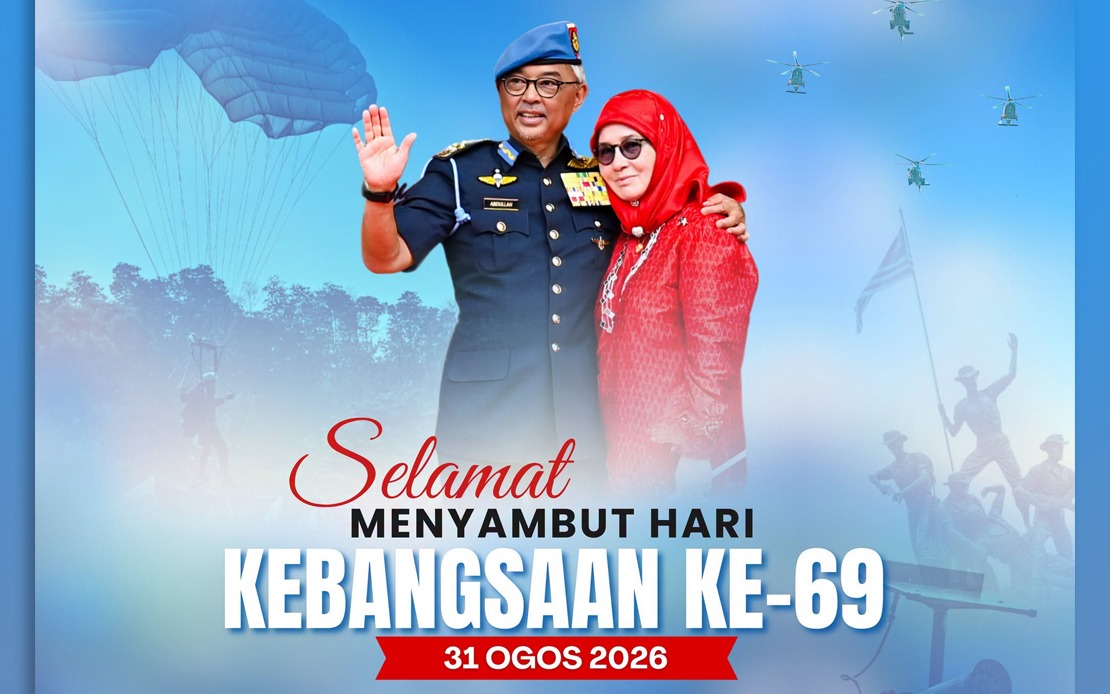
Marking Malaysia's 69th year of independence, the Sultan of Pahang Al-Sultan Abdullah Ri'ayatuddin Al-Mustafa Billah Shah and Tengku Ampuan Pahang Tunku Azizah Aminah Maimunah Iskandariah have issued a joint message to the people of the state, emphasising the enduring importance of national unity and solidarity. Released through the Pahang Sultanate's official Facebook page on August 30, their message reflects the traditional role of Malaysia's royal institution in reinforcing civic values during the annual Merdeka celebration.
The royal couple expressed profound gratitude to Allah SWT for the blessings of peace, prosperity and harmony that have characterised seven decades of independent statehood. This acknowledgment carries particular significance at a time when Malaysia faces evolving social, economic and political challenges that test the cohesion forged during the independence struggle. By framing national stability as a divine blessing rather than merely a political achievement, the royal message connects religious values with secular governance—a distinctive feature of Malaysia's constitutional monarchy system.
In their statement, Their Royal Highnesses identified independence and sovereignty as sacred trusts requiring collective stewardship across generations. This framing is especially relevant to contemporary Malaysian discourse, where questions about national identity, constitutional limits, and the proper distribution of power between federal and state authorities remain contested. The Sultan's emphasis on preserving these foundational elements suggests a conservative positioning on institutional continuity, even as Malaysia navigates demographic change, economic restructuring, and regional geopolitical shifts.
The royal message placed particular emphasis on unity, mutual respect and tolerance as the pillars sustaining national harmony. These principles are neither abstract nor universally practised in Malaysian society, where communal tensions periodically surface over religious interpretation, ethnic representation, and economic opportunity. By highlighting these values on National Day, the Pahang royals joined other institutional voices calling for renewed commitment to the social compact that underpins multiethnic coexistence. For observers across Southeast Asia, Malaysia's model of constitutional monarchy embedded within a multicommunal framework remains a point of comparative interest.
Crucially, the royal couple invoked the Rukun Negara—Malaysia's founding civic creed comprising belief in Allah, loyalty to the sovereign and constitution, upholding the rule of law, and cultivating mutual respect—and urged all Pahang residents to embody these principles in daily practice. This call for grassroots implementation of constitutional values is significant because it positions the monarchy as guardian not merely of formal institutions but of the ethical and behavioural standards necessary for those institutions to function effectively. Such messaging has become more pronounced in recent years as Malaysian leaders across the political spectrum grapple with perceptions of institutional decay and erosion of public trust.
The Sultan and Tengku Ampuan also articulated particular concern for younger Malaysians, urging the rising generation to appreciate the historical struggles preceding independence and to assume custodial responsibility for national heritage and cultural continuity. This intergenerational emphasis addresses a genuine anxiety among Malaysia's institutional and political classes about whether younger citizens—especially those born after 2000—maintain sufficient connection to foundational narratives of sacrifice and compromise that preceded 1957. Education policy, cultural programming, and media representation have all become contested terrain in this intergenerational transmission.
The royal message's emphasis on preserving heritage and social harmony reflects Pahang's specific position within Malaysia's political and cultural landscape. As a state where traditional sultanate structures retain considerable institutional weight and symbolic resonance, Pahang's royal house has historically positioned itself as custodian of Malay-Muslim identity and traditional governance norms. Yet this positioning must negotiate contemporary pressures toward greater democratic participation, transparent administration, and recognition of plural identities—tensions visible across Malaysia's monarchical system.
By invoking ongoing divine protection and blessing, the royal couple grounded their message in spiritual vocabulary that transcends partisan politics. This rhetorical move is important because it allows the institution of monarchy to address national issues without appearing to favour any political faction, maintaining the constitutional convention that the Crown remains above electoral competition. In Malaysia's sometimes fractious political environment, such institutionally neutral yet substantively significant messaging from the royal house provides continuity and offers a counterweight to partisan polarization.
The timing and content of the Pahang royals' message sit within a broader pattern of institutional messaging during Malaysia's National Day season. Statements from the Yang di-Pertuan Agong, state sultans, and senior government figures typically converge around themes of unity, gratitude, and forward-looking development. However, what distinguishes this message is its specific emphasis on embedding patriotism and constitutional values in everyday behaviour rather than treating them as ceremonial abstractions. This reflects growing recognition among Malaysian leaders that formal constitutional arrangements cannot sustain themselves without corresponding habits of civic conduct among ordinary citizens.
For the wider Southeast Asian region, Malaysia's approach to National Day messaging through its royal institution offers comparative perspective on how monarchies can function as stabilizing forces within competitive democratic systems. Unlike some regional neighbours where state authority concentrates in executive hands, Malaysia's constitutional framework distributes symbolic and real authority across multiple institutions—the Crown, parliament, judiciary, and civil service—creating checks on centralisation. The royal contribution to civil messaging, particularly on themes of social cohesion, represents one mechanism through which this institutional pluralism operates in practice.
The Sultan and Tengku Ampuan's invocation of lasting peace, prosperity and well-being as objects of prayer encapsulates the aspirational dimension of National Day observance. These are not inevitable conditions but require constant cultivation through both governmental action and citizen participation. In Pahang specifically, this formulation resonates with ongoing development challenges including economic diversification beyond traditional resource extraction, educational access in rural areas, and healthcare provision across a geographically dispersed population. The royal prayer thus carries implicit acknowledgment that national blessings require addressing concrete material concerns.

