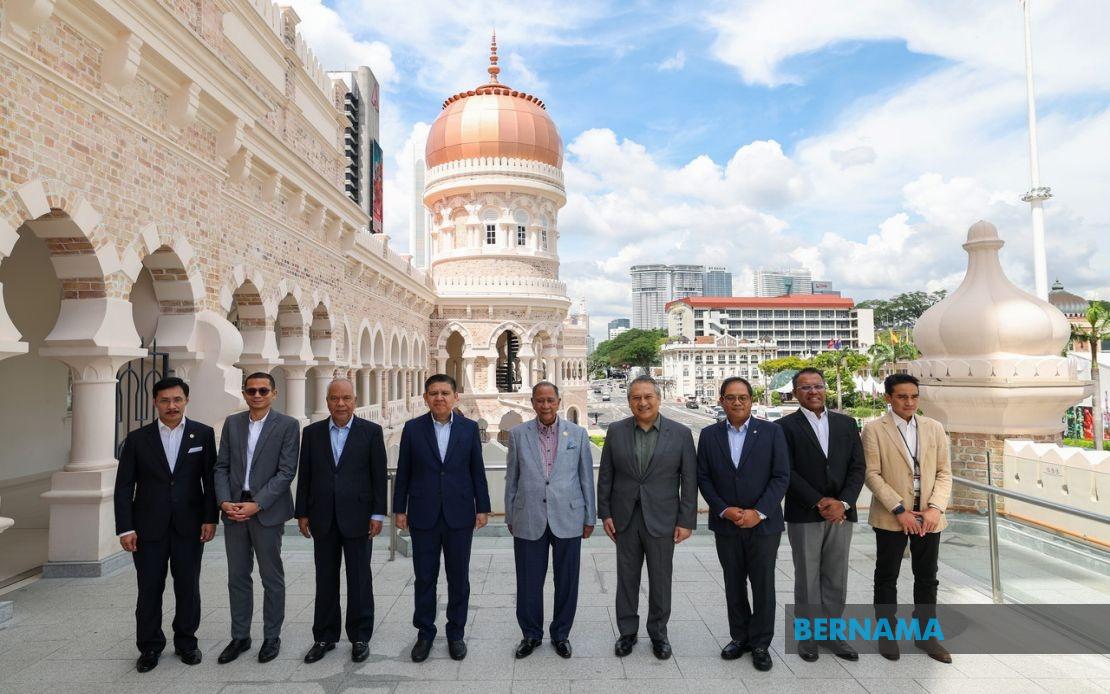
The Sultan of Kedah, Al Aminul Karim Sultan Sallehuddin Sultan Badlishah, conducted a tour of the Sultan Abdul Samad Building in Kuala Lumpur on June 24, reinforcing the institution's continued engagement with the nation's most iconic heritage structures. Arriving at approximately 10:30 am, the royal visitor was received by senior officials from Khazanah Nasional, the sovereign wealth fund managing the landmark's restoration and present operations.
The Sultan Abdul Samad Building stands as one of Malaysia's most historically significant structures, having served as the administrative nerve centre of the colonial and early independent state. The building's architectural presence remains inseparable from the national narrative—it was here that the Union Jack was lowered and the Federation of Malaya flag raised for the first time in 1957, a moment that crystallised Malaysia's transition to independence. Today, its role has evolved from administrative headquarters to a carefully curated public space designed to educate Malaysians and visitors about the nation's formative decades.
During the visit, His Royal Highness toured the Confluence Hall, an exhibition space dedicated to documenting the origins and development of Kuala Lumpur through carefully selected displays and interpretive materials. Think City, the urban renewal organisation collaborating on the project, provided detailed briefings on the exhibits' narratives and contextual significance. The Sultan then proceeded to the Visionary Hall, which employs multimedia installations and architectural models to illustrate the capital's planned expansion and contemporary development trajectory. These spaces represent a modern approach to heritage preservation, moving beyond merely protecting a building's physical fabric to activate its cultural and educational potential.
The restoration initiative reflects a broader philosophical shift in how Malaysia approaches its built heritage. Rather than treating heritage sites as static monuments cordoned off from public engagement, Khazanah Nasional has repositioned the Sultan Abdul Samad Building as a dynamic educational venue. The inclusion of facilities such as the School of Hard Knocks, operated by Royal Selangor, alongside the exhibition galleries suggests an integrated approach to heritage activation—blending preservation with entrepreneurial activity and public programming.
Khazanah Nasional's managing director, Datuk Amirul Feisal Wan Zahir, emphasised the broader significance of the royal endorsement. According to his remarks, the Sultan's visit constituted meaningful recognition of the organisation's conservation philosophy, which extends far beyond structural engineering and restoration carpentry. The approach encompasses strategic storytelling about Kuala Lumpur's metamorphosis, Selangor's role in national development, and Malaysia's journey as an independent nation. For an institution managing state assets and pursuing nation-building objectives, such royal acknowledgement carries symbolic weight that legitimises both the financial investment and the curatorial choices embedded in the restoration project.
The building's reopening to the public on February 2 marked the culmination of intensive restoration work carried out under the Khazanah Heritage Fund programme. The preceding eleven months of conservation efforts, overseen during His Majesty Sultan Ibrahim's ceremonial officiation of Phase One's completion on January 31, represented a substantial commitment of resources and expertise. The timing of the Sultan of Kedah's visit, approximately five months after public opening, suggests deliberate coordination among Malaysia's royal households to collectively validate heritage preservation as a national priority.
Visitation figures provide a tangible measure of public receptiveness to the restored space. Since February, approximately 200,000 visitors have passed through the Sultan Abdul Samad Building, indicating genuine community interest in reconnecting with Malaysia's institutional history. This volume suggests that heritage tourism and education constitute viable revenue streams for Khazanah Nasional, supporting the financial sustainability of long-term preservation efforts. For Southeast Asian countries grappling with heritage conservation funding challenges, such engagement metrics offer encouraging precedent.
The Sultan Abdul Samad Building's historical nomenclature evolution itself encapsulates Malaysia's political transformation. Originally designated the Secretariat Building during the colonial administration, it was subsequently named after Sultan Abdul Samad, the ruler of Selangor during the late nineteenth century. This renaming reflected post-independence efforts to assert indigenous authority over national institutions and territorial identity. The building therefore represents not merely architectural heritage but also the contested politics of naming, commemoration, and institutional legitimacy that characterise Malaysia's postcolonial development.
The inclusion of heritage preservation among royal priorities carries implications beyond cultural and tourism considerations. In Malaysia's constitutional monarchy, the rulers exercise custodial authority over matters of state protocol, national identity, and institutional continuity. When reigning monarchs and other senior royals visibly engage with heritage conservation projects, they effectively signal that such endeavours align with the Crown's conception of national interest and institutional stewardship. This institutional endorsement can influence resource allocation decisions across government and the private sector, potentially accelerating heritage preservation agendas throughout the federation.
For Malaysian readers assessing the nation's contemporary trajectory, the Sultan Abdul Samad Building's transformation offers instructive lessons about balancing modernisation with historical memory. The building's incorporation of contemporary exhibition design, digital storytelling, and commercial facilities demonstrates that heritage preservation need not entail nostalgic retreat from contemporary life. Instead, thoughtful curation can create spaces where Malaysians encounter their national past through a present-day lens, potentially strengthening collective understanding of how historical decisions continue shaping current circumstances.
Regional observers noting Malaysia's approach to heritage may find parallels instructive for their own nations. Southeast Asia's postcolonial states share comparable challenges regarding colonial-era architecture, institutional heritage, and the relationship between physical preservation and national narrative-building. The Sultan Abdul Samad Building model—combining restoration, public education, revenue-generating facilities, and explicit royal patronage—offers a potentially replicable framework for other countries seeking to preserve iconic structures while ensuring contemporary relevance and financial viability.