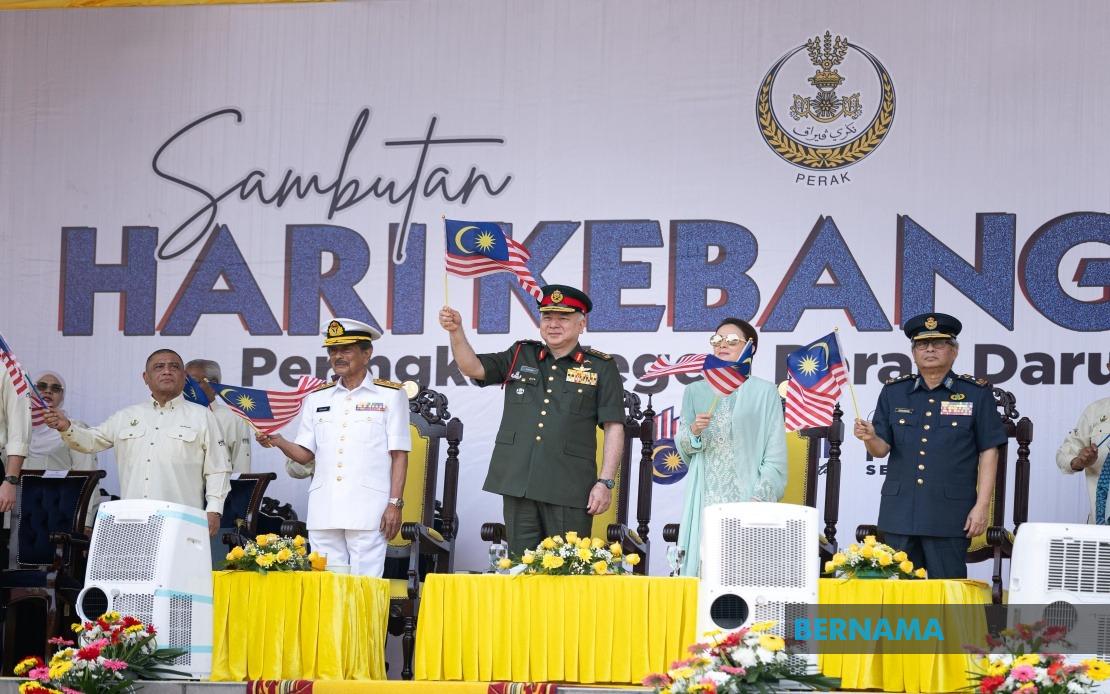
Sultan Nazrin Shah and Raja Permaisuri Tuanku Zara Salim graced the Perak-level National Day 2026 Awards Presentation Ceremony at Dewan Bandaran Ipoh on Saturday, where the Sultan personally recognized 11 individuals for their outstanding contributions to Malaysia's defence and security. The royal couple were joined by Perak Menteri Besar Datuk Seri Saarani Mohamad, state officials, and members of the royal household, including Raja Muda Raja Jaafar Raja Muda Musa and Raja DiHilir Raja Iskandar Dzurkarnain Sultan Idris Shah, underscoring the formal significance of the occasion.
The recipients of the Sultan's commendation represented a cross-section of Malaysia's uniformed services, reflecting the multi-agency effort required to maintain national sovereignty. Six personnel came from the Malaysian Armed Forces, two from the Royal Malaysia Police, and three from the Royal Malaysian Navy. Each honouree received RM1,000 in cash alongside a certificate of appreciation, tangible recognition of their service that extends beyond ceremonial acknowledgement to practical support for these dedicated individuals.
Among the most visibly decorated heroes recognized was Warrant Officer 2 Mohamad Razali Din, who sustained a catastrophic injury during Operation Naga near Banding when he stepped on a landmine, resulting in the amputation of his left leg below the knee. His continued service despite such profound physical sacrifice exemplifies the determination expected of those who dedicate their lives to national defence. The formal presentation of his award carried particular poignancy, as it acknowledged not merely a single moment of bravery but years of adaptation and perseverance following life-altering trauma.
Warrant Officer 2 Megat Abdullah Megat Othman received special mention for his aggressive operational success during Operation Batu Kawah in Sri Aman, where he personally neutralized three communist terrorists. Beyond receiving the standard cash award and certificate, Othman was additionally presented with a commando knife, a symbolic recognition that distinguished his tactical achievement from other forms of service. This differentiated recognition reflects the military tradition of honouring combat effectiveness alongside broader contributions to national security.
The broader composition of honourees included Staff Sergeant Idris Ismail, Corporal Mokhtar Sulaiman, Lance Corporal Khairul Anuar Abdul Hamid, and Lance Corporal Alias Abd Wahab from the armed forces, as well as retired Sub-Inspector Omar Jayus and retired Sergeant Major Abdul Malek Nordin from the police force. The inclusion of retired personnel, particularly retired First Admiral Mohamad Imran Abd Hamid, retired Commander Mohd Akhbar Mohd Yusof, and retired Warrant Officer 2 Ahmad Safwi Shaari from the navy, demonstrates that national recognition extends beyond active service to honour lifetime achievements in uniform.
Beyond individual accolades, Sultan Nazrin also distributed prizes across multiple competitive categories associated with National Day 2026 celebrations, including winners of the national month parade and beautification competition. This broader awards framework positions the recognition of service heroes within the larger context of national day festivities, emphasizing how security personnel and national pride are intimately connected in Malaysia's observance of independence.
In his address to the gathering, Menteri Besar Saarani articulated a profound reflection on Malaysian national identity, emphasizing that the nation was neither created nor sustained by homogeneous populations but rather through the deliberate choice of diverse communities to coexist as a unified state. This framing is particularly significant for Perak, historically a multicultural crossroads where different ethnic and religious communities have long intersected. Saarani's emphasis on shared constitutional frameworks and the unifying role of the Malay language and the institution of the Malay Rulers provides intellectual context for why honouring these diverse service personnel matters beyond ceremonial politics.
The Menteri Besar's cautionary remarks about maintaining national cohesion reflect growing concerns about social fragmentation in Malaysian discourse. He articulated how societal unity, underpinned by shared symbols like the Jalur Gemilang flag and mutual institutional commitments, begins to erode when communities view difference as more salient than shared citizenship. His observation that neighbourhoods and friendships dissolve when people are perceived primarily through ethnic, religious, or factional identities rather than as individuals speaks to contemporary Malaysian anxieties about polarization and divisiveness.
Saarani's warning that failing to actively maintain inter-community bonds leads to progressive detachment carries particular resonance for Perak, a state that has experienced significant political instability in recent years alongside broader national tensions. His assertion that distance widens when shared national anchors become blurred articulates a sophisticated understanding of how social fragmentation proceeds gradually rather than through dramatic rupture. For Malaysian audiences, particularly those in multi-ethnic urban and suburban settings, this message transcends ceremonial rhetoric to address practical concerns about neighborhood stability and long-term coexistence.
The timing of this awards ceremony during National Day festivities provides important symbolic synchronization between individual heroism and collective national identity. By honouring security personnel who have sacrificed for Malaysia's territorial integrity and sovereignty, Sultan Nazrin underscores the principle that individual sacrifice constitutes the foundation upon which national unity rests. The ceremony thus functions as both acknowledgement of specific contributions and broader reaffirmation of the social compact underlying Malaysian citizenship.
For observers across Southeast Asia, the Perak ceremony illustrates how Malaysia's institutional structures, particularly the constitutional role of the Malay Rulers, continue to play vital functions in mediating national values and social cohesion. The presence of multiple tiers of royal authority alongside elected government officials demonstrates the layered governance architecture through which Malaysia negotiates questions of national identity and collective purpose. This institutional pluralism, while sometimes viewed as administratively complex, appears designed to ensure that diverse perspectives remain represented in processes of national meaning-making.
The recognition of both active and retired service personnel across multiple uniformed services reflects a mature understanding that national security is sustained through institutional continuity rather than individual heroism alone. By honouring those who have transitioned to civilian life alongside current personnel, the ceremony acknowledges that security contributions extend beyond active service years to encompass the institutional knowledge and mentorship that retiring personnel provide to successive generations of defenders. This emphasis on continuity has particular relevance for Malaysia, which faces evolving security challenges requiring sustained institutional capacity and institutional memory.

