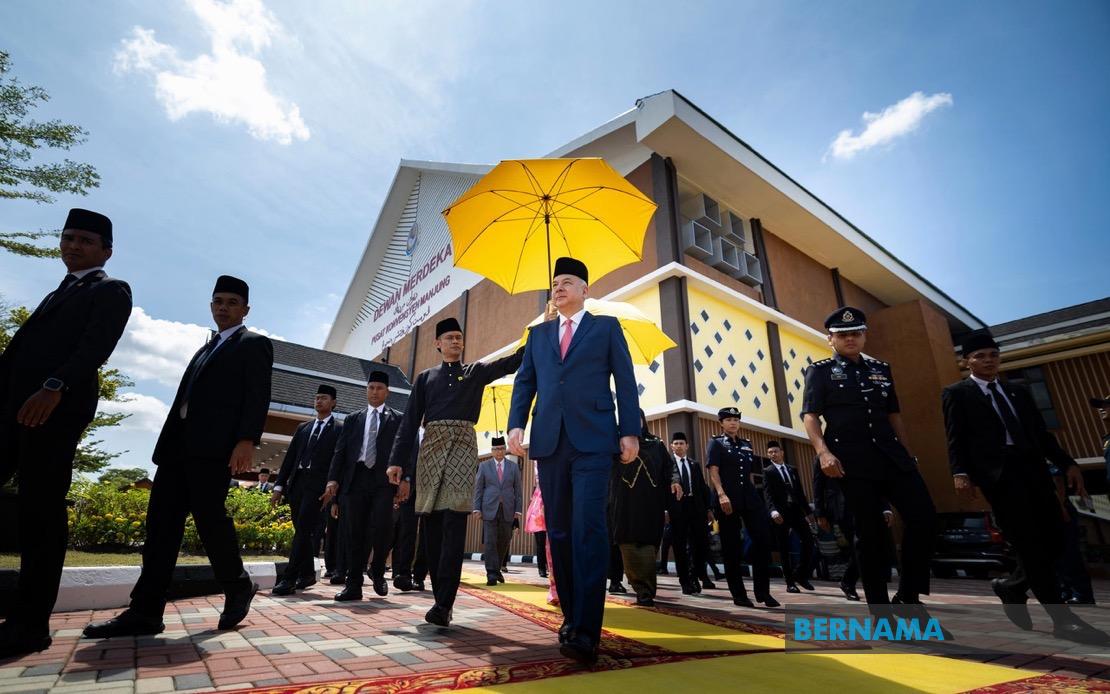
Sultan Nazrin Shah, the Sultan of Perak, has formally inaugurated the Merdeka Hall at Manjung Municipal Council in Lumut, marking a significant moment for the district's development agenda. The ceremony, attended by the Raja Permaisuri of Perak Tuanku Zara Salim and Raja Di Hilir Raja Iskandar Dzurkarnain Sultan Idris Shah, brought together senior state and federal government officials including Perak Menteri Besar Datuk Seri Saarani Mohamad and Higher Education Minister Datuk Seri Dr Zambry Abd Kadir to witness the opening of what is being framed as a transformational infrastructure project for the coastal district.
The completion of Merdeka Hall represents the convergence of multiple developmental threads in Manjung's recent history. The initiative to rebuild the facility originated nearly a decade ago in 2016, when the then-Perak Menteri Besar prioritised the project and secured Federal Government funding approval. The journey from initial planning to completion underscores the extended timeframes often required for major municipal infrastructure projects in Malaysia, reflecting both bureaucratic processes and the complexities of coordinating between state and federal authorities. The RM12.7 million investment demonstrates significant commitment from government coffers, positioning the hall as a centrepiece facility for the district's public engagement and economic development strategy.
Manjung Municipal Council is celebrating its silver jubilee this year, having undergone considerable institutional evolution since its establishment as a district council on January 1, 1980. The council's elevation to full municipal status on August 1, 2001, represented recognition of the district's growing economic and administrative importance. The timing of the Merdeka Hall opening to coincide with this 25-year milestone creates symbolic continuity, positioning the new facility as both a celebration of past achievements and a springboard for future endeavours. This layering of commemorative moments—the founding of the original council, its municipal upgrade, and now the opening of a major public venue—creates a narrative arc that local authorities can leverage for community pride and investor confidence.
The 2,500-capacity Merdeka Hall is being positioned as a multipurpose venue intended to serve official state functions, regional conferences, and community gatherings. Its design capacity reflects local aspirations for hosting larger conventions and events that could attract regional and international visitors. For a district the size of Manjung, a venue of this scale represents a substantial infrastructure addition that could theoretically accommodate significant portions of the district's population for collective events. The architectural and logistical investment suggests municipal authorities are thinking ambitiously about Manjung's role within Perak's broader tourism and economic landscape.
Menteri Besar Saarani explicitly framed the hall's opening as part of a three-pronged development narrative that encompasses project completion, institutional commemoration, and long-term economic positioning. The vision to achieve Tourism and Maritime City status by 2030 represents an ambitious rebranding effort for Manjung, leveraging its natural coastal assets and strategic location along the Strait of Malacca. This positioning aligns with broader Malaysian policy initiatives that emphasise tourism diversification and maritime sector development as economic engines for regional growth. For Manjung specifically, the strategy suggests moving beyond its historical identity as an industrial and port hub toward a more integrated tourism-commerce model.
The Merdeka Hall's naming carries deliberate symbolic weight within Malaysia's post-independence governance framework. Saarani's remarks about the name serving as a reminder of independence as a sacred trust reflect how Malaysian authorities regularly invoke foundational national narratives to frame contemporary development projects. The invocation of independence as a value to be continuously safeguarded through institutional development represents a rhetorical strategy common in Malaysian political discourse, linking mundane infrastructure provision to broader national aspirations. This connection between a municipal venue and founding national principles illustrates how Malaysian governance frames even local projects within larger ideological contexts.
The project's successful completion represents a tangible example of federal-state cooperation, a relationship that has periodically been contentious in Malaysian politics. Saarani emphasised this collaborative achievement between the Federal Government's funding approval and state government execution, highlighting continuity of governance across electoral cycles and different political administrations. This emphasis on smooth intergovernmental coordination may carry significance given Malaysia's history of centre-state tensions, particularly around resource allocation and developmental priorities. The successful delivery of a RM12.7 million project through these coordination mechanisms could serve as a model narrative for other pending infrastructure initiatives.
Manjung's transformation aspirations must be contextualised within Perak's broader economic challenges and opportunities. The state has historically relied heavily on mining and agriculture, sectors vulnerable to commodity price fluctuations and structural economic change. Positioning Manjung as a tourism and maritime hub reflects efforts to diversify away from traditional resource extraction toward service-oriented and tourism-based revenue generation. The Strait of Malacca location provides genuine strategic maritime advantages, while coastal tourism development aligns with successful models demonstrated in other Malaysian states. However, actualising these ambitions requires sustained investment beyond venue construction, encompassing hospitality infrastructure, transportation connectivity, and destination marketing.
The 2030 timeline for achieving Tourism and Maritime City status represents a medium-term development horizon that requires coordinated effort across multiple stakeholders. Local authorities, private sector investors, and state-federal coordinating bodies must align around shared objectives. The Merdeka Hall opening signals commitment from government actors, but attracting the business investment and tourism infrastructure necessary for genuine sectoral transformation requires additional catalysts. International airport connectivity, hotel and resort development, and experience-based attractions must complement the venue infrastructure to realise the strategic vision. The hall itself functions as a foundational piece in a larger development puzzle rather than a transformative intervention in isolation.
For Malaysian observers interested in municipal development and regional economic strategy, the Manjung project illustrates both the potential and limitations of infrastructure-focused development approaches. The substantial investment demonstrates government confidence in the district's potential, while the ceremonial framing with royal patronage and high-level ministerial attendance reflects the political importance assigned to the project. Whether the Merdeka Hall ultimately becomes a catalyst for broader tourism and maritime economic development, or remains primarily a government function venue, will depend on complementary investments, private sector participation, and international market conditions. The immediate opening ceremony represents a successful milestone, but the venue's real strategic significance will emerge through its utilisation patterns and the economic activity it helps generate over the coming years.

