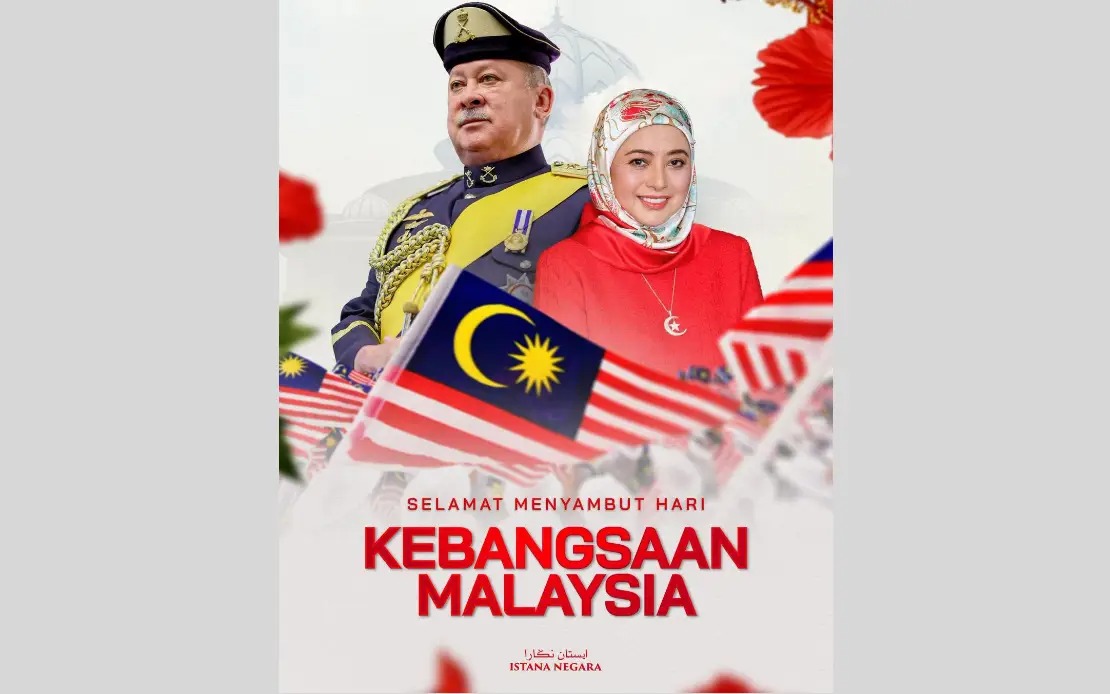
Malaysia's reigning monarchs, Sultan Ibrahim Sultan Iskandar and Queen Raja Zarith Sofiah, officially inaugurated the nation's 69th National Day celebrations in Putrajaya on August 31, extending warm greetings to all Malaysians through a message posted on the King's official social media platform. The royal couple's presence underscored the ceremonial significance of the occasion, which has evolved into one of the nation's most prominent annual observances since independence in 1957.
Prime Minister Datuk Seri Anwar Ibrahim and his spouse, Datuk Seri Dr. Wan Azizah Wan Ismail, received Their Majesties upon their arrival at the Putrajaya venue at 8 am, marking the official commencement of the day's formal proceedings. The gathering also included Communications Minister Datuk Seri Fahmi Fadzil, who chairs the National Day and Malaysia Day (HKHM) 2026 Main Committee. This coordination between the palace, executive government, and appointed committee leadership reflects the institutional framework through which Malaysia orchestrates its most significant civic commemoration.
The ceremony itself was structured around the overarching theme of "Malaysia MADANI: Kesejahteraan Dinikmati," which translates to emphasising shared prosperity and the enjoyment of wellbeing across the nation's diverse population. This thematic approach has become central to the government's contemporary messaging, positioning National Day not merely as a historical remembrance but as an active statement of national purpose and contemporary values. The concept of Malaysia MADANI seeks to frame development and governance through a lens of inclusivity and collective benefit rather than narrow partisan interest.
The spectacle unfolded with a formal military ceremony that established the solemn, ceremonial tone befitting the occasion. Following this, the programme transitioned into celebratory segments featuring stage performances and an elaborate parade that carried forward the Malaysia MADANI narrative throughout its visual presentation. Such transitions from formal military protocols to civilian celebration reflect Malaysia's approach to National Day as both a serious civic institution and a popular, participatory festival.
The parade and procession component mobilised substantial resources and personnel, drawing 10,819 participants organised into 76 separate contingents representing diverse segments of Malaysian society. Twenty-two brass bands provided musical accompaniment, while 11 specially decorated vehicles added visual spectacle to the route. The deployment of 328 land, sea, and air assets, alongside 112 service animals, demonstrated the scope of coordination required for such a major national event. Additionally, 22 electric vehicles participated, reflecting contemporary environmental and sustainability considerations now incorporated into official ceremonies.
Among the more striking visual elements was a human graphic display arranged on the terraces of the venue, comprising 26 distinct formations. These formations created a composite tapestry designed to encapsulate Malaysia's multicultural character and national identity. Such elaborate choreography serves multiple functions: it provides domestic audiences with inspiring imagery of national unity, generates content for international media consumption, and creates symbolic representation of the nation's commitment to diversity and social cohesion at a moment of collective national reflection.
For Malaysian observers and regional commentators, the 69th National Day celebration carried particular weight given the contemporary political context. The ceremony's public messaging emphasised prosperity distribution and wellbeing as core national concerns, potentially responding to public discourse around economic inclusivity and quality of life. By positioning Malaysia MADANI as the animating principle of the celebration, government institutions signalled continuity of this governance framework and its public salience as an electoral and policy priority.
The scale and elaboration of the Putrajaya celebrations reflect Malaysia's resources and institutional capacity to stage sophisticated state ceremonies. For Southeast Asian neighbours and international observers, such displays function as statements of national capability and institutional stability. The participation of the reigning monarch in person, rather than through ceremonial delegation, conveyed symbolic affirmation of the constitutional monarchy's active role in national life.
The involvement of military, cultural, and civilian elements in coordinated pageantry represents a carefully calibrated effort to project national unity while celebrating diversity. Educational institutions, community groups, and professional organisations represented through various contingents allow broad segments of the population to participate directly in the ceremonial act, rather than merely observing. This participatory structure has become characteristic of modern National Day celebrations across Southeast Asia and reflects evolving understandings of national commemoration.
The Malaysia MADANI framework continues to shape how Malaysia's leadership conceptualises and communicates national purpose. By situating this theme at the centre of the 69th National Day celebrations, the government reinforced its positioning of prosperity and wellbeing as the primary legitimate measures of governance performance. For Malaysian citizens, particularly those concerned with economic distribution and social policy, such messaging carries implications for how effectively the government can translate aspirational rhetoric into material improvement in their lives.

