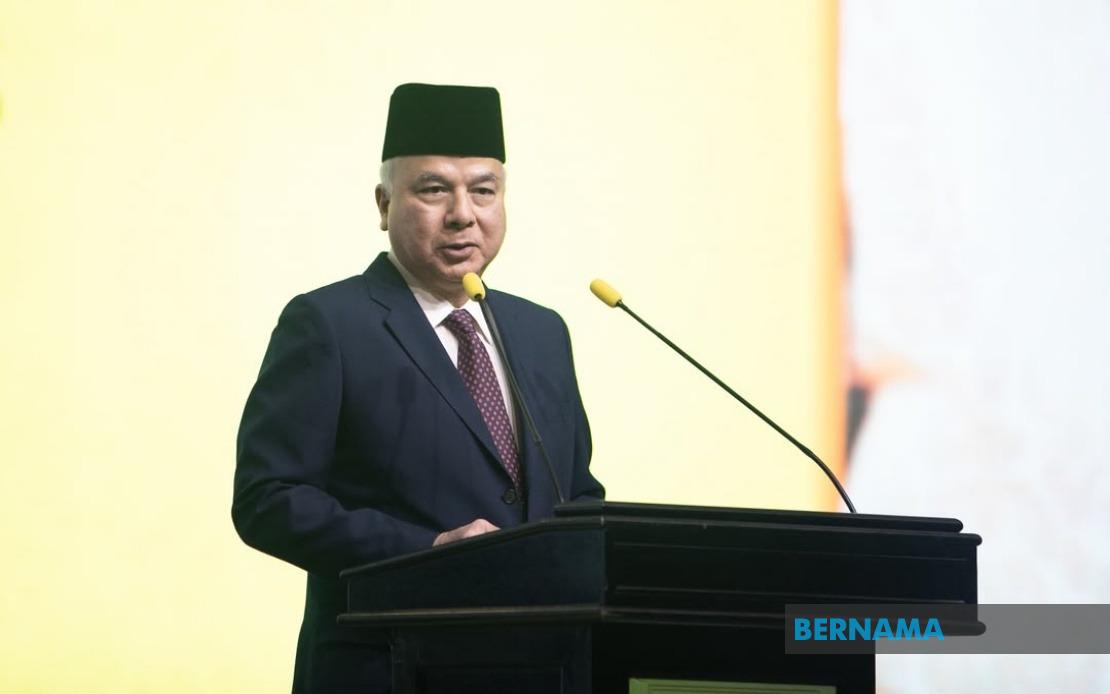
The Sultan of Perak, Sultan Nazrin Shah, has delivered a stark warning about governance and national development: even the wealthiest and most culturally vibrant societies will falter if their institutions crumble, their leaders dodge accountability, and political life becomes dominated by personal ambition rather than genuine public service. Speaking at the 8th World Conference on Islamic Thought and Civilisation in Ipoh on July 21, he articulated a vision of good governance grounded in practical institutional strength rather than rhetorical flourishes, addressing an audience that included Deputy Prime Minister Datuk Seri Fadillah Yusof, Perak Menteri Besar Datuk Seri Saarani Mohamad, and Higher Education Minister Datuk Seri Dr Zambry Abd Kadir.
The Sultan outlined three pillars of effective governance that resonate deeply with contemporary Malaysian and Southeast Asian challenges. First, transparency in public finance ensures citizens understand how their tax contributions are deployed and can verify that resources genuinely serve collective interests rather than enriching elites. Second, impartial application of the law creates the fundamental equality that underpins social cohesion—no official, regardless of rank or wealth, operates beyond the reach of justice, and no ordinary person is denied its protection. Third, a political culture characterised by civil disagreement transforms potential conflict into constructive democratic engagement, allowing power to transfer peacefully when voters so decide. These elements form an interconnected system; the absence of any one weakens the entire structure.
Crucially, Sultan Nazrin distinguished between stability rooted in genuine institutional legitimacy and the false stability of suppressed dissent. Many of the world's most politically stable democracies are simultaneously vibrant arenas of debate and contestation—the difference lies not in the absence of disagreement but in the existence of trusted mechanisms for resolving it. When citizens believe elections are genuinely free and fair, when courts operate independently from political pressure, and when public office is understood as a sacred trust rather than personal property, disagreement becomes a feature of healthy governance rather than a threat to national cohesion. Conversely, political instability emerges precisely when these shared institutional rules erode, when citizens lose faith in electoral integrity, judicial impartiality, or bureaucratic neutrality.
The Sultan articulated a particularly sharp insight about the human cost of institutional failure. When governance collapses, vulnerable populations—the poor, the marginalised, those without political voice—suffer first and most severely. A budget, he stressed, functions simultaneously as a financial document and as a moral statement revealing which constituencies a government has chosen to prioritise. In Malaysia's context, where income inequality remains pronounced and regional disparities persist, this observation carries particular weight. Public spending patterns communicate whose dignity a government acknowledges and whose needs it considers legitimate.
Beyond fiscal matters, the Sultan highlighted the role of a professional civil service as the embodiment of state unity in concrete form. When public servants act uniformly in citizens' interests, regardless of their ethnic background, religious affiliation, or party political sympathies, they instantiate the principle that all inhabitants possess equal standing before the state. Leadership characterised by humility, genuine listening before policymaking, and recognition that power is borrowed rather than owned accomplishes more in generating citizen loyalty and national pride than any slogan or rhetorical campaign. This framing directly addresses concerns about political polarisation across the region, where appeals to group identity often override commitment to institutional integrity.
On economic matters, Sultan Nazrin rejected isolationism as economically self-defeating. No nation, however talented or resource-endowed, prospers through autarky; modern prosperity depends on currents of trade, investment, knowledge transfer, and technological exchange flowing across borders. Economies that embrace open commerce while building resilient, diversified domestic industries consistently outperform those retreating into protectionism or dependence on single sectors. For Malaysia, a country whose prosperity has historically depended on regional and global trade networks, this perspective reinforces the strategic importance of maintaining integration despite rising protectionist pressures elsewhere.
However, Sultan Nazrin introduced an essential caveat: cooperation must not become a euphemism for dependency, nor should openness come at the cost of national autonomy. The challenge lies in calibrating engagement—welcoming foreign investment and expertise while simultaneously building domestic capacity and preserving the ability to chart an independent course. This balance proves particularly relevant for Southeast Asian nations navigating great power competition and seeking development partnerships that enhance rather than diminish their strategic agency. The principle applies equally to military cooperation, trade arrangements, and technological partnerships.
The Sultan reserved particular attention for Islamic finance as an underutilised mechanism for regional economic cooperation and development. Malaysia has established itself over decades as a global hub for sukuk issuance, takaful insurance, and Syariah-compliant fund management—a position of considerable regional and international significance. Yet he argued that Islamic finance's true potential extends far beyond technical compliance with prohibitions on riba and interest. Instead, it embodies a distinctive philosophical framework emphasising risk-sharing, asset-backing, and equitable participation in economic returns, principles with profound implications for how resources are mobilised and distributed.
Applying this philosophy rigorously could transform Islamic finance into a powerful engine for cross-border infrastructure investment, small and medium enterprise financing across Organisation of Islamic Cooperation member states, and the provision of patient capital for long-term development challenges. Clean water access, renewable energy transitions, digital infrastructure, and skills development—the defining development challenges of the coming decade—require precisely the kind of capital structures that Islamic finance philosophy envisions. Currently, most Islamic financial instruments function largely as compliance mechanisms for existing conventional financial practices; reimagining them as vehicles for fundamentally different approaches to economic participation represents both an intellectual and practical frontier for the region.
Sultan Nazrin's remarks warrant particular consideration from Malaysian policymakers and regional observers because they integrate governance, development, and financial architecture into a coherent framework. Strong institutions and accountable leadership enable transparent public investment; transparent public investment builds citizen trust; citizen trust permits the cooperation and stability necessary for sustainable economic development. Conversely, institutional erosion creates the cycles of instability and elite capture that trap developing economies in patterns of low growth and inequality. For Malaysia specifically, at a moment when institutional integrity across multiple sectors faces scrutiny and when regional development remains uneven, the Sultan's emphasis on institutional strength as the foundation of national success offers both diagnosis and direction.
The Sultan's speech ultimately articulates a traditional vision of governance grounded not in revolutionary transformation but in the consistent, disciplined application of institutional principles that have sustained successful societies. Transparency, impartiality, accountability, civil discourse, professional bureaucracy, listening leadership—these constitute neither revolutionary demands nor novel discoveries but rather the unglamorous foundations upon which national success rests. In an era of populist rhetoric promising shortcuts to prosperity and nationalist rhetoric celebrating strength divorced from institutional constraint, his call for institutional discipline and accountable governance stands as a counterweight to appealing but ultimately destructive political fashions.

