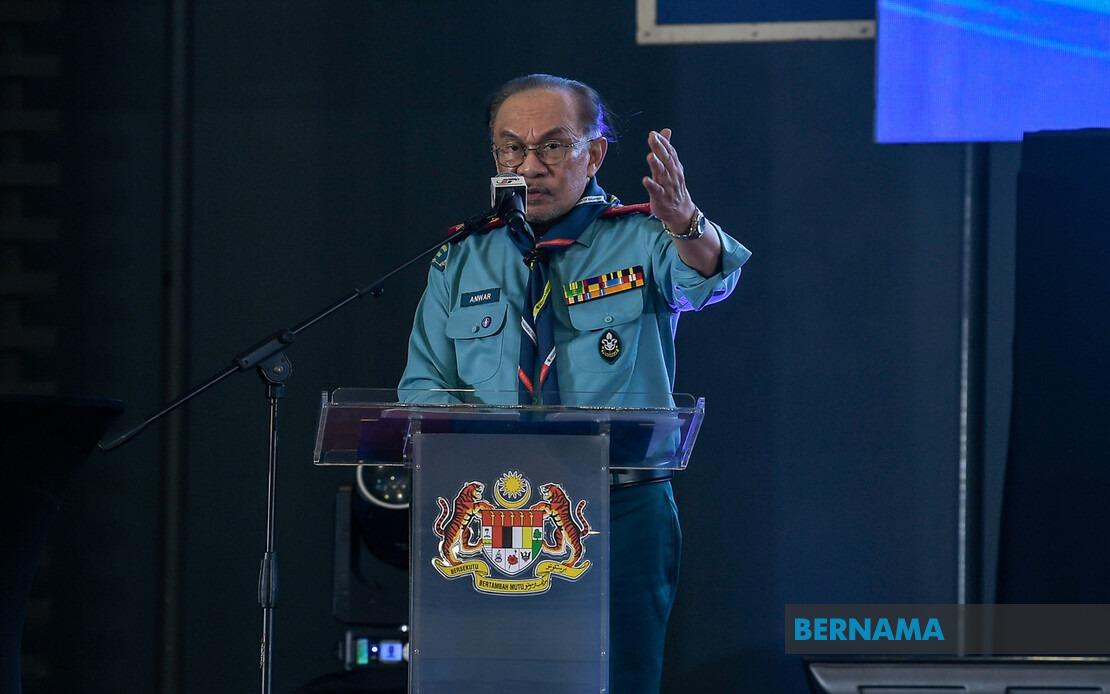
Prime Minister Datuk Seri Anwar Ibrahim has pushed back against perceptions that promoting the Malay language necessarily comes at the expense of proficiency in other tongues, framing multilingualism instead as complementary strengths that benefit the nation. Speaking at Universiti Teknologi MARA (UiTM) Permatang Pauh during the Ambang Merdeka Sahabat MADANI 2026 programme, Anwar articulated a vision of linguistic plurality where citizens maintain command of the national language while simultaneously developing capabilities in global and regional languages.
The Prime Minister's remarks arrive amid recurring debates about language policy in Malaysia, where questions about the balance between Malay and English in education have periodically surfaced. His intervention seeks to reframe these discussions as a false dichotomy, rejecting the notion that mastery of Malay must inevitably come at the cost of English competency. Instead, Anwar positioned both languages as serving distinct and reinforcing purposes within Malaysia's educational and economic ecosystem.
English, according to Anwar, has evolved into a dominant global language that Malaysia cannot afford to ignore in an increasingly interconnected world. Rather than viewing English as a threat to Malay's position as the official language, he suggested the education system should embrace English as a complementary tool. This approach acknowledges the practical reality that international business, academic collaboration, and technological advancement predominantly operate through English, while simultaneously affirming Malay's role as the unifying national language that all citizens should master.
Mandarin Chinese represents another strategic dimension to Anwar's multilingual framework. The Prime Minister highlighted its growing importance as a major economic language within the Southeast Asian region and beyond, pointing to China's expanding economic influence and the commercial imperatives driving Malaysian businesses and professionals to acquire Chinese language skills. Rather than treating Mandarin as an alternative to Malay, Anwar positioned it as an economic necessity that opens additional opportunities for Malaysian workers and entrepreneurs in regional markets.
Tamil proficiency also featured in Anwar's linguistic vision, reflecting Malaysia's multicommunal composition and the importance of strengthening ties within Malaysia's Indian community. His emphasis on Tamil alongside Mandarin and English underscores an inclusive approach to language policy that recognises the legitimate interests of all major communities within the nation. By explicitly naming these three languages, Anwar sought to validate their importance while maintaining Malay's centrality.
The Prime Minister employed the phrase "not a zero-sum game" to characterise linguistic competency, a formulation that directly challenges assumptions that gains in one language necessarily represent losses in another. This framing carries significant implications for Malaysian education policy and curriculum design. It suggests that schools and universities should simultaneously prioritise foundational Malay literacy for all students whilst creating structured pathways for developing proficiency in English, Mandarin, and Tamil according to student interests and community needs.
Anwar grounded his multilingual argument in economic pragmatism, describing language mastery as an "economic imperative" that secures individual and national interests. This framing shifts the conversation from cultural or nationalist preoccupations to concrete considerations of competitiveness and opportunity. Students who command multiple languages gain advantages in the regional and global job markets, attracting multinational employers and enabling participation in cross-border business ventures. Malaysia's position as a regional economic hub depends partly on its workforce's ability to communicate across linguistic boundaries.
Beyond linguistic considerations, Anwar articulated concerns about social cohesion, cautioning against actions that might sow discord among Malaysia's diverse racial and religious communities. His emphasis on preventing racial hostility and maintaining harmony reflects awareness that language debates can occasionally acquire heated communal dimensions. The Prime Minister reminded listeners that national unity requires sustained effort and cannot be assumed to persist indefinitely without deliberate preservation.
Anwar advocated for values of mutual sharing, caring, and reciprocal support as foundations for inclusive development, positioning these virtues as prerequisites for ensuring that all citizens, irrespective of ethnicity, benefit equitably from national economic progress. This ethical framing complements his linguistic arguments by suggesting that multilingualism serves not merely instrumental economic purposes but also contributes to social integration and cross-community understanding.
The Prime Minister's intervention carries particular significance given Malaysia's history of language policy controversies and periodic tensions surrounding educational language medium. By explicitly validating multilingualism whilst affirming Malay's constitutional position, Anwar attempted to chart a middle path acceptable to diverse constituencies. His approach acknowledges legitimate national interests in preserving Malay whilst recognising practical necessities of global economic participation.
For Malaysian policymakers, educators, and parents, Anwar's articulation provides clearer guidance on language priorities within the MADANI framework. Rather than framing language education as zero-sum contests, the government signals support for curricula emphasising Malay competency as a baseline requirement whilst creating complementary opportunities for developing English, Mandarin, and Tamil proficiency. This multitrack approach aligns with regional trends, as neighbouring countries increasingly emphasise multilingual education as a competitive advantage.

