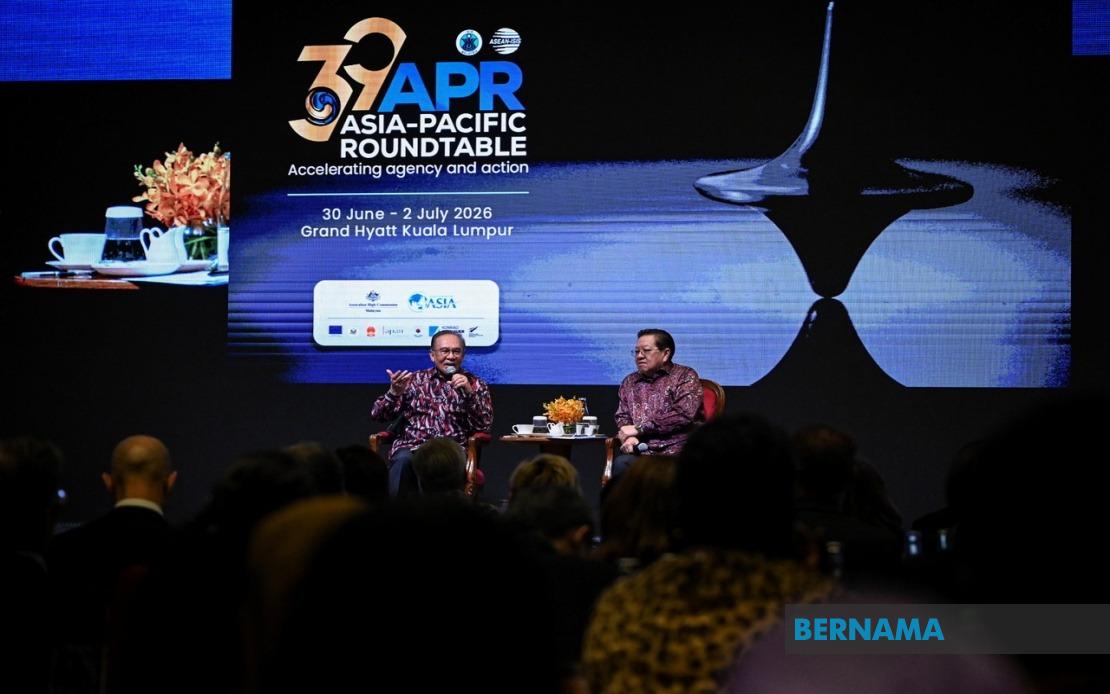
Prime Minister Datuk Seri Anwar Ibrahim has placed domestic governance reform at the centre of his administration's agenda, arguing that a nation cannot effectively contribute to resolving global challenges until it has put its own house in order. Speaking at the 39th Asia-Pacific Roundtable in Kuala Lumpur on July 2, Anwar outlined a vision in which Malaysia builds institutional strength and social cohesion at home as a prerequisite for meaningful international engagement, signalling a recalibration of priorities under his leadership.
The Prime Minister identified four pillars that will shape his government's trajectory over the coming years: improving the quality of governance systems, dismantling entrenched corruption, narrowing the widening gap between rich and poor, and guaranteeing that every Malaysian has genuine access to quality education and healthcare. These objectives reflect an understanding that legitimacy and credibility in the international arena flow from demonstrated success in meeting citizens' fundamental needs. Rather than pursuing headline-grabbing positions on distant geopolitical disputes, Anwar has signalled that his government intends to prove through concrete action that reform is possible.
Crucially, Anwar has framed Malaysia's international role not as secondary but as interdependent with domestic progress. He acknowledged that Malaysia will continue to voice principled positions on global affairs, yet emphasized that such advocacy carries weight only when accompanied by visible improvements at home. This approach challenges a common pitfall among developing-world leaders: the temptation to seek prominence on the world stage while neglecting the institutions and social contracts that give a nation genuine standing. For Malaysian policymakers and observers, this signals a shift toward pragmatism and accountability.
A central element of Anwar's articulation is his determination to demonstrate that a Muslim-majority democracy can simultaneously uphold Islamic values while embracing democratic governance, moderation in political discourse, and genuine inclusivity across religious and ethnic lines. This proposition carries particular significance in Southeast Asia, where questions about the compatibility of Islam and democracy remain contentious in some quarters. By positioning Malaysia as a functioning model of this compatibility, Anwar seeks to counter narratives that portray religious identity and democratic practice as inherently incompatible.
The Prime Minister moved beyond conventional geopolitical language by challenging the notion of a "clash of civilisations" as a framework for understanding global tensions. Instead, he argued—drawing on the late Palestinian-American intellectual Edward Said—that international conflicts are more accurately understood as a "clash of ignorance". This reframing suggests that many tensions stem not from irreconcilable value systems but from prejudice, misrepresentation, and failure to engage authentically with those who hold different worldviews. The implication for regional stability is significant: it positions dialogue, education, and mutual understanding as viable pathways toward reducing friction.
Anwar invoked the Quranic concept of "li ta'arafu"—often translated as mutual acquaintance or understanding—to articulate a vision of coexistence that moves beyond mere tolerance toward genuine appreciation of difference. For a multiracial, multireligious nation like Malaysia, this distinction matters profoundly. Tolerance can be passive and fragile, easily eroded when interests conflict. Appreciation and understanding, by contrast, imply active engagement and deeper social bonds. This philosophical grounding provides a counterweight to zero-sum identity politics that has at times fractured Malaysian society.
The government's MADANI framework, referenced by the Prime Minister, seeks to balance technological progress with attention to human values and social cohesion. In an era where rapid digitalization and economic transformation can disrupt traditional communities and exacerbate inequality, this dual focus is instructive. The framework suggests that development cannot be measured solely by GDP growth or infrastructure projects but must include metrics related to social trust, cultural vitality, and human dignity. For Southeast Asian nations grappling with similar modernization pressures, Malaysia's attempt to codify this balance offers a regional model worthy of scrutiny.
Anwar's emphasis on ensuring every citizen access to basic education and healthcare reflects recognition that institutional legitimacy rests on delivering tangible improvements in human welfare. In Malaysia's context, where healthcare and education systems face funding pressures and quality disparities across regions, these commitments carry real implementation challenges. The remarks signal intent, but follow-through will determine whether this administration can restore public confidence in state institutions—a critical foundation for effective governance.
The broader implication of Anwar's position is a recalibration of Malaysia's international posture toward greater restraint and focus. Rather than seeking maximum visibility or influence in every regional and global forum, the government appears to be prioritizing credibility through demonstrable domestic success. This approach may reduce Malaysia's profile on certain international issues in the short term, but it could enhance the country's long-term influence by rebuilding institutional capacity and social trust. For a nation that has experienced periodic governance crises and public disenchantment with leadership, this pivot toward introspection and reform may prove strategically sound.

