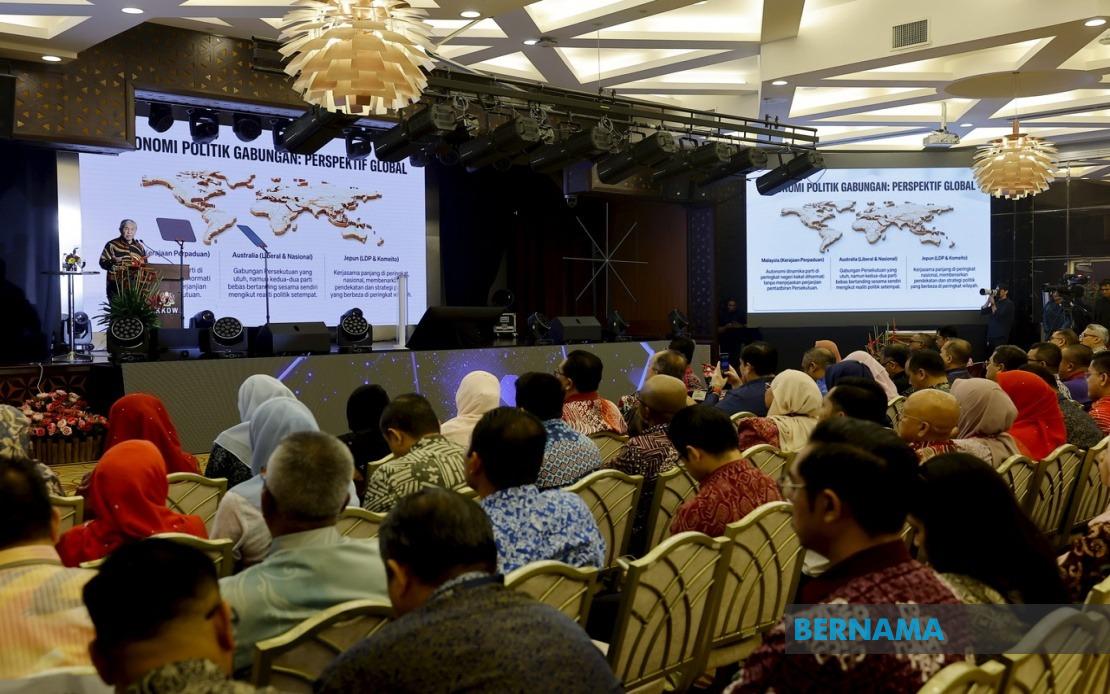
Deputy Prime Minister Datuk Seri Dr Ahmad Zahid Hamidi has sought to reassure Malaysians that the nation's federal administration will remain steady regardless of political manoeuvring at the state level, a statement that carries particular weight given recent electoral contests and coalition dynamics. Speaking at the Rural and Regional Development Ministry's monthly gathering in Putrajaya on August 6, Ahmad Zahid, who also chairs Barisan Nasional, articulated a carefully calibrated message: the multiparty Unity Government has been constructed on foundations robust enough to withstand the inevitable tensions that arise when coalition partners pursue distinct regional interests.
The context for these remarks is significant. Malaysia's political landscape has been volatile in recent years, with state elections in Johor and Negeri Sembilan providing flashpoints for internal competition among parties nominally bound together in the federal coalition. Such contests naturally amplify rivalries and test the cohesion of alliance structures, raising legitimate questions about whether victories or defeats at the state level might ripple upward to affect the stability and coherence of the central government. Ahmad Zahid's intervention appears designed to provide a reassuring counternarrative: that healthy political competition among coalition members need not translate into governmental paralysis or institutional breakdown.
The deputy prime minister's core argument rests on a distinction between structural stability and partisan identity. He emphasised that as long as Parliament remains in session—that is, until it is dissolved for a fresh general election—the federal government will discharge its functions, the bureaucracy will continue operating, and the programmes and policies already set in motion will proceed uninterrupted. This formulation essentially treats governmental continuity as a separate domain from the partisan contests that energise Malaysia's political system. The implication is that voters and stakeholders need not fear that state-level shifts in power distribution will destabilise the machinery of federal administration or delay delivery of promised benefits.
Central to Ahmad Zahid's framing is the concept of "political autonomy within a coalition government." This phrase suggests a middle path between two extremes: on one hand, the demand for absolute party discipline that would require coalition partners to suppress their distinct identities and strategic objectives; on the other, a fragmented arrangement where each party pursues its interests without regard for collective stability. Instead, Ahmad Zahid articulated a model wherein each party retains the freedom to chart its own political course, adopt independent strategies, and contest elections on its own terms—provided that all parties honour the foundational agreement that brought the Unity Government into being. This formulation acknowledges the reality that Malaysia's major political organisations have not surrendered their individual aspirations or merged into a monolithic bloc, even while serving together in national administration.
For Malaysian observers, this distinction carries practical implications. The Unity Government, which brought together parties previously locked in opposition, has always been understood as a pragmatic arrangement forged to address specific political circumstances. It was never presented as a permanent fusion or a realignment of Malaysia's fundamental political structures. Ahmad Zahid's remarks essentially reaffirm this transactional character: the coalition exists to provide stable governance until the next general election cycle, at which point parties will again present themselves to voters as distinct entities with distinct programmes. State elections and the rivalries they generate are thus framed as natural expressions of democratic competition within this larger architecture rather than threats to it.
The timing of these comments also merits attention. Recent state contests have seen winners and losers distributed across the coalition, creating differential incentives for coalition partners to emphasise their individual contributions or to position themselves advantageously for the inevitable federal election. By issuing this statement, Ahmad Zahid appears to be signalling that such jockeying is tolerable and expected—indeed, that it does not violate the terms of the Unity Government arrangement. This may serve to reduce tensions that might otherwise fester if coalition leaders feared that any visible divergence of interests or strategies was treacherous or destabilising.
However, Ahmad Zahid's assurance also implicitly sets boundaries. While parties may pursue autonomous strategies, the foundational agreement remains binding. The precise terms of this agreement—what obligations it imposes, under what conditions it might be considered violated, and what remedies might apply if a party overreaches—are matters of considerable political sensitivity. Disputes over interpretation of coalition arrangements have sparked crises in other multiparty democracies, and Malaysia's own coalition history includes episodes where disagreements over the limits of autonomy within alliances precipitated government changes. Ahmad Zahid's remarks do not elaborate on these institutional details, but their emphasis on mutual understanding and sustained commitment suggests that maintaining the Unity Government will require ongoing negotiation and restraint among coalition partners.
From a regional perspective, Malaysia's experience with coalition governance and the challenges of maintaining stability across diverse political actors offers lessons relevant to other Southeast Asian democracies navigating similar arrangements. The Unity Government model—permitting individual party identity within a collective governance framework—represents one approach to resolving tensions between democratic pluralism and administrative necessity. Ahmad Zahid's framing of this model may provide a template for other regional leaders seeking to manage similar coalitional pressures without resorting to either authoritarian consolidation or institutional collapse.
Moving forward, the credibility of Ahmad Zahid's reassurance will depend on whether the Unity Government actually withstands state-level political competition without fracturing or retreating into paralysis. The next federal election will be the definitive test of whether the coalition's founding arrangements prove sufficiently resilient and whether coalition partners' behaviour—both in winning and losing contests at regional and national levels—genuinely reflects acceptance of the autonomy-within-unity framework that Ahmad Zahid articulated. Until that test arrives, his statement serves primarily to establish the official government narrative: stability is assured, competition is normal, and the people's elected representatives will continue to serve their constituents through the mechanisms of the Unity Government.

