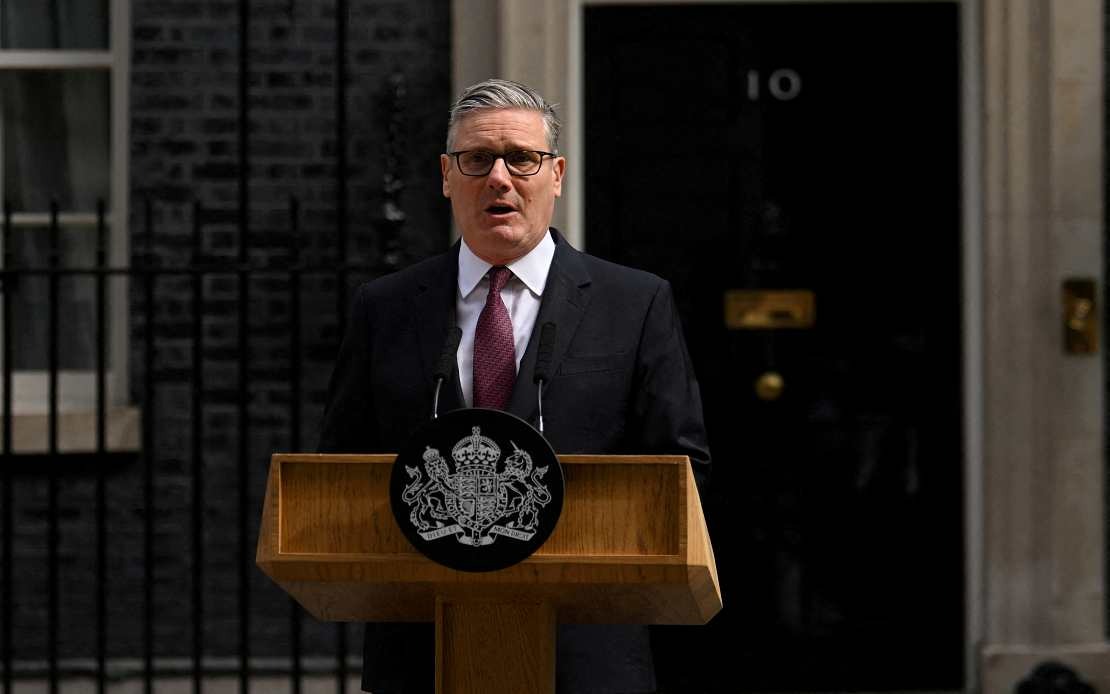
Keir Starmer concluded his tenure as British Prime Minister on Monday with a final address at Downing Street, announcing that his "work is done" before formally submitting his resignation to King Charles. Speaking alongside his wife Victoria and senior Labour figures, the outgoing premier reflected on his party's transformation and the achievements during his administration, while signalling that Andy Burnham would assume the leadership mantle.
Starmer's departure marks the end of a significant chapter in British politics, coming just two years after Labour's resounding 2024 general election victory. His decision to step down appears calculated, allowing the party to manage a controlled succession rather than face internal turbulence or external pressure. The timing suggests a deliberate strategy to reshape Labour's direction while maintaining momentum after the electoral triumph that ended years of Conservative governance.
The outgoing premier used his final remarks to emphasise the progress made during his time in office, contending that Britain had become "stronger and fairer" than when Labour assumed power. This framing attempts to establish a positive legacy and validate the government's policy agenda, even as he prepares to relinquish executive authority. His comments about the country's improved standing carry particular weight given the international challenges Britain has navigated, from economic pressures to geopolitical tensions.
Starmer's journey to this point reflects a remarkable political recovery. In 2019, Labour suffered a historic electoral defeat that many observers believed signalled the party's decline. Over the subsequent years, Starmer methodically rebuilt Labour's electoral coalition, repositioning it as a centrist, competent alternative to the Conservative government. His ability to unite fractious party factions and present a coherent policy platform proved crucial to the 2024 landslide, which gave Labour a mandate for substantial reform.
The six-and-a-half-year period Starmer references—from his election as Labour leader in 2020 through his resignation—encompasses a dramatic political arc. He inherited a party scarred by internal division, electoral losses, and questions about its viability as a governing force. Through careful management of Labour's internal dynamics and a focus on bread-and-butter issues affecting voters, he restored the party's credibility and captured public confidence.
Andy Burnham's emergence as Starmer's successor reflects the Labour Party's broader direction and priorities moving forward. As a prominent figure within the party's mainstream faction, Burnham represents continuity while potentially bringing his own emphasis and policy priorities to the role. His ascension is unlikely to signal radical departures from Starmer's foundational approach, though his leadership style and focus areas may shape how Labour governs in its next phase.
For Malaysian and Southeast Asian observers, Starmer's transition offers insights into how established democracies manage leadership change and party succession. The orderly nature of the transition—announced clearly, occurring without rancour, and following constitutional procedures—reflects institutional maturity that distinguishes established Western democracies. This contrasts with leadership transitions in some regional governments, which occasionally involve confrontation or constitutional ambiguity.
The timing of Starmer's departure also suggests strategic calculation about Labour's electoral prospects and the government's capacity to implement its agenda. By stepping aside while Labour retains strong public support and parliamentary supermajorities, Starmer avoids the trap of overstaying his tenure or watching support erode through years of difficult governance choices. This approach recognises that governments typically face pressure and unpopularity as they implement controversial policies and navigate unforeseen crises.
Starmer's emphasis on his party's transformation carries significance for understanding modern British politics. The shift from the Jeremy Corbyn era's left-wing platform to Starmer's centrist positioning reflects broader changes in how Labour understands voter priorities and the electorate's ideological centre. This repositioning proved electorally successful, suggesting that voters valued stability, competence, and conventional policy approaches over more radical alternatives.
The formal resignation process—Starmer visiting King Charles to offer his resignation before departing office—underscores the constitutional frameworks that govern British politics. Unlike presidential systems common in some democracies, Britain's parliamentary model grants the monarch formal authority while requiring that effective power rests with elected representatives commanding parliamentary confidence. This constitutional architecture allows for relatively smooth transitions when political circumstances change.
As Burnham prepares to assume the premiership, questions about Labour's direction and priorities under his stewardship will dominate British political discourse. His approach to economic policy, social reform, and international relations may differ from Starmer's in subtle but significant ways, potentially reshaping the government's trajectory during the remainder of the parliamentary term.
Starmer's resignation, while significant for British politics, carries broader implications for how Western democracies manage governance and leadership transitions. His decision to step down following electoral success, while his party remains in parliamentary favour, demonstrates that even successful leaders eventually cede authority. This pattern contrasts with some global leaders who cling to power indefinitely, raising questions about institutional longevity and democratic renewal across different political systems.
The transition from Starmer to Burnham represents Labour's opportunity to consolidate its electoral victories and address the mounting challenges facing Britain. Whether the new administration can maintain public confidence and implement its agenda effectively will determine whether this leadership change proves transformative or merely cosmetic. For observers globally, the transition exemplifies how established democracies navigate the complexities of power transfers within disciplined political parties.

