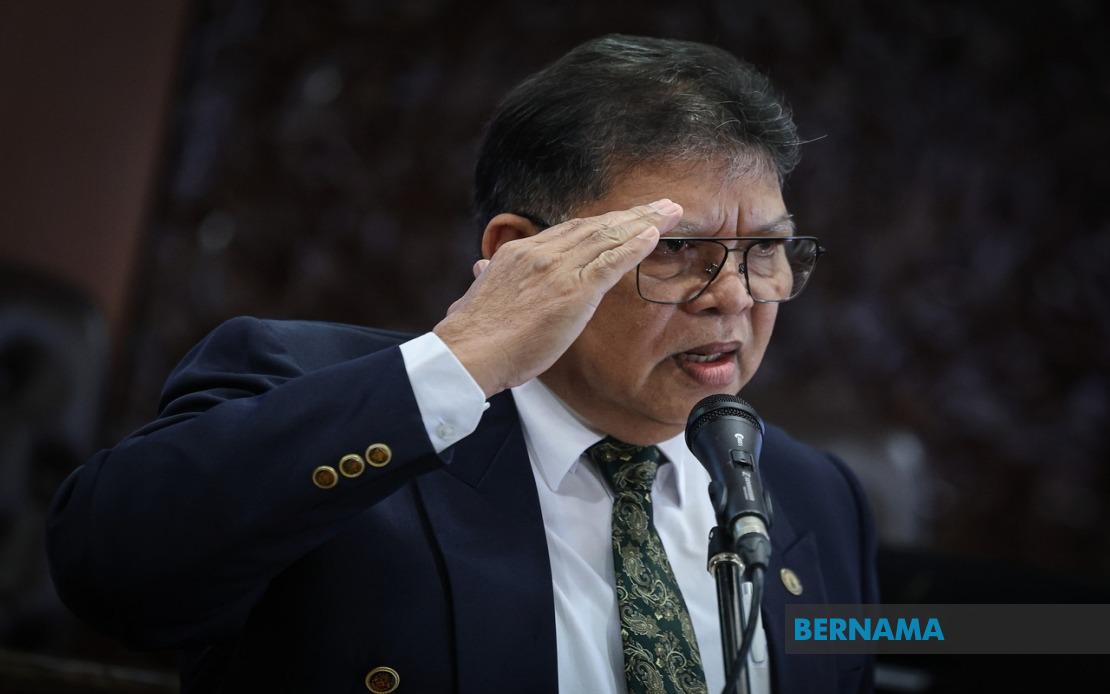
Dewan Rakyat Speaker Tan Sri Johari Abdul has advocated for an overhaul of Malaysia's electoral framework, specifically proposing the adoption of proportional representation to strengthen the parliamentary presence of minority communities. His remarks, delivered during the Harmony Symposium held at the Parliament building, underscore growing concerns about demographic shifts and their potential consequences for inclusive governance. The proposal represents a significant intervention from the nation's chief legislative officer on a matter that touches the core of Malaysia's political architecture and its commitment to pluralism.
Johari's intervention stems from demographic projections that frame an urgent policy challenge. According to the figures he cited, Bumiputera Malays are projected to constitute 77 per cent of Malaysia's population by 2050, a shift with profound implications for how electoral constituencies are drawn and which communities retain meaningful parliamentary representation. This demographic reality presents a mathematical problem within Malaysia's current first-past-the-post system: as minority communities become geographically dispersed across constituencies where they no longer form voting majorities, their ability to elect representatives independently diminishes significantly. Johari articulated this concern with directness, questioning where minority voices would find space within parliament if current electoral arrangements persist unchanged.
The Speaker's argument extends beyond mere representation mechanics. His framing emphasises that silenced minority voices create social fractures with tangible consequences for national cohesion. This reasoning reflects a broader understanding that democratic legitimacy depends not merely on majority rule but on minority communities perceiving their interests as genuinely reflected in parliamentary deliberations. When constituencies are designed around demographic majorities, minority voters scattered across multiple seats face increasing difficulty in translating their preferences into elected representatives, potentially generating alienation and resentment that corrode social harmony. Johari positioned this concern as central to Malaysia's long-term stability rather than a narrow sectional interest.
Proportional representation systems operate on fundamentally different principles than Malaysia's current constituency-based model. Under such arrangements, parties receive parliamentary seats proportional to their overall vote share rather than through territorial majorities, a mechanism that historically provides pathways for minority parties and dispersed voter communities to secure representation. Countries employing variants of proportional representation have sometimes achieved better outcomes in representing diverse populations, though such systems introduce their own complexities regarding government formation and coalition stability. For Malaysia specifically, implementing proportional representation would require substantial constitutional and legislative amendments, representing a profound shift in how power translates from electoral support to parliamentary seats.
Johari contextualised his proposal within a broader intellectual framework emphasising forward-looking governance. He explicitly rejected focusing on contemporary grievances or historical disputes, instead urging policymakers to contemplate Malaysia's challenges across timescales of five to 100 years. This temporal reframing suggests that electoral systems should be evaluated based on their capacity to sustain national cohesion across generations rather than their performance in addressing immediate political demands. His invocation of Malaysia's ethnic diversity—noting the presence of 77 ethnic groups—reinforced the argument that a truly inclusive system must accommodate this complexity, not merely accommodate majority interests.
The symposium itself represents institutional efforts to embed minority representation and racial harmony discussions within parliament's operations. Syahredzan Johan, who chairs the Malaysia Cross-Party Parliamentary Group on Racial and Religious Harmony (KRPPM-KKA) and represents the Bangi constituency, framed the gathering as an attempt to translate abstract principles of harmony into concrete policy mechanisms. This positioning suggests that formal parliamentary structures, rather than civil society alone, should bear responsibility for developing frameworks protecting minority interests. The involvement of multiple parties in the cross-party group indicates that minority representation concerns transcend partisan divisions, though disagreement clearly exists regarding appropriate solutions.
Syahredzan outlined KRPPM-KKA's broader agenda of advancing minority protection through legal and policy reforms across government institutions. The group's ambition extends beyond parliament itself, envisioning coordination between legislative bodies, executive agencies, civil society organisations, and educational institutions in constructing a more inclusive political order. This systems-wide approach acknowledges that electoral arrangements alone cannot guarantee substantive minority voice without complementary reforms in bureaucratic processes, judicial protections, and cultural institutions that shape how diverse communities experience citizenship. Such institutional coordination remains underdeveloped in Malaysian governance, presenting implementation challenges even if legislative will for electoral reform materialised.
The practical obstacles to implementing proportional representation deserve consideration when evaluating Johari's proposal. Malaysia's federal system, state-level representation mechanisms, and existing constitutional provisions all interlock with electoral arrangements in ways that resist simple modification. A transition from first-past-the-post to proportional representation would necessarily trigger cascading questions about seat distribution between states, preservation of geographic representation, and potential impacts on legislative stability. These technical challenges have deterred electoral reform in numerous democracies despite acknowledged fairness concerns, suggesting that translating Johari's conceptual argument into legislative reality would require sustained political commitment and sophisticated constitutional engineering.
The minority representation question carries particular salience for Malaysia's Southeast Asian context and regional standing. As a nation with constitutionally entrenched protections for Bumiputera interests and explicit federal arrangements acknowledging ethnic pluralism, Malaysia occupies a distinctive position among regional democracies. Its capacity to maintain functioning multiethnic institutions without descending into majoritarian exclusion represents an instructive model—or warning—for other Southeast Asian nations grappling with minority rights and democratic legitimacy. Electoral system choices therefore carry implications beyond Malaysia's borders, signalling how democratic frameworks can either facilitate or obstruct minority political participation in diverse societies.
The reception of Johari's proposal within political and civil society circles will likely reveal deeper divisions regarding Malaysia's constitutional trajectory. Conservative voices may argue that existing constitutional provisions guaranteeing minority rights, religious protections, and Bumiputera status represent adequate safeguards requiring no fundamental electoral restructuring. Progressive reformers may embrace proportional representation as an essential mechanism for translating demographic change into fairer representation but encounter resistance from coalitions benefiting under current arrangements. The Speaker's willingness to vocally champion this position, despite its potential controversy, suggests confidence that the demographic argument possesses sufficient urgency to warrant serious policy consideration across ideological boundaries.
Moving forward, the challenge lies in converting Johari's conceptual advocacy into detailed policy proposals amenable to technical scrutiny and constitutional negotiation. Proportional representation itself encompasses numerous variants—pure systems, mixed-member arrangements, list-based mechanisms—each carrying different implications for Malaysian governance structures and electoral outcomes. Any substantive reform would require extensive consultation with component parties, state governments, the judiciary, and affected communities to develop approaches balancing minority voice protection with other governance priorities. The symposium and cross-party parliamentary working group provide institutional venues for such deliberation, though translating deliberation into legislative change remains the most demanding phase of reform.

