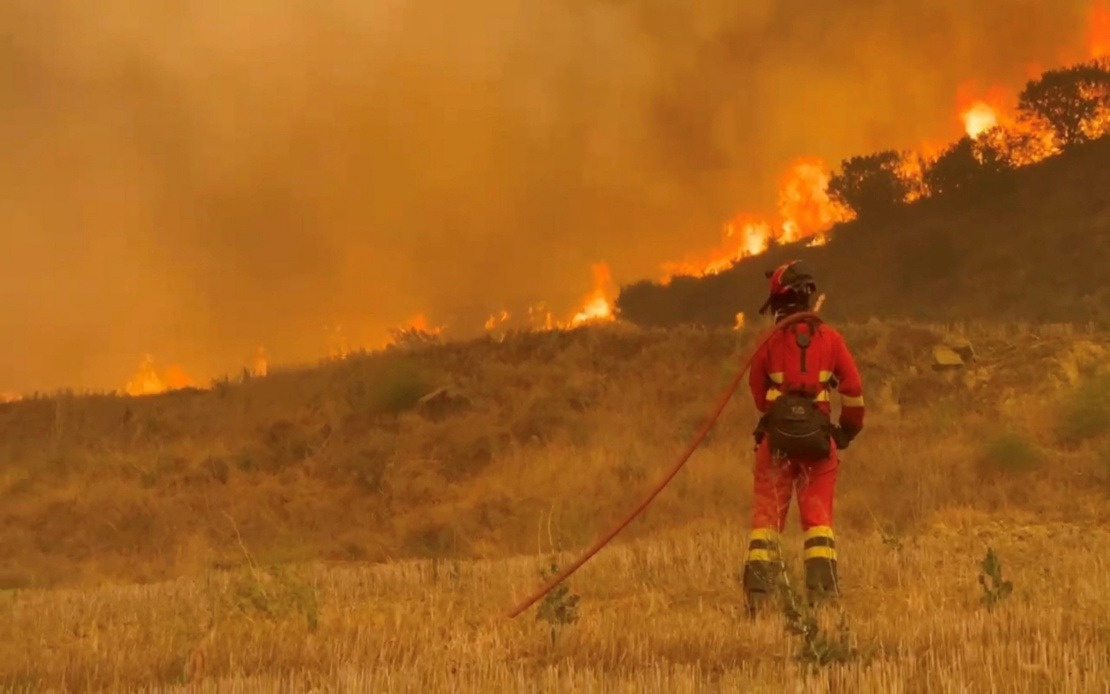
Spain is confronting an escalating wildfire crisis as its largest blaze of the year continues to rage through the northeastern province of Zaragoza, consuming approximately 12,000 hectares and displacing over 1,100 residents. The fire, which ignited on Wednesday in the Cinco Villas region, remains highly active with significant overnight expansion into Friday, presenting a formidable challenge to Spanish emergency services already stretched across multiple concurrent incidents.
The scale of the disaster has prompted unprecedented evacuation operations across six municipalities—five in Zaragoza and one in the neighbouring region of Navarre. Authorities have cordoned off vast areas, with parts of the affected region remaining under strict lockdown as the fire continues its relentless advance. The blaze has established a perimeter spanning approximately 60 kilometres, effectively isolating entire communities and forcing residents to abandon their homes with minimal notice.
Emergency response efforts have been substantial but tested by the fire's volatility. Ground crews totalling around 400 personnel, supported by 19 aircraft, were mobilised by Thursday to combat the flames. Firefighting teams concentrated their overnight efforts on the municipality of Uncastillo, where residential areas faced direct threat from advancing flames. The scale of deployment underscores the severity of the situation, yet the fire's aggressive behaviour suggests that current resources remain insufficient to achieve full containment.
The infrastructure impact extends beyond evacuated zones. A sprawling network of roads spanning the affected area remain sealed to civilian traffic, disrupting transport links and hampering supply chains across the region. However, authorities managed to restore electricity to all impacted communities relatively swiftly, a critical achievement that prevents cascading humanitarian challenges among displaced populations.
Spain's wildfire emergency extends beyond this single catastrophic incident. A separate blaze in La Mierla, located in the northern province of Guadalajara, has independently consumed approximately 900 hectares and remains actively burning. This fire has necessitated its own evacuation protocols and lockdown procedures in surrounding communities, forcing authorities to fragment their response efforts across multiple fronts. The regional government subsequently requested deployment of Spain's Military Emergency Unit, which deployed approximately 100 additional personnel to reinforce firefighting operations.
A third significant fire near Lozoyuela, positioned north of Madrid, presents a more ambiguous scenario. Whilst emergency services report the situation progressing favourably compared to other concurrent blazes, the fire remains neither fully controlled nor completely contained. This intermediate status demands sustained vigilance and continued resource allocation, preventing authorities from redeploying personnel to other zones despite the comparative stability.
Investigative efforts have identified human involvement in at least one incident. Civil Guard authorities arrested a man suspected of deliberately starting the Madrid-region fire, suggesting that deliberate arson may be compounding naturally occurring fire risks. The regional government has indicated its intention to participate in legal proceedings as a civil party, signalling a commitment to accountability even as firefighting operations continue.
The convergence of environmental and climatic conditions has created a particularly volatile situation across Spain. Exceptionally high temperatures combine with powerful winds and unusually low humidity levels to create ideal combustion conditions. Paradoxically, abundant vegetation fuelled by an unusually rainy spring provides ample fuel for rapidly spreading flames. This combination of wet-season growth followed by sudden dry conditions has historically preceded severe fire seasons across Mediterranean regions.
Beyond immediate weather patterns, structural vulnerabilities in Spain's landscape have contributed significantly to wildfire susceptibility. Climate change has intensified temperature extremes and altered precipitation patterns, extending fire seasons and increasing their severity. Simultaneously, the progressive abandonment of rural areas has allowed vegetation to accumulate unchecked, creating dense fuel loads that burn with greater intensity. This represents a critical challenge for Mediterranean nations including Spain, Portugal, and Greece, where rural depopulation and climate pressures intersect to amplify fire risks.
For Southeast Asian observers, Spain's current crisis offers sobering lessons regarding wildfire management in an era of climatic instability. Malaysia and neighbouring countries, whilst not Mediterranean ecosystems, face increasingly severe seasonal burning episodes driven by similar climatic and environmental pressures. The scale of Spanish emergency mobilisation—involving hundreds of ground personnel and dozens of aircraft—demonstrates the resource intensity required to suppress major wildfire events. Regional governments across Southeast Asia may find their current firefighting capacities similarly strained by intensifying fire seasons.
The economic and humanitarian costs of Spain's wildfire season extend far beyond direct destruction. Displacement of over 1,100 residents represents immediate humanitarian burdens, whilst disrupted infrastructure imposes broader economic costs on affected regions. Air quality degradation from smoke extends health impacts across much wider populations than those directly threatened by flames. These cascading effects underscore why wildfire preparedness increasingly demands integrated regional coordination rather than isolated national responses.
Spain's experience illustrates the inadequacy of reactive firefighting approaches when confronted with compounding environmental pressures. Proactive vegetation management, rural land stewardship incentives, and climate adaptation planning must accompany traditional emergency response capabilities. For Southeast Asian nations observing these events with concern, the urgency of developing comprehensive, prevention-focused wildfire strategies becomes increasingly apparent as climate change intensifies fire pressures across multiple continents simultaneously.

