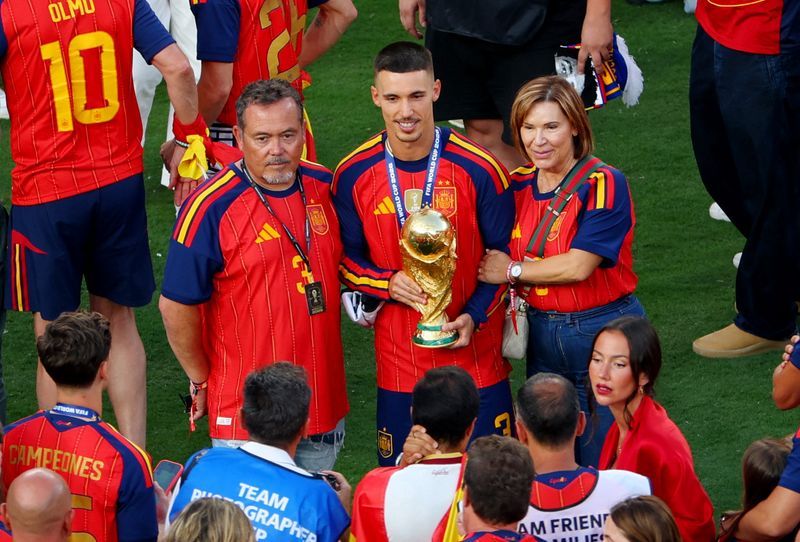
Spain's conquest of world football championship glory was never about individual brilliance or tactical revolution, but rather a steadfast commitment to a philosophical approach that has become synonymous with the Spanish game itself. Their slender 1-0 victory over Argentina in the final, secured through substitutes Nico Williams and Ferran Torres in extra time, represented not a departure from Spanish football identity but a reaffirmation of the principles that have defined their success over recent years.
The manner of victory was distinctly Spanish. Possessing the ball for more than 65 percent of the match, Spain completed over twice as many passes as their opponents while crafting 12 shots on target. Argentina's attacking threat remained muted, managing just one off-target effort late in extra time. Yet statistics alone cannot capture the essence of what occurred. This was controlled, methodical dominance tempered by occasional anxiety—a team refusing to abandon their identity even when alternatives might have offered easier paths to victory.
Luis de la Fuente's tactical setup embodied a philosophy that extends far beyond formation or positioning. By deploying replacement players to score the decisive goal for the third time in the knockout rounds, Spain demonstrated an exceptional depth of collective understanding. The fact that late-arriving players could step into crucial moments and execute the team's intricate patterns with precision speaks to the quality of preparation and the degree to which Spanish football has moved beyond reliance on star individuals. This organizational strength offers a valuable lesson for developing football nations throughout Southeast Asia, where squad rotation and bench depth often prove problematic.
Spain's tournament performance revealed both considerable strength and a notable vulnerability. Scoring 14 goals across eight matches distributed among eight different players reflected the attacking flexibility that underpinned their success. This sharing of goalscoring responsibility echoed their European Championship triumph in 2024, where 10 different players contributed to a tournament-record 16 goals. However, the number of clear-cut opportunities Spain created but failed to convert highlighted an enduring weakness: the absence of a traditional, clinical centre forward capable of converting half-chances into goals at critical moments.
The individual accolades accumulated by Spanish players underscored their collective excellence. Pau Cubarsi received the Best Young Player award, Unai Simon was named Best Goalkeeper, and midfielder Rodri claimed the tournament's Most Valuable Player honour. Remarkably, Spain's only failure to capture an individual prize was the Golden Boot, which went to France's Kylian Mbappe. This distribution of recognition across defensive, midfield, and attacking positions reflected a team where no single player dominated proceedings, yet each component functioned at the highest level.
De la Fuente's personal journey to this pinnacle adds another dimension to Spain's achievement. Previously dismissed by Spanish media as Luis de la "Who" following years spent developing young talent through the Spanish Football Association's youth infrastructure, he transformed patient apprenticeship into international football's ultimate prize. His appointment vindicated a developmental philosophy emphasizing long-term player cultivation over short-term results, a model that contrasts sharply with the reactive managerial changes common in Southeast Asian football.
Beyond tactical excellence, Spain's victory extended their unbeaten run to 38 consecutive matches, surpassing Italy's previous record and underscoring three years of sustained dominance in international competition. This consistency reflects institutional strength and a commitment to methodical improvement rather than reliance on occasional brilliant performances. For regional football associations studying successful models, Spain's combination of player development infrastructure, coaching stability, and philosophical coherence offers instructive examples.
The composition of Spain's squad carried profound symbolic significance within the Spanish context. Players hailed from distinct regions—Mikel Oyarzabal, Simon, and Merino from the Basque Country; Borja Iglesias from Galicia; Ferran Torres from Valencia; Rodri from Madrid; Fabian Ruiz and Gavi from Andalucia; Pedri from the Canary Islands; and Cubarsi with Cucurella among nine players from Catalonia. Additionally, young talents Lamine Yamal and Nico Williams represented both immigration's success and the emergence of a multicultural Spanish identity. This regional and ethnic diversity within a cohesive footballing unit transcended the political and cultural tensions that periodically fragment Spanish society.
Football's capacity to unite diverse populations has long been recognized, yet Spain's World Cup triumph demonstrated this unifying power at a moment when political differences often overshadow commonality. The diversity represented in the squad—spanning Spain's various autonomous communities and reflecting multiple waves of immigration—competed as an integrated whole, each regional accent and cultural heritage subsumed within collective purpose. For one night at least, football accomplished what political discourse frequently cannot: making Spain feel genuinely whole.
The implications for Southeast Asian football extend beyond tactical analysis or training methodologies. Spain's model emphasizes patience in player development, philosophical consistency across coaching changes, and confidence in collective identity over individual stardom. Regional football associations might consider whether their own structures adequately support young talent development, whether managerial instability undermines long-term planning, and whether squad composition reflects demographic reality or nostalgic preferences. Furthermore, Spain's demonstration that diverse populations can achieve extraordinary collective results while maintaining individual identity offers lessons for multicultural Southeast Asian nations navigating their own sporting development.
Spain's World Cup victory ultimately transcends the football pitch. It represents validation of a complete system—youth development, coaching infrastructure, philosophical consistency, and inclusive squad selection—all functioning harmoniously. The ball worship that characterizes Spanish football, often criticized for occasional sterility or over-elaboration, produced tangible success when combined with mental toughness, defensive discipline, and clinical finishing in crucial moments. As Southeast Asian football continues maturing, studying how Spain transformed philosophical principles into sustained competitive excellence offers valuable guidance for ambitious football nations seeking to challenge established powers.

