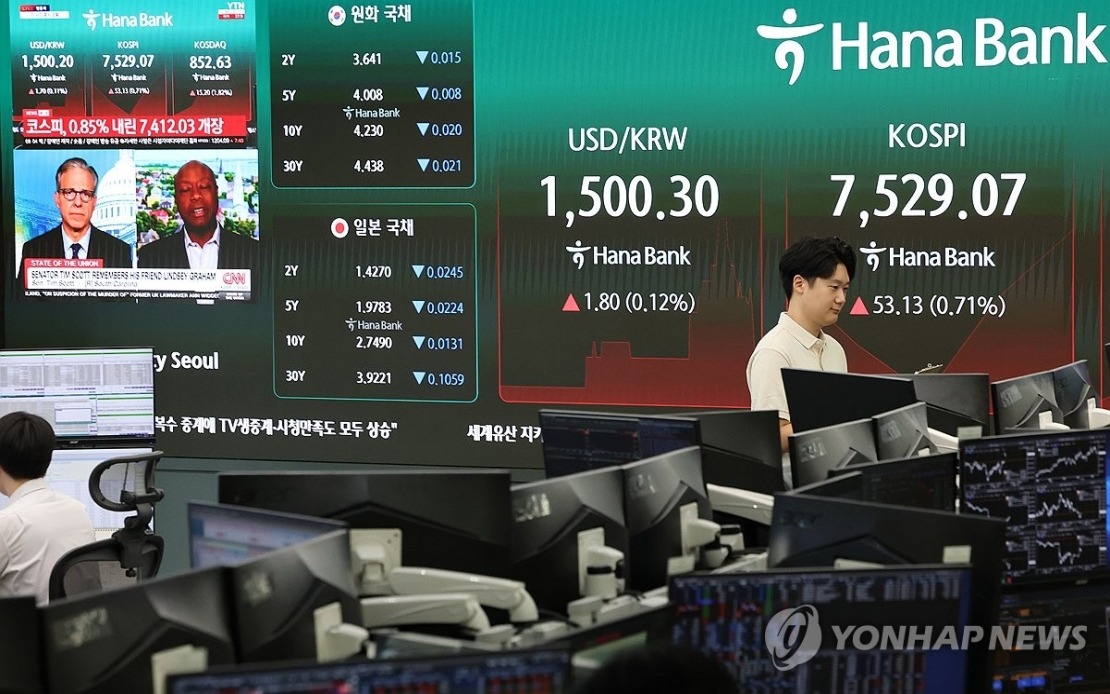
South Korea's bourse operator triggered a marketwide circuit breaker on Monday afternoon after the benchmark Korea Composite Stock Price Index tumbled sharply, reflecting investor anxiety stemming from renewed geopolitical friction in West Asia. The Korea Exchange halted KOSPI-listed share trading for twenty minutes following the sharp downturn, underscoring how sensitive regional markets remain to international security developments.
The circuit breaker mechanism—a safeguard designed to pause trading and prevent panic selling—activated at approximately 1:28 p.m. local time once the KOSPI had declined more than eight percent from the previous trading session's closing level. This automatic stabiliser represents a crucial market protection feature, allowing investors time to reassess their positions and cool heated market sentiment before resuming commerce.
The selloff reflected widespread investor caution triggered by escalating tensions between the United States and Iran centred on control and passage through the strategically vital Strait of Hormuz. This waterway remains one of the world's most critical chokepoints for energy supplies, with roughly one-third of global seaborne crude oil transiting through its narrow passage. Any disruption to shipping lanes there reverberates across global markets within hours, particularly affecting petroleum-dependent Asian economies like South Korea, Japan, and Malaysia.
For Southeast Asian observers, the implications carry particular weight. The region's shipping routes and energy security remain tethered to Middle Eastern stability. Prolonged US-Iran tensions risk elevating oil prices, which would inflate import costs for nations lacking substantial domestic crude reserves. South Korea, despite its technological prowess, remains heavily dependent on Middle Eastern energy imports, making such geopolitical shocks immediately consequential for its economy and export-dependent manufacturing sectors.
This marks the seventh instance in the current calendar year that the Korea Exchange has activated its circuit breaker mechanism, indicating a notably volatile trading environment punctuated by periodic sharp downturns. The frequency of these pauses suggests markets continue grappling with multiple headwinds—geopolitical uncertainty, trade tensions, and economic concerns—that periodically trigger sharp investor retreats from equities.
Circuit breakers function as market circuit boards, automatically interrupting trading flow when volatility exceeds predetermined thresholds. The twenty-minute pause permits algorithmic trading systems to recalibrate, retail investors to process information, and institutional managers to execute orderly exits rather than cascading panic-driven sales. In theory, this breathing space prevents flash crashes and market distortions that can occur during periods of maximum fear.
The particular vulnerability of South Korea's equity market to external shocks reflects several structural realities. As a mature export economy deeply integrated into global supply chains, the nation's corporate performance depends substantially on international conditions beyond its control. Samsung Electronics, Hyundai Motor, and SK Innovation—among the KOSPI's heaviest constituents—all maintain extensive overseas operations and face risks from both trade disruptions and energy price spikes.
Moreover, South Korea's domestic investor base increasingly competes with foreign capital for stock market exposure. When geopolitical anxieties mount, international money frequently rotates away from emerging and developed Asian equities toward safer havens like US Treasuries or Swiss francs. This dynamic can amplify selling pressure during crisis periods, as happened on Monday.
The Strait of Hormuz remains perpetually sensitive to US-Iran tensions given Washington's decades-long hostility toward Tehran and its 2018 withdrawal from the nuclear accord. Any military escalation risks choking the waterway through which roughly 21 million barrels of crude oil transit daily. Such disruptions immediately affect petroleum prices globally and reverberate through energy-intensive manufacturing economies throughout Asia.
For Malaysian policymakers and investors, South Korea's market gyrations carry cautionary significance. Both nations share similar economic vulnerabilities: dependence on global trade, exposure to Middle Eastern energy supplies, and integration into technology supply chains vulnerable to disruption. When Korean markets seize amid external shocks, Malaysian financial institutions and exporters should anticipate spillover effects, particularly if contagion spreads to regional banking sectors or triggers currency turbulence.
The recurrent activation of circuit breakers throughout 2024 suggests market participants remain unsettled by an unusually complex array of risks. Beyond Middle Eastern tensions, investors globally grapple with questions surrounding artificial intelligence's real economic impact, potential recession scenarios in major economies, and elevated interest rates that reduce equity valuations. This confluence of uncertainties keeps volatility elevated and trading patterns unpredictable.
Looking forward, the sustainability of South Korea's equity market recovery will depend substantially on whether geopolitical tensions ease and whether corporate earnings growth accelerates sufficiently to justify current valuations. Until such stabilisation emerges, further circuit breaker activations appear probable, serving as periodic market resets during periods when fear temporarily overwhelms fundamental analysis.

