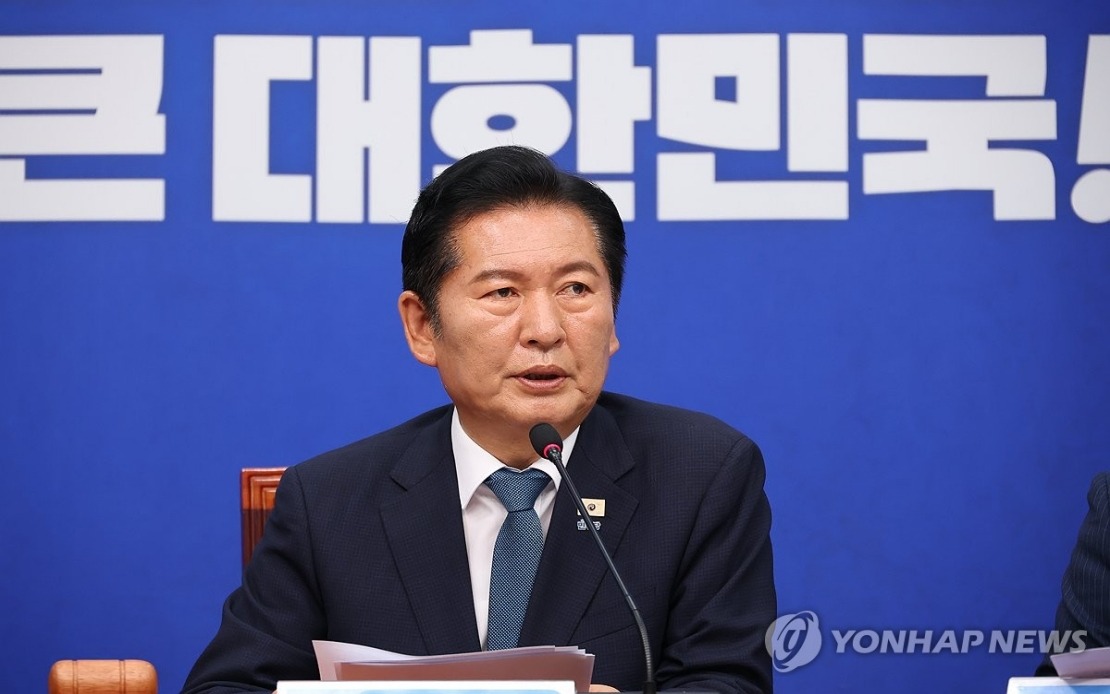
Jung Chung-rae, a senior legislator in South Korea's ruling Democratic Party, stepped down from his position as party chairman on Wednesday in a calculated political manoeuvre widely interpreted as positioning himself for re-election at the party's forthcoming national convention. The move, announced during a session of the party's highest decision-making body at the National Assembly in Seoul, marks a turning point in the party's internal power dynamics as it gears up for leadership succession talks scheduled for mid-August.
In explaining his departure, Jung adopted the familiar language of political introspection, telling party colleagues that recent days had prompted deep reflection on his personal journey and political career. His remarks struck a tone of perseverance against adversity, suggesting he had navigated a challenging tenure marked by resistance from multiple quarters. Rather than portraying himself as defeated or deflated, he framed his resignation as a principled choice made after considerable deliberation, a rhetorical positioning common in East Asian politics when politicians seek to reset their public standing before major contests.
Jung's tenure as party chairman has been defined by his stated commitment to supporting President Lee Jae Myung's administration and fostering cohesion among the ruling party, government ministries, and the presidential office. Throughout his term, he maintained that unity between these institutions served the broader national interest and reflected his core political philosophy. However, this message of harmonious governance masked deeper fractures within the party between Lee's supporters and rival factions.
The resignation letter came amid mounting criticism from pro-Lee elements within the Democratic Party who contend that Jung's leadership style favours his own hardline constituency at the expense of closer alignment with the president's agenda. This faction has argued that Jung prioritises appeasing his base of supporters rather than functioning as an effective bridge between the presidential administration and parliamentary operations. Such internal tensions are characteristic of governing parties in Korea, where centralised presidential power frequently clashes with the independent interests of parliamentary leadership.
The August 17 convention is shaping up as a three-cornered competition that reflects the Democratic Party's fractured landscape. Jung will compete against Prime Minister Kim Min-seok, who enjoys significant backing from President Lee, positioning him as the administration's preferred candidate. Running alongside them will be Song Young-gil, a former Democratic Party leader seeking a return to party influence. According to DP legislator Park Jie-won, Song has already informed the president of his intention to enter the race and has indicated openness to potentially consolidating his candidacy with Kim's—a strategic move that would substantially weaken Jung's prospects.
For Malaysian and Southeast Asian observers, South Korea's internal party dynamics offer instructive parallels about the perpetual tension between presidential and parliamentary powers in presidential systems. The conflict between Jung and Lee's supporters illustrates how even ruling coalitions contain structural fault lines that can constrain policy execution. Unlike Malaysia's Westminster tradition, where the prime minister typically chairs the ruling coalition, Korea's system creates distinct power bases that frequently operate at cross-purposes, complicating legislative-executive relations.
The timing of Jung's resignation demonstrates sophisticated political calculation. By stepping down voluntarily rather than being forced out, he preserves his standing among supporters and can frame his candidacy as a fresh mandate-seeking exercise rather than a comeback attempt. Meanwhile, interim party leader Han Byung-do assumes ceremonial duties until the convention, allowing the party machinery to operate under temporary neutral stewardship during what promises to be an internally contentious campaign season.
The three-way race for party leadership carries implications beyond personality contests. The winner will effectively shape the Democratic Party's trajectory during a critical period of South Korean politics, determining how the party supports or constrains President Lee's remaining term. Kim's potential elevation would consolidate presidential influence over the party, whereas a Jung victory would signal the resilience of parliamentary independence within the ruling coalition. Song's participation adds unpredictability, as his status as an elder statesman could appeal to party members seeking a unifying figure.
For the broader Southeast Asian region, Seoul's political developments warrant attention because South Korea remains a significant economic and diplomatic actor. Party leadership transitions in Seoul can influence bilateral relationships, regional positioning on security matters, and coordination within international forums where Korea and Southeast Asian nations intersect. The Democratic Party's internal stability therefore carries implications beyond domestic Korean politics.
Jung's strategy of resigning to seek re-election represents a high-risk gambit. If the pro-Lee consolidation behind Kim proves overwhelming, Jung could find himself sidelined from his own party infrastructure. Conversely, if party members rebel against presidential direction and seek autonomous leadership, Jung's positioning as an independent voice challenging Lee's dominance could prove advantageous. The August convention will reveal whether party grassroots prefer presidential alignment or parliamentary autonomy in their next chairman.
The Democratic Party's succession drama also reflects broader patterns in Korean politics where factional competition within ruling parties often determines national policy more significantly than inter-party competition. Understanding these intra-party dynamics is essential for foreign observers seeking to interpret Korean political stability and policy direction. Jung's resignation, therefore, marks not an endpoint but rather the opening gambit in a complex power negotiation that will likely define South Korean politics through the remainder of Lee's presidency.