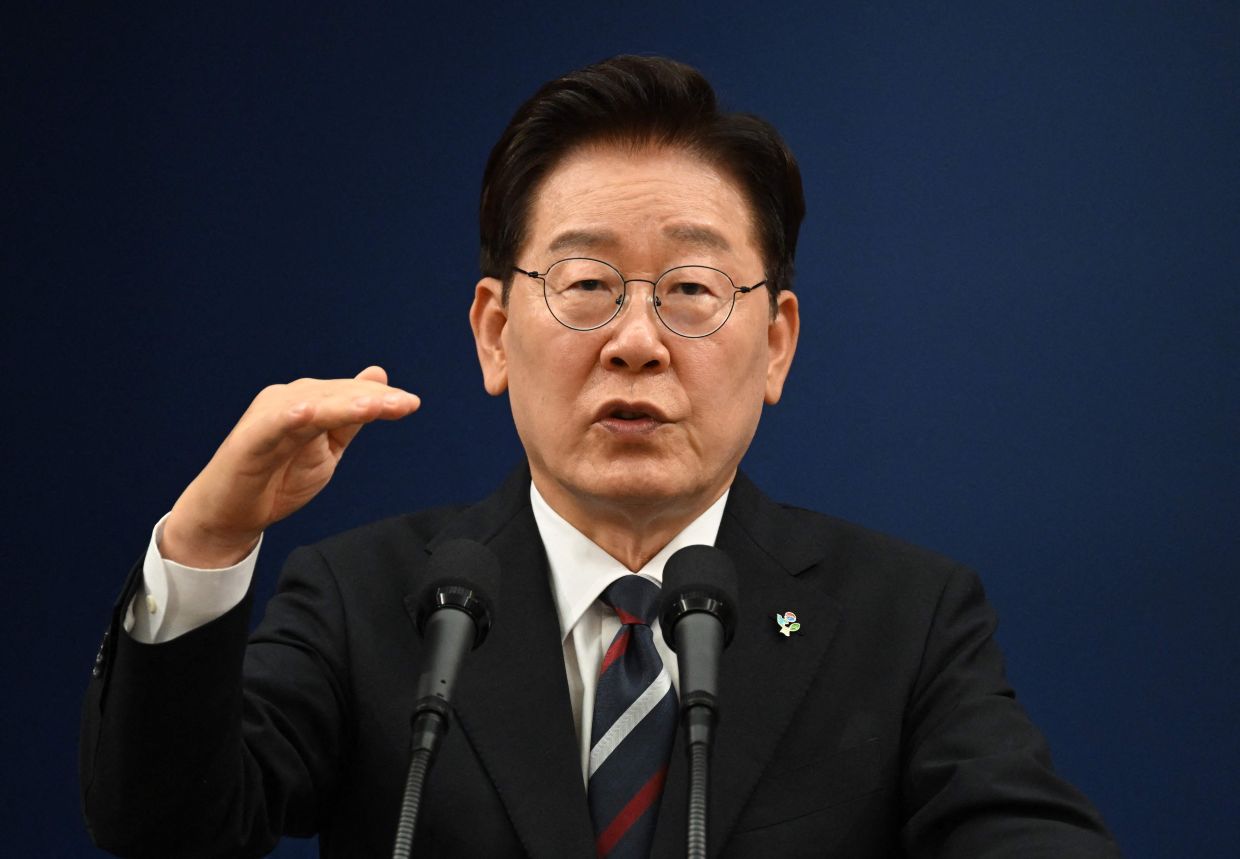
South Korean President Lee Jae Myung has reached a critical political inflection point, with his approval rating slipping into negative territory for the first time since his inauguration on June 4, 2025. According to polling data released on June 22 by Realmeter, one of South Korea's leading survey organisations, just 46.7 per cent of the public now view his performance favourably, a decline of 4.8 percentage points from the previous week. This marks the fifth consecutive week of decline and represents a watershed moment for a leader who entered office with much stronger popular support.
The shift is particularly striking because negative assessments have now edged past positive evaluations for the first time. The disapproval rating climbed to 49.7 per cent, surpassing the approval figure, although pollsters note the difference falls within the survey's margin of error of plus or minus two percentage points. An additional 3.6 per cent of respondents expressed uncertainty about the president's performance. The trajectory has been unmistakable, with Lee's approval plummeting from 60.5 per cent in mid-May to just above half in mid-June—a sharp erosion of political capital in a brief span.
When positioned against the historical experiences of Lee's predecessors, the speed of this deterioration carries significant weight. Former President Yoon Suk Yeol, who preceded Lee, did not experience a crossover into negative territory until June 2022, approximately six weeks into his term—timing comparable to Lee's current situation. The pattern appears consistent across administrations. Park Geun-hye required roughly 16 months before disapproval exceeded approval, while Moon Jae-in managed to maintain majority support for nearly 19 months before crossing the same threshold. By this measure, Lee's decline represents an unusually rapid collapse of public confidence for a newly inaugurated president.
The primary driver of Lee's declining approval stems from a bungled administration of the June 3 local elections, when numerous polling stations experienced critical ballot shortages that disrupted voting procedures and frustrated citizens. This electoral management fiasco triggered demands for accountability and exposed governmental incompetence at a highly visible moment. Compounding this self-inflicted wound are escalating factional disputes within Lee's Democratic Party of Korea, particularly surrounding preparations for an August 17 leadership convention to select a new party chairperson. These internal conflicts have consumed political oxygen and projected an image of disunity precisely when public confidence in government was needed most.
Realmeter's analysis highlights how these dual crises have created a broader erosion of political support across the landscape, even as some positive developments might have provided offsetting momentum. The president's recently concluded European trip was generally perceived as successful, and the Kospi stock exchange index achieved the symbolic milestone of surpassing 9,000 points. However, these accomplishments have proven insufficient to counterbalance mounting public frustration. Notably, growing concerns about widening disparities in asset markets have begun to undermine support among the moderate voters who typically form the centrist backbone of political coalitions, while residents of the Greater Seoul metropolitan area—encompassing Seoul, Incheon, and Gyeonggi Province—have shown particular disillusionment.
Regional analysis reveals sharply uneven impacts across South Korea's political geography. Lee's support has collapsed most dramatically in the country's traditionally conservative southeastern regions, where approval fell 9.9 percentage points to just 34.6 per cent in Daegu and North Gyeongsang Province. This erosion in stronghold territory signals that even the president's core constituency is wavering. In the Seoul metropolitan area, the decline has been substantial though somewhat less severe: Incheon and Gyeonggi Province registered a 7.6 percentage point drop to 44.8 per cent approval, while Seoul itself fell 7.6 percentage points to 39.8 per cent. The fact that major urban centres are providing such meagre support represents a particularly acute political challenge.
Demographic fracturing has also accelerated, with approval among self-identified moderate voters declining 4.9 percentage points to 47.5 per cent—a particularly troubling indicator given that moderates represent crucial swing voters in Korean electoral competition. Support among liberal voters remained comparatively robust at 80.4 per cent but still declined 3.2 percentage points, suggesting even Lee's natural constituency is not immune to dissatisfaction. Conservative voters, representing the opposition camp, showed minimal change with only a 0.7 percentage point decrease to 19.8 per cent, indicating they were already minimally supportive and have little further room to decline.
In response to the damaging polling numbers, the presidential office offered a carefully calibrated statement acknowledging the results with what it characterised as humility and seriousness. The Cheong Wa Dae, South Korea's presidential compound, framed the approval decline as reflecting the public's assessment of both economic conditions and broader governmental performance. By articulating that the administration would attend more closely to public concerns and expectations, the presidential office signalled recognition of a legitimacy crisis while stopping short of acknowledging specific policy failures. Whether such rhetorical repositioning can arrest the downward momentum remains uncertain, particularly given that the underlying causes—the electoral debacle and party infighting—show limited signs of resolution.
Parallel survey data examining party preferences reveals a volatile political environment extending beyond presidential approval. The opposition People Power Party maintained a narrow advantage over Lee's Democratic Party of Korea, commanding 42.3 per cent support compared to 40.1 per cent, but the margin had compressed significantly. The Democratic Party gained 2.1 percentage points while the People Power Party lost 2 percentage points, suggesting momentum may be shifting. However, the People Power Party faces its own vulnerabilities, confronting mounting pressure to respond to the ballot shortage controversy while managing internal disputes about whether party leadership should resign. These competing pressures have fractured conservative voter cohesion and accelerated an exodus of younger voters aged in their 20s and 30s, with the opposition party's approval among twenty-somethings plunging 10.5 percentage points to 48.6 per cent.
The Democratic Party's modest recovery in party preference polling reflects what Realmeter characterises as a crisis-management strategy emphasising party unity and bipartisan cooperation, particularly through a National Assembly investigation into election administration failures. By positioning itself as participating in serious accountability mechanisms rather than defending governmental incompetence, the ruling party has managed to stabilise its base support despite ongoing factional tensions. This tactical shift has generated modest gains among core Democratic voters, providing some breathing room for party leadership. Nevertheless, the simultaneous decline in presidential approval suggests that Lee personally bears considerable political liability that party-level messaging cannot entirely mitigate.
For regional observers including Malaysian analysts tracking Korean political developments, Lee's rapid approval decline illustrates the precarious nature of early presidential mandates when administrative performance failures occur. The electoral management crisis has crystallised public doubts about governmental competence at a formative moment when presidential authority is typically at its apex. With multiple challenges simultaneously pressing—internal party management, economic anxieties manifesting in asset market inequality concerns, and residual public anger over the ballot shortage episode—Lee faces a compressed timeline to demonstrate effective governance and restore public confidence. The weeks ahead will prove critical in determining whether the president can reverse the downward trajectory or whether this initial collapse in support presages a longer-term legitimacy crisis.