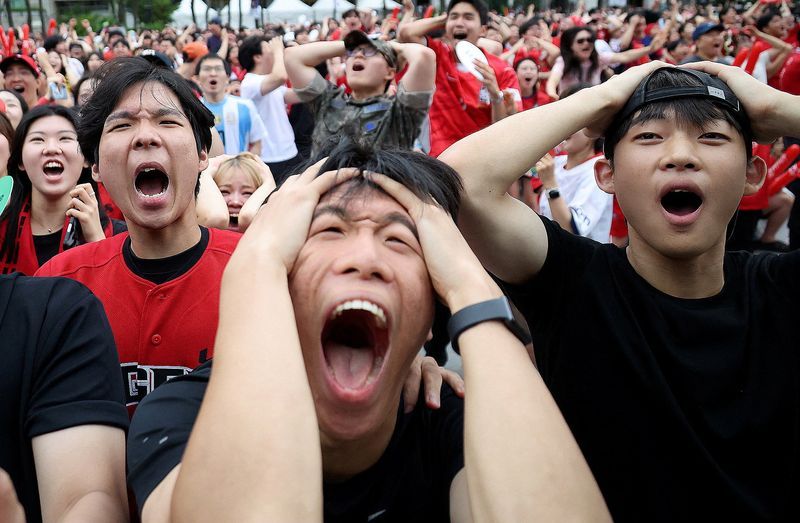
South Korea's president has launched a scathing attack on the national football team's management following an unexpectedly early elimination from the World Cup, demanding that government authorities conduct a formal inquiry into the debacle. President Lee Jae Myung expressed his bewilderment at the outcome on Sunday via social media, describing himself as "utterly baffled" by a result that defied widespread expectations that the team would comfortably progress from what was considered a favourable group draw.
The football squad's disappointing campaign saw them suffer consecutive defeats to Mexico and South Africa, a sequence of results that left them finishing third in Group A—crucially, outside the eight best third-placed teams that advance to the knockout rounds. For a nation that has consistently qualified for the World Cup since 1986 and possesses considerable football infrastructure and resources, the premature departure represented a significant underperformance that has shocked supporters and political leadership alike.
President Lee's frustration extends beyond the immediate sporting failure to encompass what he characterised as systemic institutional dysfunction within the selection process. In his public statement, he articulated a fundamental critique of how personnel decisions are made in South Korean football administration, arguing that when loyalty and factional considerations supersede genuine merit and competence, poor outcomes become inevitable. This observation reflects broader concerns about governance that extend well beyond the sporting arena in Korean society.
The president specifically targeted the reappointment of Hong Myung-bo as national team manager in 2024, a hiring decision that had already generated substantial controversy within Korean media circles. Journalists and commentators had questioned the transparency and propriety of the selection process, with critics suggesting that the appointment reflected behind-the-scenes political maneuvering rather than an objective evaluation of Hong's qualifications relative to other available candidates. Hong has consistently denied these allegations of favouritism, but the subsequent poor performance on the international stage has intensified scrutiny of the decision-making process that brought him into the role.
Lee's comments highlight a critical governance challenge facing sports organisations across Asia: the tension between merit-based selection and systems where personal connections and factional allegiances can override professional competence. He emphasised that such problematic appointments become possible precisely because accountability mechanisms are weak or absent, allowing those with hiring authority to escape meaningful oversight or consequences. This structural vulnerability, he suggested, creates conditions where decisions that prioritise private interests over public benefit can proliferate.
The public backlash against Hong has been notable and multifaceted. A petition calling for his dismissal posted on South Korea's national assembly website accumulated sufficient signatures to trigger an official review process within days of its launch. More colourfully, social media has circulated images of shops and businesses displaying notices that explicitly ban Hong from their premises—a visceral expression of public frustration with the manager that illustrates just how deeply the disappointing World Cup campaign has affected Korean society and damaged his standing with ordinary citizens.
President Lee has instructed the Ministry of Culture, Sports and Tourism to undertake a comprehensive investigation into the circumstances surrounding the team's failure. This directive goes beyond simply establishing what went wrong tactically or strategically on the field; instead, it seeks to examine the organisational and personnel decisions that preceded and contributed to the poor performance. The ministry has been asked to analyse root causes, establish clear responsibility, and propose preventive measures to ensure that similar failures do not occur in future major tournament campaigns.
The implications of this political intervention extend beyond football. In Southeast Asian democracies, including Malaysia, the South Korean case illustrates how major sporting failures can become flashpoints for broader questions about institutional governance and accountability. When national teams underperform at prestigious tournaments, the disappointment often becomes channelled into critiques of administrative structures and hiring practices. This dynamic underscores why sports governance matters at the highest levels of government—the stakes are not merely sporting pride, but public confidence in institutional integrity.
For Malaysian policymakers and sports administrators observing events in South Korea, the case offers instructive lessons about the importance of transparent, merit-based selection processes in sports management. The reputational damage suffered by the South Korean football program, the public anger directed at decision-makers, and now the government-mandated investigation all demonstrate the serious consequences that can follow when appointments are perceived as lacking proper justification or transparency. Building robust institutional frameworks that prioritise competence and accountability can help protect both sporting performance and public trust.
The broader question raised by President Lee's intervention is whether sports organisations in the region adequately balance insulating sporting decisions from political interference while simultaneously maintaining legitimate public accountability. This tension remains largely unresolved, as evidenced by the Korean case. While political leaders have legitimate reasons to be concerned about the proper use of public resources and the competence of those managing national teams, direct presidential commentary on individual personnel decisions also raises questions about the proper boundaries of political involvement in sports governance.
The World Cup exit and ensuing controversy have exposed fault lines in South Korean football administration at a time when the sport occupies considerable cultural and political significance. For a nation with strong footballing traditions and investment in developing the game, the disappointment has triggered not merely calls for tactical adjustments or coaching changes, but fundamental questions about whether the institutions and processes governing the sport are fit for purpose. Whether the forthcoming government investigation will produce meaningful reforms remains to be seen.

