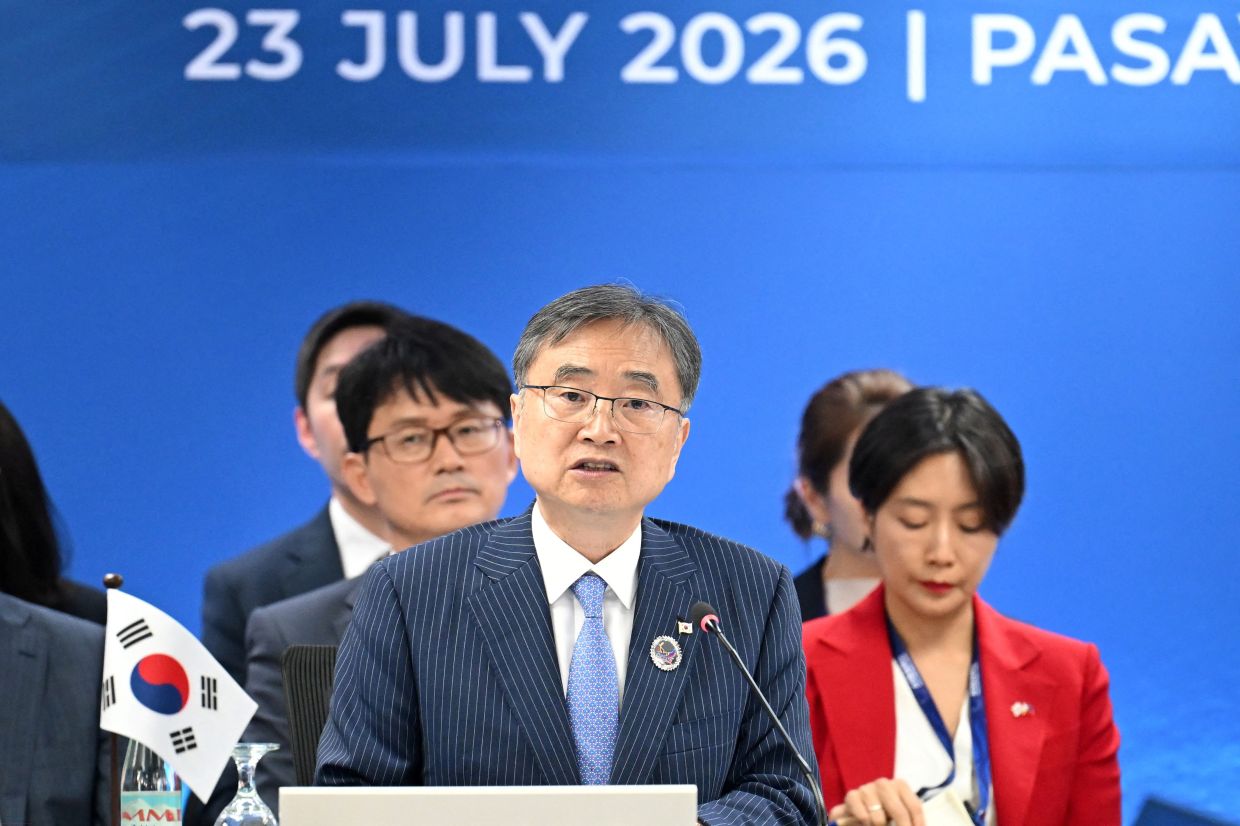
South Korea's Foreign Minister Cho Hyun and Unification Minister Chung Dong-young have openly clashed over how best to approach North Korea, exposing fractures within President Lee Jae Myung's government at a critical moment when Seoul is attempting to restore communication channels with Pyongyang after years of deteriorating relations. The public disagreement, which emerged following a Wednesday policy meeting chaired by Lee himself, threatens to undermine the administration's carefully calibrated effort to soften its posture toward the North and signal a willingness to engage.
Cho criticised Chung's ambitious engagement proposals as overly idealistic and premature, pointedly noting that the Foreign Ministry had not endorsed the plans and questioned whether they reflected any broader consensus within government. Speaking to reporters immediately after the meeting, Cho suggested that Chung's vision lacked the institutional backing necessary to be taken seriously by either domestic stakeholders or Pyongyang. The Foreign Minister's public rebuke was unusually sharp for a cabinet-level dispute, signalling deep disagreement rather than merely different emphases within a unified strategy.
Chung responded swiftly the following day, defending his approach and arguing that idealistic thinking was precisely what South Korea needed to fundamentally alter the current impasse with the North. His four-party dialogue proposal, which would bring together the two Koreas, the United States, and China, represented an attempt to create a multilateral framework that could move beyond the bilateral deadlock that has plagued the peninsula for years. Chung's insistence that ideals must precede practical results reflected a philosophical difference with Cho about whether Seoul should pursue incremental confidence-building or push for more transformative diplomatic initiatives.
The Unification Ministry's broader engagement strategy encompasses efforts to resurrect channels of communication that have atrophied during the pandemic years and beyond. This represents a significant philosophical shift from the previous conservative government's approach, which prioritised denuclearisation as a precondition for substantive engagement. Lee's administration has instead adopted what it terms a "peace-first" posture, betting that demonstrating goodwill and reducing hostile rhetoric might create space for dialogue without demanding nuclear concessions upfront.
Pyongyang's response to this strategic recalibration remains guarded and largely dismissive. Despite Seoul's deliberate dismantling of anti-North Korean propaganda broadcasts and other measures it characterises as hostile, the North has offered minimal reciprocation. This asymmetry in gestures, combined with the now-public disagreement between Seoul's two key North Korea policy ministries, creates precisely the kind of opening that Pyongyang has historically exploited to justify its own intransigence. Analysts note that visible internal South Korean divisions provide North Korea with justification for dismissing Seoul's overtures as insufficiently authoritative or likely to be reversed by future administrations.
The broader context of inter-Korean relations has darkened considerably since 2020. Kim Jong Un's 2024 declaration that Pyongyang would abandon the goal of reunification and his subsequent demolition of joint projects built during periods of warmer relations signal a fundamental hardening of North Korea's position. The practical consequences are stark: just 63 North Korean defectors crossed into South Korea during the first half of 2026, compared with 1,047 in 2019, indicating that Pyongyang has dramatically tightened border controls and security measures. This tenfold reduction in defections reflects not just improved surveillance but also desperation among North Korean civilians, who perceive fewer opportunities for escape.
Lee's pivot toward engagement has come at considerable cost to human rights advocacy organisations working on North Korean issues. By downplaying rights concerns in what the administration views as a pragmatic trade-off to avoid antagonising Pyongyang, Seoul has signalled that humanitarian advocacy is expendable in pursuit of diplomatic progress. The government's decision to suspend certain rights-related broadcasts and reports, coupled with its co-sponsorship of United Nations human rights resolutions that critics say lack teeth, has created a funding crisis for groups like PSCORE, which fights for human rights protections within North Korea itself.
The diplomatic pivot also represents a sharp departure from the approach favoured by Lee's immediate predecessor, whose administration maintained consistent pressure on Pyongyang while advancing a human rights agenda. Some conservative observers and rights advocates view the current strategy as morally compromised, arguing that trading away human rights concerns in exchange for uncertain diplomatic gains sets a troubling precedent. The philosophical tension between idealism and pragmatism that emerged in the Cho-Chung dispute reflects a deeper question about whether South Korea should pursue dialogue at almost any cost or maintain principled positions on governance and humanitarian issues.
Attempts by both the Foreign and Unification ministries to downplay the significance of their disagreement on Friday suggested that Seoul's leadership recognises the damage that public policy discord can inflict on international negotiations. Declining to offer further elaboration beyond promises of improved coordination, both offices sought to project unity while the underlying tensions remained unresolved. The Presidential Blue House's silence on the matter, offering no immediate commentary, further underscored the administration's sensitivity to perceptions of internal division at a moment when coherent strategic messaging is essential.
Lim Eul-chul, a professor specialising in Korean peninsula affairs at Kyungnam University, articulated the core problem: visible governmental disagreement about North Korea policy reinforces Pyongyang's longstanding suspicion that any South Korean concessions or agreements lack durability and could be reversed by subsequent administrations or even internal policy shifts. This perception of instability makes it rational for the North to avoid meaningful commitments, since leadership changes or bureaucratic disputes in Seoul might render such agreements obsolete. The vicious cycle of Seoul offering gestures that Pyongyang dismisses as insufficiently authoritative, leading to frustration in South Korean policy circles, has plagued inter-Korean relations for decades.
For Malaysia and Southeast Asia more broadly, the implications of this Korean peninsula stalemate extend beyond bilateral inter-Korean concerns. A renewed arms race on the peninsula, should diplomatic efforts fail entirely, would pull regional partners like Japan and potentially trigger destabilising competition for influence among major powers. Conversely, successful dialogue could reduce military tensions and create space for regional cooperation on issues ranging from trade to environmental management. The region's smaller powers have long viewed Korean peninsula stability as fundamental to their own strategic environment, making Seoul's diplomatic coherence a matter of more than parochial concern.
Lee's administration faces a difficult balancing act in coming weeks and months. It must simultaneously demonstrate commitment to genuine engagement with the North while maintaining sufficient internal coordination that Pyongyang recognises Seoul's negotiating positions as durable and authoritative. The public dispute between Cho and Chung, rather than being resolved through quiet bureaucratic adjustment, has now become part of the permanent diplomatic record, visible to both North Korean analysts and international observers. Whether the administration can recover strategic momentum after this setback, or whether it signals the beginning of a slow unravelling of the engagement strategy itself, remains uncertain.

