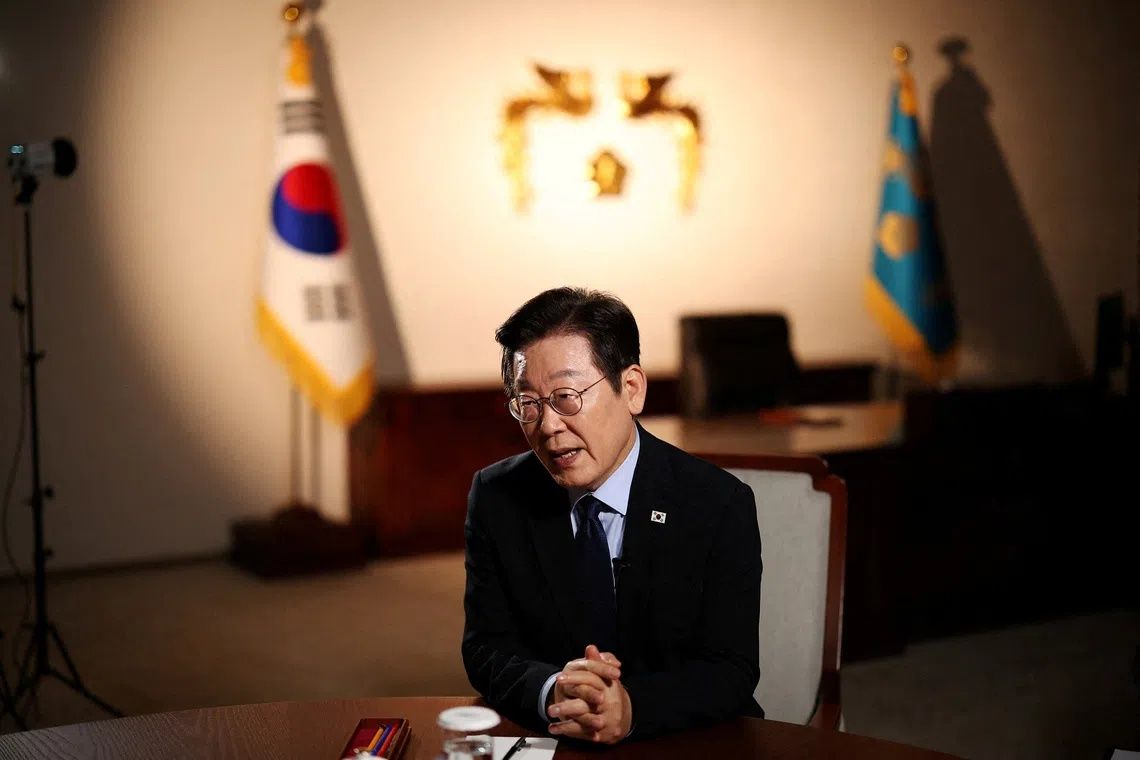
South Korean President Lee Jae Myung has expressed backing for a sweeping constitutional amendment that would permit presidents to serve consecutive four-year terms and pursue re-election, according to officials from the presidential Blue House who spoke to Yonhap news agency on Friday. The proposal represents a significant departure from South Korea's present governance structure, which confines leaders to a single five-year presidential term with no possibility of standing for office again. Lee's endorsement of this reform underscores the intensifying debate within Seoul about how to reshape executive power in one of Asia's most significant democracies.
Under the existing one-term-only system, South Korean presidents typically become politically diminished in their final years as they cannot pursue further electoral validation. This dynamic has historically contributed to questions regarding accountability and the concentration of authority during the twilight period of each presidency. Lee's proposed model attempts to balance this concern by introducing a mechanism that would theoretically encourage presidents to maintain public support throughout their tenure, as re-election would depend on demonstrated performance and sustained approval. The shift would also align South Korea's presidential system more closely with those found in other established democracies, where terms are typically shorter and re-election is permitted.
According to Blue House statements relayed through Yonhap, the four-year renewable term format enjoys the broadest acceptance among the South Korean public. This finding carries particular weight in a nation where opinion polling regularly influences legislative deliberations on constitutional matters. The official characterised the proposal as responsive to public preferences, suggesting that extensive polling and consultation had informed the presidential position. For Malaysian observers, the emphasis on public consensus reflects how even authoritarian-adjacent systems increasingly feel compelled to justify major constitutional alterations through appeals to democratic legitimacy.
Lee has simultaneously positioned his administration as addressing longstanding grievances about what critics describe as South Korea's "imperial presidency" — a system wherein the executive wields extensive powers that observers argue exceed those found in comparable democracies. By proposing to strengthen parliamentary authority alongside the presidential term reform, Lee attempts to reframe the discussion as one primarily concerned with diffusing excessive executive power rather than merely seeking personal political advantage through re-election eligibility. This dual-track approach represents shrewd political communication, linking individual institutional reform to broader systemic rebalancing.
The proposal to enhance parliamentary powers constitutes a crucial counterbalance within Lee's constitutional framework. Strengthening the National Assembly would theoretically constrain presidential overreach by expanding legislative capacity to check executive decisions, approve budgets independently, and scrutinise administrative actions. Such rebalancing has particular resonance in South Korea, where the legislature has historically struggled to impose meaningful constraints on presidential initiatives, especially when the same party controls both branches. For Southeast Asian nations observing this debate, the discussion illustrates how even consolidated democracies continue grappling with questions of institutional equilibrium.
Any constitutional amendment in South Korea requires surmounting a substantially high threshold of support. The Blue House official emphasised that modifications demand backing from at least 200 lawmakers within the 300-seat National Assembly, effectively necessitating broad cross-party consensus. This requirement serves as a structural brake on impulsive constitutional tinkering and ensures that fundamental institutional changes reflect genuine agreement across the political spectrum rather than momentary majorities. The official further underscored that such amendments must emerge through deliberate parliamentary processes, signalling that Lee's administration intends to pursue this reform through established channels rather than through executive decree or extraordinary measures.
The timing of Lee's expressed preference carries political significance. South Korea has experienced considerable constitutional turbulence in recent decades, with multiple amendments reflecting shifting power balances and political circumstances. The current single five-year term originated from the 1987 democratisation movement, which specifically rejected the longer multi-term presidencies associated with earlier authoritarian governments. Any proposal to alter this provision therefore necessarily engages with foundational historical narratives about South Korean democracy. Lee's framing of the reform as concerned with dispersing power rather than concentrating it attempts to navigate this politically sensitive terrain.
The proposal raises substantive questions about whether four-year renewable terms with strengthened parliamentary oversight genuinely redistributes authority or merely creates different dynamics of executive-legislative interaction. Critics might contend that permitting re-election could incentivise presidents to prioritise short-term popularity over long-term institutional health, potentially encouraging populist governance. Conversely, supporters argue that electoral accountability every four years would impose more consistent discipline on presidential conduct than the present system, wherein lame-duck status releases leaders from electoral considerations entirely.
For Malaysia and the broader Southeast Asian region, South Korea's constitutional debate offers instructive lessons about how established democracies navigate tensions between executive efficiency and institutional constraint. Malaysia's own ongoing discussions about constitutional reform and executive power occur within a context where neighbouring democracies like South Korea actively reexamine their fundamental institutional arrangements. The South Korean experience demonstrates that even relatively mature democracies continuously reassess whether their constitutional frameworks adequately balance competing values of effective governance, democratic representation, and protection against power concentration.
The National Assembly will ultimately determine whether this constitutional reform advances through parliamentary procedures. The requirement for substantial cross-party consensus means that Lee's personal advocacy, while significant, constitutes only one voice within a complex legislative negotiation. Opposition parties and civil society actors will certainly scrutinise the proposal, raising questions about motivations and practical consequences. The coming months will reveal whether this reform initiative gains sufficient traction to reshape South Korean governance or remains a presidential preference unrealised through parliamentary consensus.

