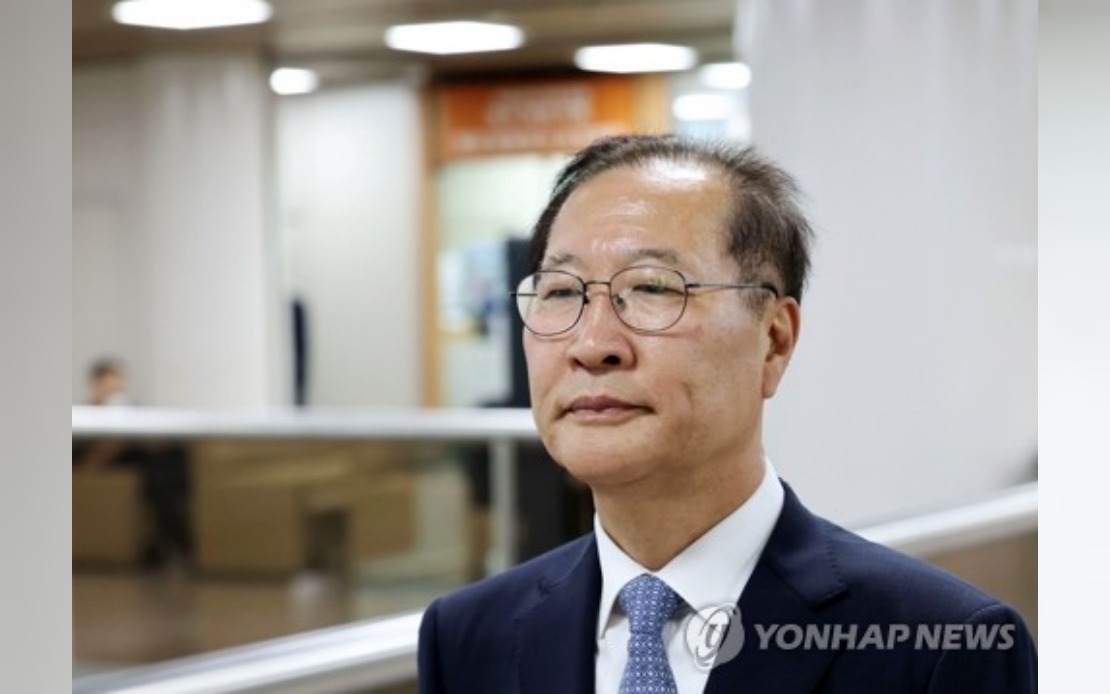
A South Korean court has delivered a decisive blow to former Justice Minister Park Sung-jae, imposing a 25-year prison sentence for his active participation in what authorities characterise as an insurrectional bid by then-President Yoon Suk Yeol. The Seoul Central District Court's ruling on Monday exceeded the prosecutor's own request for a 20-year term, underscoring judicial severity regarding the defendant's conduct during the constitutional crisis triggered by Yoon's martial law declaration on December 3, 2024.
The conviction brings another senior government official to account for their role in the failed power grab. Park now joins former Prime Minister Han Duck-soo and former Defence Minister Kim Yong-hyun among Yoon's cabinet members found guilty of participating in an insurrection—a grave constitutional offence that has exposed deep fractures within South Korea's political leadership and governance structures.
The court's detailed findings paint a picture of deliberate institutional manipulation. Prosecutors successfully convinced the judiciary that Park convened a high-level ministry meeting not merely to coordinate administrative responses to the martial law declaration, but specifically to facilitate the extralegal scheme. The evidence suggested Park sought to arrange for prosecutors to be deployed to bodies supporting the martial law regime, whilst simultaneously assessing prison capacity seemingly in preparation for mass arrests of political opponents and other key figures expected to be detained under emergency powers.
In its written judgment, the court articulated a fundamental principle regarding constitutional duty. The bench stated that Park "ultimately turned his back on his duty of upholding the Constitution at the idea that the insurrection could succeed, choosing instead to take part in it." This language carries profound implications for how South Korean jurisprudence evaluates official complicity in unconstitutional acts—the court essentially found that Park's calculations favoured political expediency over constitutional obligation.
The immediate placement of Park into custody following sentencing reflected judicial concern about evidence preservation. Courts often invoke this protective measure when defendants occupy positions that might afford them opportunity or inclination to influence witnesses or obstruct ongoing investigations. The move signals that authorities view Park's institutional access and administrative authority as continuing potential vulnerabilities.
The conviction on both insurrection and abuse-of-power charges provides legal scaffolding for understanding how the court conceptualised Park's wrongdoing. Rather than treating his actions as passive compliance with superior orders, the judiciary found active misuse of his ministerial position to further the insurrectional scheme. This distinction matters significantly for accountability frameworks—it establishes that cabinet ministers bear individual responsibility to resist unconstitutional directives, not merely to follow hierarchical chains of command.
Particularly noteworthy is the court's dismissal of additional anti-corruption charges related to Park's alleged interference with prosecution investigations into Kim Keon Hee, the former president's wife. The bench concluded these matters fell outside the special counsel's investigative jurisdiction, preventing prosecution on that dimension. This limitation underscores how jurisdictional boundaries can constrain accountability mechanisms, even when misconduct appears evident.
The case against Park reflected the special counsel team's broader prosecutorial strategy in addressing the martial law episode. By targeting multiple cabinet members with parallel charges, prosecutors have constructed a narrative demonstrating systemic governmental failure rather than isolated individual lapses. Each conviction reinforces the institutional nature of the constitutional violation and the breadth of complicity within executive circles.
Yoon himself received a life sentence in February 2024 for orchestrating the martial law decree, though he has lodged an appeal challenging that conviction. The progression of sentencing across different officials—from the president down through the cabinet hierarchy—illustrates how accountability mechanisms are working through the governmental structure, though the outcomes and appeal processes remain unsettled.
Park's legal team has signalled immediate intent to appeal, characterising the judgment as contradicting both factual evidence and legal precedent. This contestation will likely proceed through South Korea's appellate framework over coming months, potentially adding further chapters to a constitutional crisis that has already shaken public confidence in governmental institutions and democratic guardrails.
The implications extend beyond South Korea's borders, particularly for Southeast Asian observers monitoring institutional resilience and judicial independence. Countries across the region, including Malaysia, face comparable questions about constitutional safeguards against executive overreach and the role that professional institutions—including the judiciary and security apparatus—should play in resisting unconstitutional directives. Park's conviction establishes that mere compliance with orders from superior political authority provides no defence against charges of participatory insurrection, a principle with potential resonance throughout the region's ongoing democratic development.
For Malaysian observers, the case underscores how constitutional democracies must maintain robust institutional checks and how individual officials at every level bear personal accountability for constitutional violations. As South Korea navigates the aftermath of its martial law crisis, the cascading convictions of senior officials demonstrate that even prominent government figures cannot escape accountability when they choose political calculations over constitutional fidelity.