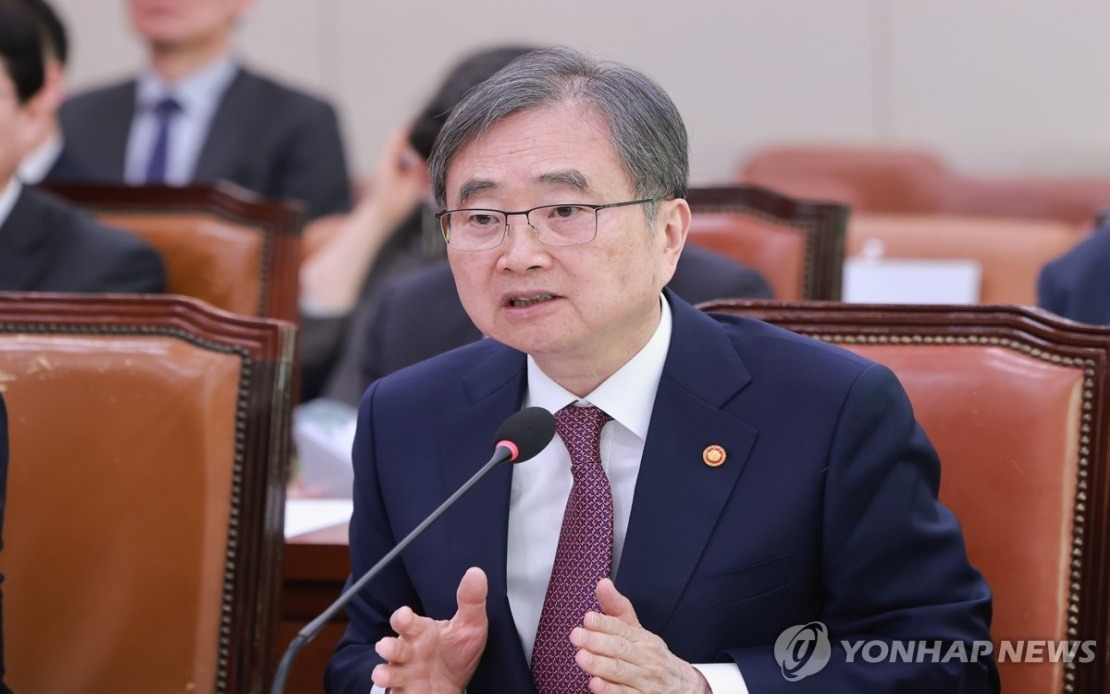
South Korea's diplomatic establishment experienced an unusual moment of international miscommunication when Foreign Minister Cho Hyun revealed that his government discovered plans to curtail combined military drills with the United States through President Donald Trump's social media announcement rather than through official channels. The disclosure, made during parliamentary testimony on Wednesday, underscores the increasingly unpredictable nature of top-level policy communications and raises questions about the coordination mechanisms between allied nations during periods of strategic tension in the Korean Peninsula.
Minister Cho provided detailed testimony to the parliamentary committee overseeing foreign affairs and unification, emphasising that officials at both Seoul and Washington had received no advance warning of Trump's intentions before the public announcement. The revelation highlights a significant breakdown in the customary protocols between allied governments, where major military policy shifts typically follow established notification procedures and diplomatic channels rather than public declarations on social platforms. The absence of such coordination, even between longstanding security partners, signals a departure from conventional practice that has governed South Korea-US relations for decades.
Defence Minister Ahn Gyu-back subsequently engaged in intensive consultations with American counterparts following the announcement, according to Cho's parliamentary statement. The Foreign Minister characterised these ongoing discussions as evidence that the situation should not be viewed as a unilateral directive imposed without dialogue, but rather as an emerging negotiation between defence establishments. This characterisation suggests Seoul's diplomatic effort to reframe what appeared initially as a surprising policy shift into a managed process of mutual adjustment, though the damage to procedural norms had already occurred.
The Ulchi Freedom Shield exercise, a major annual undertaking that brings together South Korean and American military personnel, ordinarily runs for eleven days spanning mid to late August. The Joint Chiefs of Staff announced that this year's iteration would be compressed to five days, running from August 17 to August 21 instead of the originally planned August 17 to August 27 timeframe. This reduction represents a significant abbreviation of what is traditionally one of the region's largest combined military operations, encompassing field manoeuvres, computer-simulated command post activities, and civil defence training components that simulate responses to various emergency scenarios.
Trump's initial announcement came on August 16, in which he stated that he had ordered the Pentagon to materially reduce the scale and scope of joint exercises involving South Korean and American forces. The subsequent visit by Xavier Brunson, Commander of the US Forces Korea, to Seoul's defence ministry building on Tuesday appeared to be damage control, with the commander presumably tasked with providing clarification and beginning the negotiation process that Defence Minister Ahn had referenced in his parliamentary testimony. This sequencing of events—public announcement followed by senior military official visit—suggests an uncoordinated rollout of policy that caught both governments' public-facing institutions off guard.
For Malaysia and other Southeast Asian nations, this episode carries implications that extend beyond the specific bilateral relationship between Seoul and Washington. The reduction in military exercises, particularly those that test command structures and civil defence capabilities, has psychological dimensions that ripple across the region. Countries throughout Southeast Asia monitor Korean Peninsula security developments closely, as escalations there could affect regional stability, alliance structures, and the balance of power that undergirds trading relationships and investment flows. When the primary external security guarantor of South Korea acts through social media rather than through established diplomatic protocols, it introduces uncertainty into calculations that regional nations depend upon for strategic planning.
The nature of the exercise reduction also merits examination within the broader context of Trump administration policy toward the Korean Peninsula. The Ulchi Freedom Shield is not merely a display of military capability but a demonstration of integrated defence planning between Seoul and Washington. Shortening it by roughly fifty percent potentially signals reduced emphasis on joint command and control procedures, civil defence coordination, and the routine integration of military operations that would be essential during any actual contingency. Regional observers, particularly those in Southeast Asia concerned with maritime security and freedom of navigation, may view such reductions as indicative of a shifting American strategic posture toward East Asian security commitments more broadly.
The incident also reflects contemporary challenges in government communications across diplomatic channels. Where once policies of this magnitude would develop through months of official dialogue, culminating in formal announcements coordinated between allied capitals, the modern media environment has compressed timelines and created pressure for public positioning that sometimes outpaces internal government alignment. Trump's use of social media to declare military policy demonstrates how technological change has disrupted traditional diplomatic processes, creating asymmetries of information that can strain relationships between even the closest allies.
South Korea's response has been measured, with officials attempting to normalise what was objectively an unusual occurrence. By emphasising that Defence Minister Ahn was consulting with American counterparts, Seoul sought to reestablish the narrative of managed bilateral coordination rather than allowing the perception of surprise unilateral action to dominate. This diplomatic reframing is itself significant—it reveals Seoul's interest in maintaining the appearance of orderly alliance management, even when the underlying processes have clearly malfunctioned. For countries throughout Southeast Asia that rely on American security commitments and the stability provided by alliance relationships, South Korea's deft handling of an awkward situation offers a model of how to respond when great power partners act unpredictably.
The compressed exercise schedule also carries practical implications for military readiness. Joint exercises serve training functions essential to interoperability between allied forces. Reducing the duration means less time for personnel rotation, less opportunity for command post exercises to unfold fully, and diminished scope for civil defence agencies to test integrated response procedures. These practical implications become more consequential in a region where the threat environment, particularly on the Korean Peninsula, remains active rather than merely theoretical. The strategic calculation behind Trump's directive to reduce exercise scope remains publicly unexplained, leaving room for speculation about whether cost considerations, broader foreign policy objectives, or other factors drove the decision.

