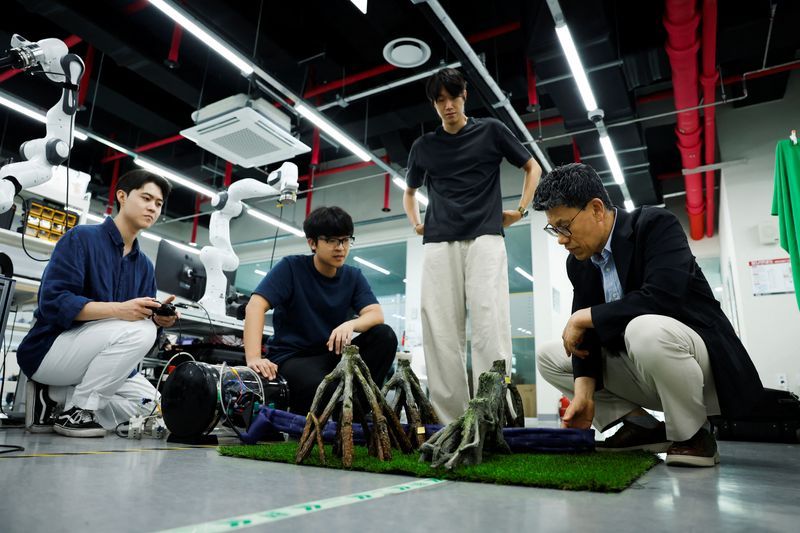
Scientists from South Korea's Korea Advanced Institute of Science and Technology (KAIST) and Stanford University have jointly developed a breakthrough robotic dressing system that enables individuals to don protective clothing without using their hands or requiring assistance from others. The innovation, unveiled in Daejeon, represents a significant advancement in wearable robotics with far-reaching implications for high-risk occupations and vulnerable populations across the region and globally.
The system operates through a network of soft, air-pressurised tubes embedded within garments that function similarly to climbing vines. When activated, these pneumatic channels guide fabric segments upward along the wearer's body through sustained air pressure, mimicking the natural growth pattern of ivy plants as they scale structures. The mechanism proves remarkably efficient, requiring merely ten seconds to envelop a wearer in a complete protective suit regardless of their physical positioning or movement. This speed and independence from static positioning represent significant practical advantages over conventional donning procedures.
The technological foundation stems from an everyday observation. Kim Nam Gyun, the project's lead researcher and a postdoctoral fellow at KAIST, conceptualised the solution while cycling through rain, recognising that automated garment deployment during active movement would solve genuine human problems. The vine robot accomplishes this by progressively turning the clothing inside-out as it advances, enabling the fabric to conform naturally to the wearer's body contours whilst maintaining structural stability. This elegant mechanical approach eschews complex algorithmic control systems, instead relying on straightforward pneumatic principles.
The technology's stability on curved surfaces and irregular terrain stems from its vine-like growth mechanism rather than wholesale body displacement. Ryu Jee-Hwan, a civil and environmental engineering professor at KAIST, emphasises that this approach permits the robotic system to navigate constricted spaces, maintain contact with varied surface textures—whether slippery, adhesive, or inclined—and adapt instantaneously to environmental geometry. This versatility addresses real-world deployment scenarios where controlled laboratory conditions cannot be assumed.
The potential applications span diverse sectors requiring rapid protective equipment deployment. Semiconductor manufacturing environments demand pristine cleanroom protocols where contamination from conventional dressing methods remains problematic. Emergency responders confronting hazardous situations benefit significantly from equipment that deploys without operator attention or manual manipulation. Medical professionals, laboratory technicians, and industrial workers handling toxic substances all represent potential beneficiaries of hands-free protective clothing systems that function during dynamic activities.
Beyond occupational safety, the research team recognises applications assisting elderly populations and individuals with mobility limitations. Traditional garment donning presents genuine obstacles for people with reduced upper-body strength, arthritic conditions, or paralysis-related disabilities. An autonomous dressing system could meaningfully enhance independence and dignity whilst reducing caregiver burden across ageing Southeast Asian societies facing rapid demographic transitions.
The innovation underscores an important counter-narrative to prevailing assumptions about technological progress. Ryu observes that artificial intelligence and software development dominate contemporary technological discourse and investment flows. However, this advancement demonstrates that mechanical engineering principles—refined through biomimicry and creative problem-solving—retain substantial capacity for delivering practical innovation. The vine robot exemplifies how observing natural systems and translating their principles into engineered solutions can produce elegant technologies that enhance human capability without computational complexity.
The research methodology itself reflects international scientific collaboration's enduring value. Combining KAIST's mechanical engineering expertise with Stanford's robotics development capabilities produced results neither institution might have achieved independently. This pattern of transpacific academic partnership remains increasingly relevant for Southeast Asian research institutions developing technological capacity and establishing themselves as regional innovation hubs.
The findings have been formally documented in IEEE Robotics and Automation Letters, a peer-reviewed publication ensuring scientific scrutiny and reproducibility. This rigorous validation pathway distinguishes genuine technological breakthroughs from speculative claims, establishing credibility within both academic and commercial sectors evaluating commercialisation potential.
Looking forward, several commercialisation pathways merit consideration. First-responder organisations across Southeast Asia managing industrial emergencies or hazardous material incidents could evaluate deployment protocols. Semiconductor manufacturers operating advanced fabrication facilities throughout the region represent concentrated potential customers. Healthcare facilities managing infectious disease containment or occupational safety represent another substantial market segment. The technology's simplicity and relatively modest pneumatic infrastructure requirements suggest manufacturing scalability without excessive capital investment.
The advancement also carries implications for emerging economies developing manufacturing competitiveness. Rather than pursuing labour-intensive garment production, Southeast Asian economies could position themselves as innovation leaders in robotic systems enhancing worker safety and productivity. Such value-added manufacturing builds technological sophistication whilst addressing genuine occupational health challenges affecting millions of regional workers.
As automation increasingly transforms workplace environments globally, solutions that enhance human safety and capability through human-centred design principles retain lasting value. This vine-inspired dressing system demonstrates that technology progress need not alienate human agency but can instead expand human possibility through thoughtful engineering that respects fundamental human needs and limitations.

