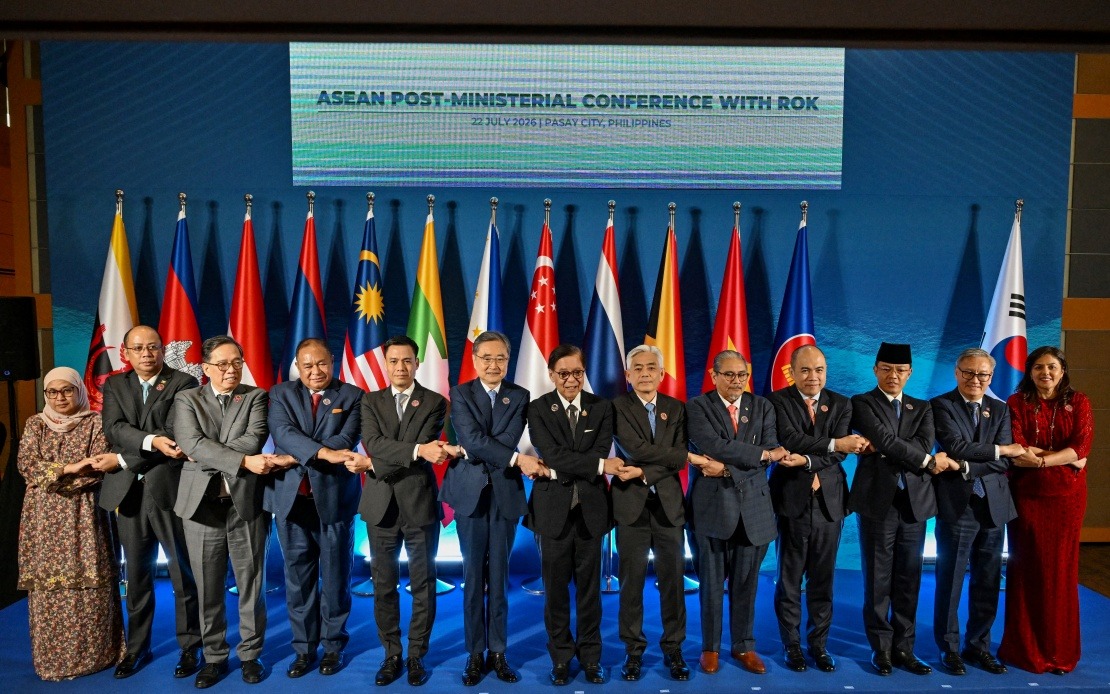
South Korea's Foreign Minister Cho Hyun and his Thai counterpart jointly presided over a Korea-ASEAN foreign ministers' gathering in Manila on Wednesday, where both sides committed to accelerating their Comprehensive Strategic Partnership and introduced fresh collaborative ventures in critical technology and creative sectors. The meeting, convened alongside broader ASEAN ministerial discussions, served as a platform for both parties to assess regional challenges and identify practical avenues for deepening substantive ties across multiple domains.
Chо characterised the evolving relationship between Seoul and the ten-member ASEAN bloc as one of mutual indispensability, particularly given the accelerating restructuring of global supply chains and the disruptive pace of technological advancement reshaping regional economies. He underscored that neither side can afford to navigate these transformative forces in isolation, advocating instead for intensified collaborative efforts to implement the partnership vision more comprehensively. This framing reflects Seoul's strategic calculation that the Southeast Asian region represents both a critical economic anchor and a geopolitical balancing mechanism in an increasingly multipolar Asia.
The partnership framework itself rests on three foundational pillars that President Lee Jae Myung formally introduced at last year's Korea-ASEAN summit. These pillars—people-centred cooperation, growth and innovation, and peace and stability—provide an institutional scaffold for bilateral engagement spanning trade, technological advancement, cultural exchange, and security considerations. By anchoring the relationship to these clearly articulated objectives, Seoul and ASEAN member states have created measurable benchmarks against which progress can be evaluated and accountability assessed.
The centrepiece of Seoul's new initiatives centres on artificial intelligence, where South Korea unveiled the Korea-ASEAN AI Partnership Initiative aimed at constructing robust AI ecosystems across the region. The programme emphasises three interconnected dimensions: nurturing the foundational infrastructure necessary for AI deployment, catalysing research endeavours and developing human capital equipped to navigate AI-driven economies, and establishing safeguards ensuring responsible and ethical AI utilisation. South Korea's positioning itself as a technology leader capable of transferring advanced AI knowledge reflects its broader strategy of leveraging technological prowess to deepen regional influence and create mutual dependencies in emerging sectors where it maintains competitive advantages.
Beyond artificial intelligence, Seoul introduced a complementary suite of initiatives targeting cultural and creative industries, a sector increasingly recognised as both economically significant and culturally influential in shaping regional soft power dynamics. South Korean entertainment, design, and creative content have already achieved substantial penetration across Southeast Asian markets, and formalising cooperation frameworks could amplify these gains while creating institutional mechanisms for deeper collaboration. The initiative reflects the contemporary understanding that cultural influence and economic interest are deeply intertwined in the modern global order.
Seoul additionally proposed establishing joint mechanisms to combat the escalating threat of online scam crimes, a challenge affecting all Southeast Asian economies and requiring coordinated intelligence sharing and law enforcement cooperation. The proposed maritime safety academy represents another practical initiative addressing shared vulnerabilities in a region crisscrossed by crucial shipping lanes and facing increasingly complex maritime security challenges. These proposals demonstrate Seoul's willingness to address concrete regional challenges rather than confining cooperation to abstract strategic frameworks.
ASEAN member states responded positively to these proposals, signalling their receptiveness to deepening engagement across the entire spectrum of cooperation. The diplomatic exchange reflected broader acceptance that while regional challenges—from supply chain disruptions to technological transformation—are formidable, collaborative approaches offer superior outcomes to unilateral posturing. This consensus creates momentum for translating announced initiatives into functional programmes capable of delivering tangible benefits to participating nations.
Economic cooperation remains foundational to the broader partnership, with particular emphasis on recalibrating the bilateral free trade agreement to accommodate contemporary priorities. Last month, Seoul and ASEAN commenced formal negotiations to upgrade their FTA framework, reflecting recognition that the original agreement structure signed between 2006 and 2009 requires modernisation to address digital economy dynamics, supply chain diversification imperatives, and emerging sectors beyond traditional goods and services. The original FTA architecture—addressing goods in 2006, services in 2007, and investment in 2009—predates the transformative technologies and geopolitical circumstances now defining regional economic engagement.
The scale of bilateral economic integration underscores the partnership's material foundation. South Korea's 2025 exports to ASEAN member states reached approximately US$122.5 billion, positioning ASEAN as Seoul's third-largest trading partner globally. This substantial commercial relationship generates powerful incentives for both sides to resolve disputes pragmatically and identify new collaboration opportunities that benefit multiple stakeholders. Trade figures of this magnitude create extensive networks of business interests invested in relationship stability and expansion.
Foreign Minister Cho also utilised the multilateral platform to solicit ASEAN's continued diplomatic support for Seoul's approach to Korean Peninsula relations, emphasising Seoul's commitment to peaceful coexistence and shared economic advancement with North Korea. ASEAN member states reiterated their support for Seoul's peninsular policy, acknowledging that stability on the Korean Peninsula carries direct implications for broader regional peace. This mutual endorsement reflects the understanding that Korean Peninsula developments can generate ripple effects throughout East and Southeast Asia, affecting security calculations and economic prospects across the wider region.
Beyond the comprehensive Korea-ASEAN forum, Foreign Minister Cho conducted bilateral consultations with counterparts from individual ASEAN member states, including the Philippines and Thailand. These separate engagements permitted more focused discussions of bilateral priorities and shared challenges specific to particular country relationships. The dual-track approach—combining multilateral coordination with bilateral depth—represents sophisticated diplomacy capable of addressing region-wide concerns whilst accommodating individual member state interests and circumstances.
The Manila gathering exemplifies contemporary regional diplomacy's complexity, where traditional alliance structures coexist with pragmatic coalition-building around specific shared challenges. Neither Seoul nor ASEAN member states operate within rigid blocs anymore; instead, they assemble flexible coalitions organised around particular objectives—AI development, maritime safety, supply chain resilience—whilst maintaining strategic autonomy. This format permits cooperation without demanding ideological uniformity or exclusive commitments, an arrangement increasingly characteristic of post-Cold War regional interaction patterns.

