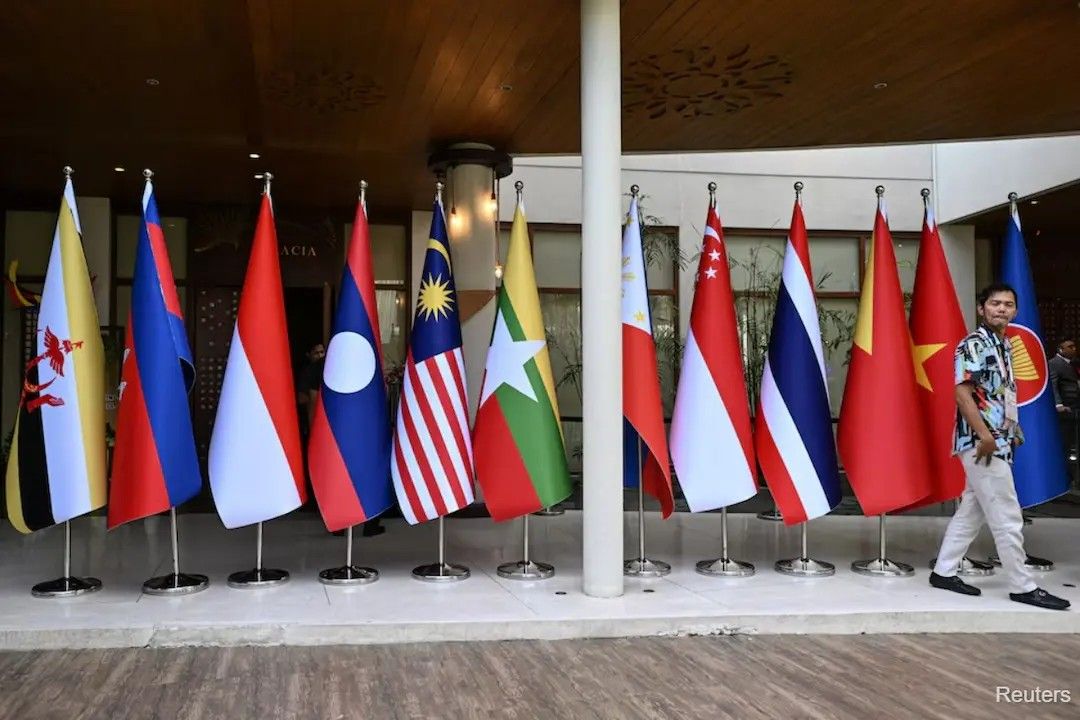
Southeast Asian foreign ministers gathered in Manila this week amid mounting friction over the South China Sea, where a confrontation between Philippine and Chinese vessels has reignited longstanding territorial disputes and complicated efforts to establish regional stability. The United States wasted no time signalling its concerns, with Secretary of State Marco Rubio arriving in the Philippines and immediately condemning what he termed "dangerous" Chinese conduct in the contested waterway—a stark reminder that great power competition continues to frame the diplomatic landscape across the region.
Rubio's presence underscores Washington's determination to maintain its strategic foothold in Southeast Asia, particularly regarding the principle of freedom of navigation through one of the world's most economically vital shipping lanes. In an opinion piece released on the day of his arrival, the Secretary of State articulated American concerns with unusual directness, warning that if the South China Sea fell under the dominion of a state prepared to weaponise trade relationships, both the United States and ASEAN nations would confront unprecedented threats to their sovereignty and prosperity. This rhetorical framing makes transparent what has long been implicit in American regional strategy: the contest over Southeast Asia is fundamentally about preventing Chinese hegemony from reshaping the international order in ways inimical to American interests and allied security.
The timing of Rubio's remarks proved particularly pointed given that they followed a serious maritime clash between Philippine and Chinese personnel at Second Thomas Shoal, a contested feature in the disputed waters. Manila accused China Coast Guard officers of physically assaulting Filipino sailors stationed aboard a grounded vessel that functions as a de facto military garrison, while Beijing portrayed Philippine actions as the provocation, claiming that Manila had dispatched small rubber boats in a confrontational approach toward Chinese vessels. This incident represents the first significant seaborne confrontation in several months, suggesting that the underlying tensions have not cooled but merely lay dormant, awaiting the next spark to reignite more serious exchanges.
Despite these escalating tensions, Rubio indicated openness to a possible bilateral meeting with China's foreign minister Wang Yi during the Manila gathering, signalling that even as Washington takes a harder rhetorical line, the door to dialogue remains ajar. This measured approach reflects the delicate balance required in Southeast Asian diplomacy, where multiple actors seek to avoid outright confrontation whilst protecting their respective interests. The mere prospect of such talks, however, underscores how precarious the regional equilibrium has become, with even routine diplomatic engagement acquiring heightened significance.
One enduring source of friction hindering regional cooperation remains the elusive Code of Conduct between ASEAN and China for the South China Sea. This agreement, pursued for years, has consistently failed to materialise into a binding framework with genuine enforcement mechanisms, leaving analysts skeptical that current negotiations will yield anything more substantive than earlier iterations. Beijing's claims to nearly the entire waterway, despite an international arbitration ruling that explicitly rejected the legal foundation of those assertions, continue to poison discussions and prevent the kind of confidence-building measures that might reduce the risk of accidental escalation between rival powers.
Beyond maritime disputes, the Philippines faces acute vulnerabilities stemming from its dependence on imported energy, vulnerabilities that have grown more acute following regional instability in the Middle East. The country declared a national energy emergency in March and has been compelled to expand its fuel sourcing in unconventional directions, including substantial oil purchases from Russia—a geopolitical departure that reflects how global disruptions cascade through the region. This week's agenda includes renewed emphasis on energy security collaboration, particularly surrounding the ratification of ASEAN's Framework Agreement on Petroleum Security, which envisions coordinated fuel-sharing mechanisms to provide member states greater resilience against supply shocks.
Paralleling these immediate concerns looms the question of Myanmar's political isolation and the humanitarian catastrophe unfolding within its borders following the 2021 military coup. The country's membership status within ASEAN remains suspended from high-level summits, creating both diplomatic strain and a painful inconsistency with the bloc's founding principle of non-interference. Thailand, which shoulders enormous burdens hosting millions of Myanmar refugees and managing a porous border, has championed efforts toward Myanmar's reintegration, with Thai Foreign Minister Sihasak Phuangketkeow recently suggesting that Myanmar's leader Min Aung Hlaing might visit Thailand in August. Sihasak argued that after five years of isolation, dialogue and explanation had become essential, reflecting Bangkok's pragmatic view that engagement offers better prospects than continued exclusion.
Yet this reintegration push has encountered significant resistance from other ASEAN members who remain troubled by Myanmar's failure to progress toward the bloc's five-point peace plan, which has languished without meaningful implementation since its adoption years ago. Malaysia, through Foreign Minister Mohamad Hasan, has explicitly stated that resuming high-level dialogue while "oppression is still taking place" within Myanmar represents a moral capitulation that Kuala Lumpur cannot endorse. This discord reveals the underlying tension within ASEAN between members inclined toward pragmatic engagement and those demanding that Myanmar demonstrate concrete improvements in governance and human rights before normalisation occurs.
The divergence of views on Myanmar reflects deeper structural challenges within ASEAN as an institution, where consensus-based decision-making increasingly struggles against the reality that member states possess fundamentally different strategic interests and values. Thailand's geographic proximity to Myanmar and its substantial refugee population create imperatives that Singapore or Malaysia may not experience with equivalent urgency, whilst Malaysia's electoral politics and public opinion may constrain its leadership differently than Bangkok's approach. These internal fissures have implications far beyond Myanmar itself, suggesting that ASEAN's capacity to formulate unified positions on strategic matters remains constrained by this heterogeneity of interests.
The convergence of these multiple crises—maritime tensions with China, Myanmar's ongoing civil conflict, energy insecurity, and the broader contest for regional influence between the United States and Beijing—reveals Southeast Asia's position as a zone of acute geopolitical vulnerability. The Manila gathering represents an opportunity for ASEAN to demonstrate collective agency, yet the evidence suggests that the bloc remains fragmented by competing priorities and unable to articulate positions that fully address the interests of all member states simultaneously. Whether this week's discussions yield genuine breakthroughs or merely rehearse familiar positions will reveal much about ASEAN's future trajectory and its capacity to shape outcomes rather than merely respond to pressures imposed by more powerful external actors.

