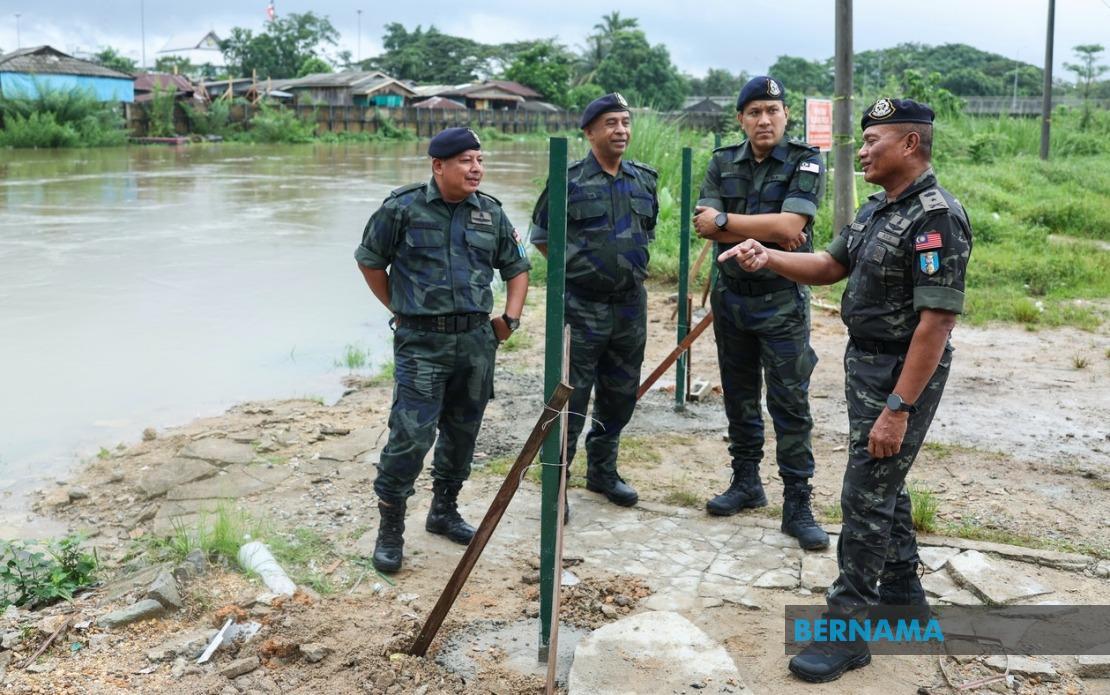
Security forces in Kelantan have exposed an evolving smuggling strategy that underscores the sophistication of human trafficking networks operating across Malaysia's northern border. When the General Operations Force (GOF) conducted Operasi Taring Wawasan Kelantan in Pasir Mas, officers discovered that migrant smugglers have fundamentally altered their approach, shifting from transporting large groups in vehicles to dispersing undocumented arrivals across forest routes in smaller clusters. This methodological change represents a tactical response to intensified border patrols and represents a challenge that security agencies must continually adapt to counter.
The operation that revealed this pattern occurred early on June 28, when GOF personnel acting on advance intelligence intercepted a Proton Exora in Kampung Banggol Kemian. When the vehicle's driver spotted security forces approaching, he abandoned the automobile and fled into nearby forest, successfully evading capture. The initial search of the vehicle yielded four Myanmar nationals occupying the rear seats, all unable to produce legitimate travel documentation. However, the operation's true scope became apparent only after subsequent sweeps of the surrounding forest terrain.
Within approximately one hour of the initial vehicle intercept, security personnel located nine additional Myanmar nationals scattered throughout the forest vicinity. These individuals had apparently only recently crossed into Malaysian territory through illegal border crossing points. The coordinated discovery of these separate groups provided the crucial evidence that allowed authorities to understand the new smuggling methodology. All thirteen detainees, ranging in age from twenty to thirty-seven years old, gave consistent accounts of how they had been transported into the country, providing security officials with rare insight into current operational practices.
According to Southeast Brigade GOF commander SAC Ahmad Radzi Hussain, the arrested individuals disclosed that they had been brought from Thailand across the Golok River by two unidentified facilitators. Rather than being delivered directly to their intended destination, the migrants were deliberately dropped off in stages across forested areas, a deliberate strategy designed to minimize the visibility of any single transported group. By fragmenting the movement of people into the country, the syndicate effectively reduces the operational footprint that might alert security personnel monitoring roads and checkpoints. This dispersal approach represents a meaningful evolution in smuggling tactics that prioritizes survival over efficiency.
The strategic rationale behind this new dispersal methodology becomes clear when examining the enforcement landscape along Malaysia's porous northern border. Large convoys of migrants traveling together on Malaysian roads present obvious targets for routine traffic patrols and checkpoint operations. By contrast, smaller groups moving through forest corridors and appearing at disparate locations create a much more diffuse detection problem. Security forces cannot easily identify a coordinated smuggling operation when migrants surface at separate times and locations. The adaptation demonstrates how criminal networks continuously learn from enforcement actions and adjust their methods accordingly.
The intelligence that initially prompted the GOF operation suggests that information networks within both smuggling and enforcement communities remain robust. Security forces receive tips from various sources regarding suspicious activity, and acting on such intelligence proved effective in this instance. However, the subsequent dispersal of migrants across the forest indicates that smugglers were aware of potential interception and had implemented contingency procedures. This cat-and-mouse dynamic characterizes border security challenges throughout Southeast Asia, where criminal entrepreneurship consistently matches or exceeds enforcement sophistication.
All thirteen arrested Myanmar nationals reportedly intended to seek employment in the Kuala Lumpur area, representing a broader pattern of migration flows toward Malaysia's economic heartland. Myanmar nationals, along with other undocumented migrants from across the region, continue to view Malaysia as a destination offering employment opportunities unavailable in their countries of origin. This economic motivation sustains the demand for smuggling services, ensuring that syndicates can continue operating as long as wage differentials and employment gaps persist between Myanmar and Malaysia. Understanding these push-pull factors is essential for crafting comprehensive responses to irregular migration.
Beyond the human trafficking dimension, the operation also yielded material evidence of smuggling infrastructure. Authorities seized the Proton Exora vehicle, valued at approximately thirty thousand ringgit, which had been actively employed in transporting undocumented persons. Such vehicle seizures, while significant in individual enforcement actions, represent only a fraction of the transportation assets deployed by organized smuggling networks. Criminal organizations can relatively easily acquire replacement vehicles, making asset seizure an incomplete deterrent. More consequential enforcement would require disrupting the financial structures and command hierarchies that enable systematic smuggling operations.
The handling of arrested individuals followed established legal procedures, with all thirteen Myanmar nationals transferred to the Criminal Investigation Division of the Pasir Mas district police headquarters. Subsequent investigations proceeded under Section 6(1)(c) of the Immigration Act 1959/63, the relevant statutory framework for prosecuting immigration violations. The involvement of the CID alongside GOF personnel demonstrates coordinated operational practices between specialized enforcement agencies. However, the consistent accounts provided by detainees regarding their transportation methods suggest that questioning and evidence collection efforts may yield intelligence regarding the unidentified facilitators who organized their movement.
The discovery of this smuggling tactic adaptation carries implications extending beyond Kelantan's borders. If syndicates operating along the Thai-Malaysia frontier have shifted to small-group dispersal methods, similar practices may have been adopted by networks operating along other regional borders. Intelligence sharing among Southeast Asian security agencies becomes increasingly important in this evolving environment. Malaysia's position as both a transit and destination country for irregular migrants places it at the intersection of complex regional migration flows, requiring sophisticated enforcement strategies and regional cooperation frameworks.
Looking forward, the security implications of this tactical shift suggest that enforcement agencies must invest in intelligence capabilities and forest surveillance technologies capable of detecting dispersed movement patterns. Traditional checkpoint-based enforcement, while important, becomes less effective when smugglers deliberately avoid transportation networks. Mobile and forest-based patrol strategies, potentially enhanced by technology, represent necessary adaptations. Additionally, addressing the root causes sustaining demand for smuggling services—particularly wage gaps between Myanmar and Malaysia—requires complementary policy responses addressing economic disparities across the region.

