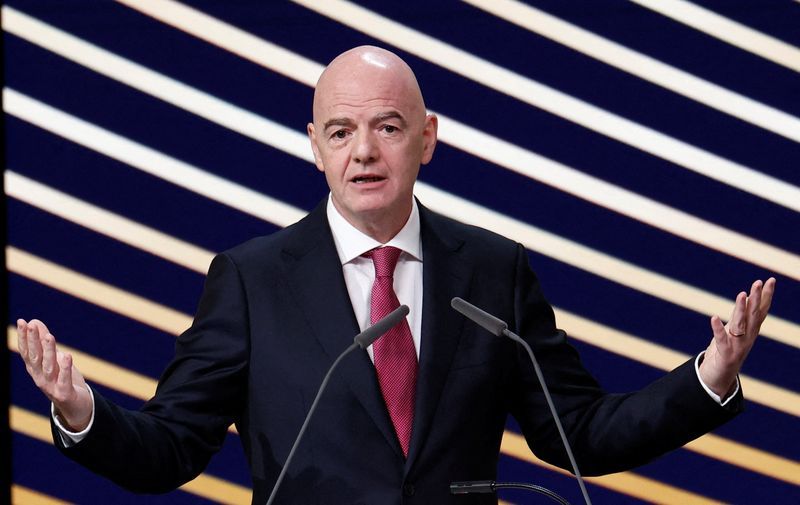
Gianni Infantino's efforts to secure a fourth term as FIFA president hinge not on reconciling with European heavyweights or established football powers, but rather on maintaining the loyalty of smaller and developing nations that have become deeply reliant on the world body's financial support. The Swiss administrator confronts an unprecedented political storm following the collapse of his proposal to introduce private equity investment into the World Cup, which triggered formal withdrawals of confidence from UEFA and CONCACAF—two of FIFA's six continental confederations representing dozens of member nations.
The crisis deepened this week when Wales became the first national football federation to publicly withdraw its backing for Infantino, while UEFA simultaneously notified him of potential legal proceedings related to the failed equity scheme. These developments underscore the severity of the challenge facing the FIFA chief, whose decade-long tenure has generally been characterized by significant spending on football development worldwide. Yet beneath the surface of his ambitious spending programmes lies a potentially fragile political foundation heavily dependent on the votes of smaller nations with limited football infrastructure and minimal independent financial resources.
The mechanics of FIFA governance create both vulnerability and opportunity for Infantino. With 211 member associations each possessing one vote, regardless of economic capacity or footballing stature, any coalition seeking his removal would need to request an Extraordinary Congress with signatures from at least 20 per cent of the membership. Such a congress must convene within three months of the request, theoretically allowing rival candidates time to mobilize. UEFA's 55 European members alone could theoretically trigger such a congress through unanimous action, and they have already signalled serious consideration of this path after their membership voted to boycott all FIFA competitions if the private equity investment proceeded.
However, translating formal opposition into actual votes for removal presents a markedly different proposition. Wealthy football nations with established professional leagues and global broadcasting agreements can absorb disruptions to their competitive schedules and enjoy influence regardless of FIFA's patronage. The true constituency upon which Infantino's political survival appears to rest comprises nations like Bhutan, Vanuatu, and dozens of others across Africa, Asia, the Caribbean and the Pacific region—countries whose football development depends almost entirely on FIFA's financial interventions and whose participation in international competitions would be severely compromised without this institutional support.
The financial incentives binding these smaller nations to Infantino are substantial and tangible. During the current 2023-26 World Cup cycle, FIFA members have accessed up to three million dollars for soccer development projects—an increase of one million dollars compared to the previous cycle. For wealthy nations with extensive domestic football infrastructure, this represents minimal resource allocation, yet for developing countries with limited tax bases and competing priorities for public expenditure, FIFA funding often determines whether national football programmes can function at all. These grants have financed training facilities, stadium construction, coaching development programmes, and international competition participation that would otherwise remain beyond reach.
Vanuatu exemplifies how thoroughly small nations have integrated FIFA patronage into their football ecosystems. The Pacific island nation, ranking 160th globally in football rankings, received a four-point-one-five-million-dollar development grant enabling construction of a six-thousand-five-hundred-seat stadium in the capital Port Vila, completed in 2022. Beyond financial support, Vanuatu has obtained institutional representation through its football association president securing one of eight vice-presidential positions on FIFA's Executive Council—a seat at the global governance table that would be unimaginable without Infantino's deliberate elevation of smaller nations' voices within FIFA's power structures. For Brian Kaltak, Vanuatu's first professional footballer playing defence for Perth Glory in Australia, the transformation represents a fundamental shift in his country's standing within global football.
This pattern replicates across developing football regions. African confederations, Asian associations, and Caribbean federations have benefitted from FIFA's infrastructure investment and competition funding under Infantino's tenure. Training grounds, gymnasium facilities, and coaching education programmes financed through FIFA grants have become foundational to national football operations in countless smaller nations. The investment model reflects a deliberate strategic choice by Infantino to build political capital among the numerical majority of FIFA's membership by demonstrating tangible developmental commitment to countries historically marginalized within football's global hierarchy.
For critics of FIFA's governance structure, this financial interdependency model exemplifies a troubling pattern wherein development funding effectively functions as political currency. By concentrating financial authority within FIFA's executive apparatus while distributing benefits to nations dependent on that authority for their football survival, the system creates structural incentives discouraging challenge to incumbent leadership. A president facing criticism from traditional football powers faces minimal vulnerability if that president simultaneously controls resources essential to smaller nations' football programmes. The mechanism reinforces hierarchical power dynamics while disguising them within ostensibly charitable development initiatives.
Infantino appears acutely conscious of where his political interests lie. Rather than expending political capital attempting reconciliation with European football establishments or major football nations capable of fielding competitive World Cup teams, his strategic focus has evidently shifted toward consolidating support among smaller nations whose votes collectively constitute a majority of FIFA's membership. The Wales withdrawal and UEFA's legal threats, while symbolically significant, do not necessarily translate into the parliamentary majority required to remove him from office. Even if all of Europe's 55 members voted for his removal at an Extraordinary Congress, they would need additional support representing more than fifty per cent of FIFA's remaining membership.
The political arithmetic becomes substantially more challenging when considering that smaller nations have demonstrably benefitted from Infantino's approach to FIFA resource distribution and governance reform. Many possess leadership figures whose international prominence derives largely from their FIFA positions and representation opportunities. For a football association president in a developing nation, FIFA representation often represents the highest profile international position available. These individuals have structural incentives to maintain the system that elevated them and provided their countries unprecedented access to football development resources. Building a coalition capable of attracting sufficient votes to remove Infantino would require convincing nations to vote against their own institutional interests and financial benefits.
The private equity proposal itself may ultimately prove less significant to Infantino's political fate than the underlying power dynamics it exposed. The proposal attempted to monetize World Cup rights and inject external capital into FIFA's operations—a fundamentally structural challenge to how FIFA functions and distributes resources. Infantino's willingness to propose such radical restructuring suggests either confidence in his political control or miscalculation regarding opposition from traditional football powers. The subsequent backlash demonstrates that European confederations and established football nations retain sufficient power to block initiatives affecting their interests, yet Infantino's capacity to maintain office despite this opposition depends on factors beyond Europe's control.
The immediate timeline for resolution remains uncertain, but pressure may intensify before the scheduled FIFA Congress in April when Infantino intends to formally announce his candidacy. Any movement toward an Extraordinary Congress would follow within months, potentially during a FIFA calendar containing important competitions and development initiatives—precisely the moment when smaller nations would be most conscious of their dependence on FIFA institutional support. The convergence of political crisis and the practical logistics of international football governance creates a compressed timeline within which fundamental questions about FIFA's leadership will be resolved, yet resolved through mechanisms reflecting the organization's fundamental structural characteristic: one nation, one vote, regardless of football tradition, infrastructure, or economic capacity.

