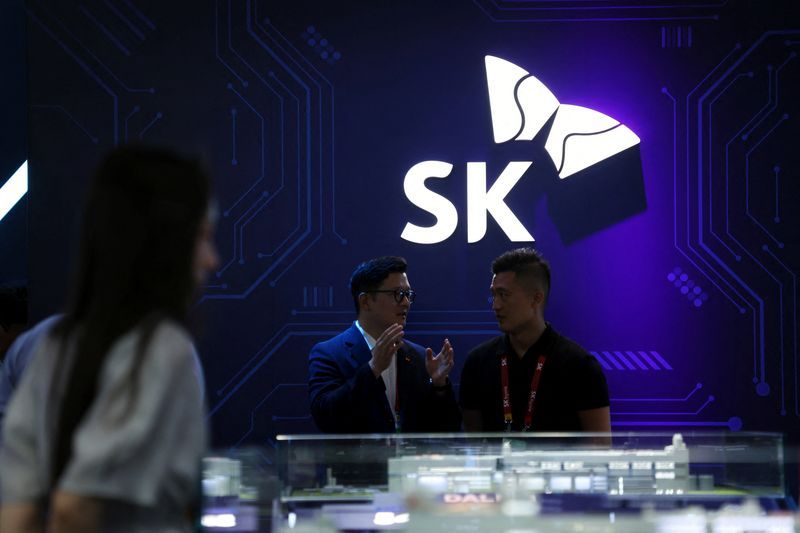
South Korea's memory chip giant SK Hynix revealed an ambitious capital-raising plan on Wednesday, announcing intentions to list American Depositary Receipts on the Nasdaq stock exchange and secure up to 45.45 trillion won ($29.43 billion) in fresh funding. The move marks a strategic pivot toward international investors and reflects the chipmaker's confidence in commanding premium valuations at a time when artificial intelligence applications are reshaping global semiconductor demand. The listing, scheduled for July 10, will generate capital needed to accelerate production expansion and technological advancement in an increasingly competitive global marketplace.
The company plans to issue 17.79 million new shares as the foundation for the ADR listing, with the structure pegging ten ADRs to one common share. This arrangement allows American and international investors to purchase shares in dollar denominations without dealing directly with Korean won-denominated securities, thereby broadening SK Hynix's shareholder base considerably. The pricing range remains subject to change during the bookbuilding process, a standard feature in major public offerings where underwriters gauge investor demand and refine valuations accordingly. The final offer price will emerge from discussions between the company and its banking syndicate, led by BofA Securities, Citigroup Global Markets, Goldman Sachs, and JP Morgan Securities.
SK Hynix has earmarked the proceeds for critical infrastructure investments designed to strengthen its competitive position in memory semiconductors. A substantial portion will fund construction of a new chip fabrication facility in Yongin, a city south of Seoul that has become a key hub for semiconductor manufacturing. Additionally, the company plans to build an advanced packaging fabrication plant in Cheongju, located in central South Korea. These physical investments will be complemented by purchases of cutting-edge manufacturing equipment, most notably Extreme Ultraviolet Scanners, which represent the frontier of chipmaking technology and enable production of the most advanced semiconductor nodes.
The scale of this fundraising endeavor would eclipse previous capital market records if completed at the upper end of the targeted range. Should SK Hynix achieve the full $29.43 billion figure, the offering would surpass Alibaba's 2014 New York stock exchange debut, which had raised $21.8 billion and held the record for largest ADR offering for nearly a decade. This milestone would underscore how semiconductor companies have ascended to occupy a place alongside technology giants in global capital markets, reflecting their indispensable role in powering the digital economy.
The timing of this listing reflects SK Hynix's transformation into one of the primary beneficiaries of the worldwide artificial intelligence revolution. The company supplies high-bandwidth memory chips essential for AI computing systems, with major customers including Nvidia, the dominant designer of AI processors, and Alphabet's Google, which integrates advanced chips into its cloud infrastructure and consumer services. These memory components represent bottleneck technology in AI deployments—without sufficient high-bandwidth memory capacity, even the most powerful AI processors cannot deliver their full potential performance. This strategic positioning has made SK Hynix indispensable to leading technology companies racing to expand AI capabilities.
The surge in SK Hynix's corporate valuation demonstrates how semiconductor competence translates into market power during transformative technology transitions. The company achieved a historic milestone this week by becoming South Korea's most valuable enterprise, surpassing Samsung Electronics, a conglomerate that has dominated the nation's stock market for decades. This transition reflects both SK Hynix's soaring profitability from AI-related memory chip sales and broader recognition that specialized memory semiconductors command higher valuations than diversified electronics manufacturing. For Malaysian investors and regional observers, the development signals how Southeast Asia's technology sector must position itself within global supply chains for advanced semiconductors.
The ADR structure carries particular significance for international capital flows and investor accessibility. Many American pension funds, university endowments, and asset managers maintain restrictions on directly purchasing foreign-listed securities, making ADRs an essential vehicle for channeling Western capital into Asian technology companies. By listing ADRs on the Nasdaq, SK Hynix opens itself to this enormous pool of institutional capital while maintaining its primary listing on the Korea Exchange. This dual-listing approach has become standard practice for major technology companies seeking simultaneous access to Korean domestic investors and Western international capital markets.
Regional implications for Southeast Asia merit careful consideration. SK Hynix's aggressive expansion reflects confidence that AI-driven demand for memory semiconductors will remain robust for years, justifying massive capital expenditure on new factories and equipment. However, the company's success also highlights how regional semiconductor ecosystems outside South Korea and Taiwan face challenges in competing for advanced chip manufacturing. Malaysia hosts numerous semiconductor testing, assembly, and packaging facilities, but advanced fabrication and design capabilities remain concentrated in a handful of global locations. The competitive intensity demonstrated by SK Hynix's expansion strategy underscores pressures facing regional chipmakers to specialize in segments where they maintain genuine advantages.
The underwriting consortium selected for this offering represents a who's who of global investment banking, reflecting the transaction's magnitude and strategic importance. BofA Securities, Citigroup Global Markets, Goldman Sachs, and JP Morgan Securities collectively bring unparalleled expertise in technology sector capital raising and international investor relations. Their involvement signals confidence in SK Hynix's business fundamentals and the sustainability of AI-driven semiconductor demand. These institutions will leverage extensive networks across American institutional investors, sovereign wealth funds, and private capital sources to distribute the offering successfully.
Looking forward, SK Hynix's capital-raising initiative will likely catalyze further consolidation and investment announcements within the global semiconductor industry. Competitors will feel pressure to accelerate their own expansion plans, potentially triggering increased competition for manufacturing equipment supplies and engineering talent. Samsung Electronics and other Korean chipmakers may unveil their own major capital programs to avoid competitive disadvantage. For emerging economies in Southeast Asia considering semiconductor industry development, SK Hynix's confident expansion underscores both the opportunities and formidable challenges in this strategically vital sector.