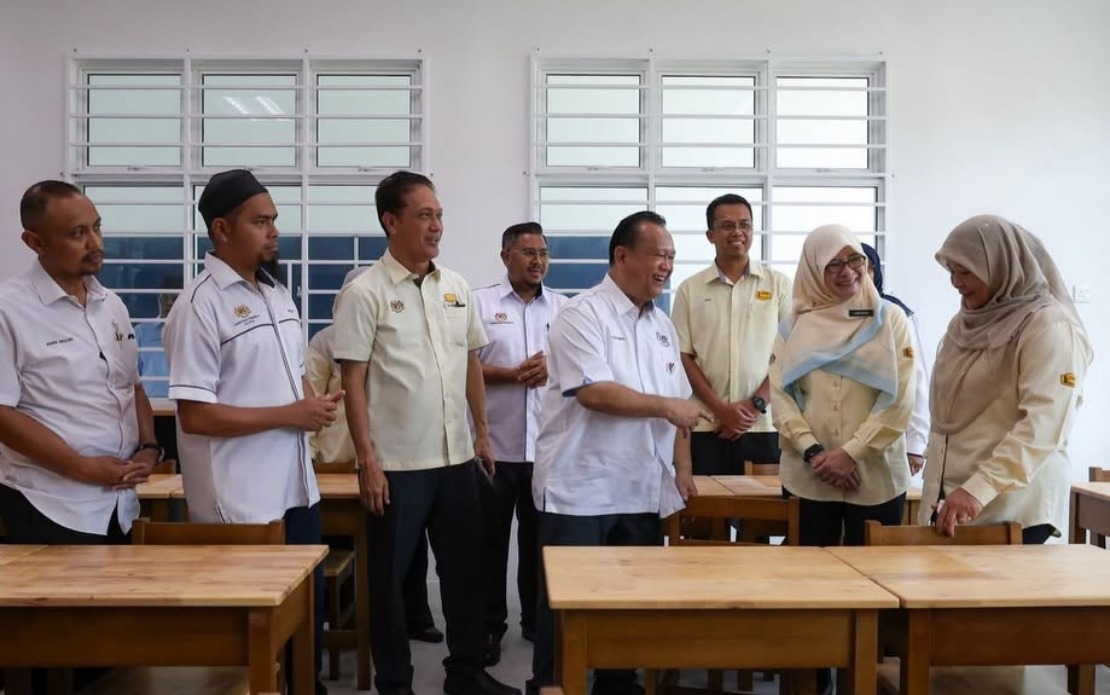
The reconstruction of a deteriorating school building in Jerantut has reached completion nearly a year faster than originally planned, signalling improved efficiency in Malaysia's government-funded infrastructure delivery. Works Minister Datuk Seri Alexander Nanta Linggi announced at a handover ceremony that SK FELDA Kota Gelanggi 1 finished its RM7.998 million overhaul on June 26, substantially outpacing the anticipated May 2, 2027 deadline. The project commenced on January 13 last year, meaning the 310-day acceleration represents a notable performance benchmark in public sector construction.
The completed development introduces substantially upgraded educational infrastructure to the rural Pahang school. A new academic block now houses three additional classrooms alongside a dedicated science room and health facility, addressing previous capacity constraints at the institution. Beyond classroom expansion, the project encompassed construction of a specialised block under the Special Education Integration Programme (PPKI), purposefully designed with equipment and layouts tailored for pupils requiring additional educational support. These enhancements directly benefit 17 students with special educational needs who previously lacked adequate dedicated facilities.
Nanta emphasised that timely delivery without extension of time represented exemplary project management within Malaysia's often-delayed infrastructure ecosystem. Achieving such acceleration without contractual extensions—common in Malaysian construction—underscores improved coordination between government agencies, contractors, and oversight bodies. The minister pointed out that this accomplishment should serve as a model for similar dilapidated school facilities nationwide, particularly across Pahang where multiple upgrading initiatives remain underway.
The completion reflects broader government efforts to rehabilitate ageing school infrastructure that has long constrained rural educational quality. Many Malaysian schools, particularly those in federal land development areas like FELDA settlements, operate from structures decades old with deteriorating facilities. The Kota Gelanggi project demonstrates that systematic intervention can modernise such environments, though the comparative rarity of such early completions suggests systemic challenges persist elsewhere.
For the Kota Gelanggi community, the improvements carry tangible implications. Students now access climate-controlled classrooms with contemporary teaching resources, science facilities enabling practical learning previously impossible, and health services previously unavailable on-site. The PPKI block's establishment particularly transforming educational access for special needs pupils, who often faced marginalisation in mainstream school settings lacking specialised resources and trained support staff.
Nanta acknowledged ongoing challenges in maintaining these upgraded facilities, issuing directives that contractors address all defects promptly during the defect liability period. He tasked the Public Works Department with sustained post-handover monitoring, emphasising that infrastructure durability depends on rigorous maintenance protocols and rapid rectification of emerging problems. This attention reflects Malaysian experience where spectacular facility deterioration often stems not from initial construction failures but from inadequate upkeep following handover.
The minister's remarks indicated that similar reconstruction initiatives across Pahang remain in progress, with optimism that comparable acceleration achievements might transpire elsewhere. Multiple schools in the state reportedly require systematic rebuilding, though project-by-project scheduling constraints and resource limitations typically prevent simultaneous implementation. Successful early delivery at Kota Gelanggi potentially catalyses momentum for accelerating these pipelines, though structural bottlenecks in government procurement and labour availability suggest variable outcomes across different sites.
This achievement carries broader significance for Malaysia's development agenda. Rural and semi-urban communities historically experience infrastructure disparities compared to urban centres, with educational facilities particularly affected. When federal projects like school reconstructions demonstrate efficiency, they provide tangible counter-narrative to persistent public scepticism regarding government capability in infrastructure delivery. Such successes, when replicated consistently, gradually rebuild institutional credibility.
From a Southeast Asian perspective, Malaysia's school modernisation efforts, though intermittent, reflect recognition that educational infrastructure quality fundamentally determines human capital development. The region increasingly competes on knowledge economy metrics, making educational environment quality consequential for long-term competitiveness. Early project completion symbolises commitment to accelerating this transition, though execution remains inconsistent across the country.
The ceremony itself represented political opportunity for the Works Ministry to showcase tangible accomplishment amid general infrastructure delivery scrutiny. Media coverage of successful projects counterbalances persistent narratives of delayed mega-projects and cost overruns characterising Malaysian infrastructure sector. For Nanta personally, the announcement provided platform emphasising ministerial competence and project oversight effectiveness ahead of potential reshuffles.
Moving forward, the Kota Gelanggi precedent raises questions about whether early completion reflected exceptional circumstances—particularly efficient contractor performance or unusually cooperative labour conditions—or whether systematic improvements in project management enabled the acceleration. If replicable, such efficiencies could substantially compress timelines across Malaysia's considerable pipeline of educational infrastructure upgrading, particularly benefiting rural communities where facility inadequacies most severely constrain educational outcomes.

