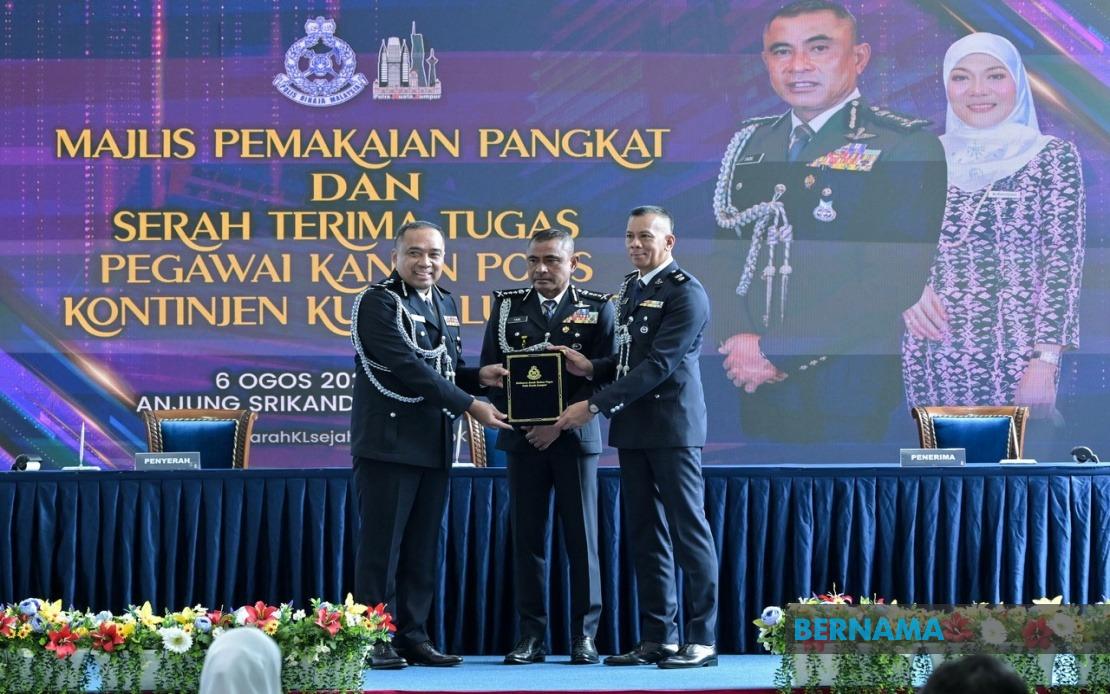
Kuala Lumpur's police command structure underwent significant changes this week as six senior officers transitioned into new roles during a formal handover ceremony presided over by police chief Datuk Fadil Marsus at the contingent headquarters. The reshuffling affects key positions across investigative, operational and district-level policing, signalling a planned rotation of leadership that police officials characterise as essential to maintaining organisational effectiveness and preventing institutional stagnation.
The restructuring involved the two most prominent investigative arms within the capital's police force. SAC Zulkarnain Samsudin relinquished his role leading the Criminal Investigation Department to SAC Sazlee Adam, while SAC Haslah Bachok stepped down from overseeing the Narcotics Crime Investigation Department, handing the portfolio to ACP Kee Hang Kee. These appointments carry particular significance given the ongoing battle against drug trafficking and organised crime in Malaysia's capital, where both agencies function as frontline units in the Royal Malaysia Police's enforcement strategy.
District-level command also experienced notable transitions. Supt Nuzulan Mohd Din assumed leadership of Dang Wangi district—one of the capital's most densely populated and crime-sensitive areas—replacing SAC Sazlee Adam, whose promotion to the CID position created a cascading effect through the hierarchy. Simultaneously, Supt Jasni Zolpa took the helm at Sentul district, relieving SAC Basri Sagoni from what represents a crucial role in managing policing operations in Malaysia's bustling commercial and residential zones.
Specialist branch positions similarly underwent restructuring. SAC Kamaruzaman Md Alib transferred from his position as Special Branch deputy chief for Intelligence and Operations, a role crucial to counterterrorism, public security and intelligence gathering. ACP Saefuddin @ Mohd Fitri Abdul Rahman inherited this sensitive post, which carries oversight of operations directly impacting national security considerations. Additionally, SAC Zulkarnain Samsudin—who simultaneously exited his CID position—also stepped down as CID deputy chief for Intelligence and Operations, with Supt Ong Seng Keong assuming these responsibilities.
The ceremony's attendance by Kuala Lumpur deputy police chief Datuk Mohd Azani Omar underscored the procedural significance of these changes within the police hierarchy. Such formal handovers, while routine administrative practice, serve as public acknowledgment of leadership transitions and establish clear chains of responsibility. The timing and coordinated nature of the changes suggest deliberate strategic planning rather than emergency replacements, reflecting standard rotational policies designed to prevent officers from becoming too entrenched in particular positions.
In his remarks at the ceremony, Datuk Fadil Marsus framed the appointments through a dual lens of recognition and responsibility. He characterised promotions and reassignments not merely as career advancement for individual officers but as institutional validation of their demonstrated competence and commitment. This messaging serves multiple purposes within police culture: it incentivises performance among aspiring officers, acknowledges the sacrifices required in law enforcement roles, and publicly demonstrates that career progression depends on tangible contributions to the force's mission.
The police chief's emphasis on "integrity, professionalism and sincerity" carries implicit expectations for the newly appointed officers. These qualities become particularly important given the scrutiny police institutions face regarding corruption allegations and public confidence. By articulating these values during the handover, Fadil Marsus signalled that the force maintains standards beyond mere operational competence, addressing concerns about the character and ethical standards expected of leadership-level personnel.
Fadil Marsus characterised the handover ceremony as symbolising broader continuity within Malaysia's police establishment. This framing acknowledges a fundamental challenge in large organisations: maintaining operational momentum while introducing fresh leadership. The Royal Malaysia Police, as a hierarchical, rank-based institution, relies on systematic transitions to prevent knowledge gaps and institutional memory loss. By rotating officers through different postings and ranks, the force theoretically broadens individual competencies while distributing institutional knowledge across the broader command structure.
The police chief specifically identified evolving security complexity as justification for the restructuring. He referenced "increasingly complex security challenges," a term encompassing transnational organised crime, drug trafficking networks, terrorism threats, and cybercrime—domains that demand sophisticated investigative capabilities and coordinated operational responses. The implication is that these six appointments represent selections of officers deemed particularly equipped to navigate such challenges, whether through prior experience, demonstrated analytical capacity, or operational track records.
Fadil Marsus's appeal for renewed commitment to crime prevention, drug abuse reduction and investigative capability improvement suggests these remain institutional priorities despite other demands on police resources. By invoking these concerns during the leadership transition, he established performance benchmarks against which the newly appointed officers will likely be evaluated. This public articulation of priorities creates accountability mechanisms, as subsequent crime statistics and drug seizure data become potential measures of leadership effectiveness.
The emphasis on community engagement represents a notable dimension of the police chief's statement. By directing newly appointed officers to strengthen ties with communities, Fadil Marsus acknowledged growing recognition within law enforcement globally that crime prevention effectiveness depends on public cooperation and trust. For Kuala Lumpur, where diverse communities and significant floating populations present particular policing challenges, community relations become operationally relevant rather than merely ceremonial.
These changes occur within Malaysia's broader context of police reform and modernisation. While the Kuala Lumpur restructuring involves routine administrative transitions, such moves accumulate to shape institutional culture and operational priorities. The Royal Malaysia Police has faced periodic criticism regarding operational effectiveness, corruption control and public accountability. Leadership transitions offer opportunities to reinforce desired standards or introduce new approaches to persistent challenges.
The six-position reshuffle ultimately represents both continuity and evolution within Kuala Lumpur's police command. By promoting established officers and rotating personnel through different responsibility domains, the force balances institutional stability with organisational renewal. Success depends on whether the newly appointed officers can translate their prior experience and demonstrated competence into measurable improvements across investigative, operational and community safety metrics.

