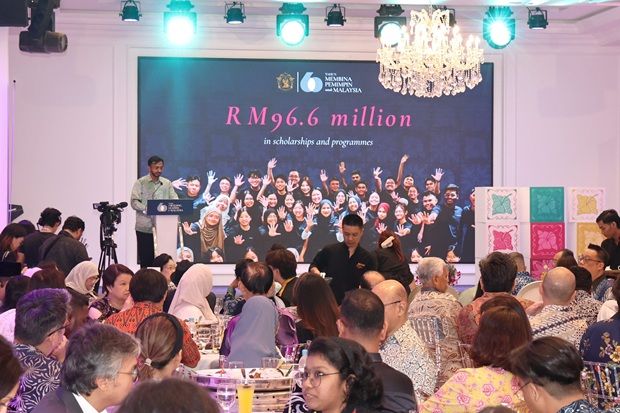
The Tunku Abdul Rahman Foundation (YTAR) commemorated six decades of educational stewardship on August 13 at Bangunan Sultan Abdul Samad, honouring a legacy that has fundamentally shaped opportunities for Malaysian youth across generations. This milestone represents not merely the passage of time, but a continuous commitment to the foundational belief that investing in education is the most valuable investment a nation can make in its future.
The foundation's origins reveal a compelling story of grassroots national mobilisation. What began as a proposal to establish an education fund honouring Malaysia's first Prime Minister, Tunku Abdul Rahman Putra al-Haj, evolved into a nationwide crowdfunding initiative spearheaded by Utusan Melayu on Tunku's birthday. Citizens across the country contributed to raise more than M$60,170.20—a sum equivalent to approximately RM380,000 in contemporary monetary terms—demonstrating the depth of public support for educational advancement at a critical juncture in the nation's development.
Recognising the significance of this community-driven effort, the Education Minister of that era, Tan Sri Mohamed Khir Johari, championed the institutionalisation of these aspirations by proposing to the Federal Government the establishment of Yayasan Tunku Abdul Rahman. Formalised through the Tunku Abdul Rahman Foundation Fund Act 1966 (Act 43), this legislative framework transformed what could have remained a temporary initiative into a permanent national institution. The shift from ad-hoc community fundraising to constitutional establishment underscored the government's understanding that systematic, long-term support for higher education access was essential to post-independence nation-building.
Since its inception, YTAR has distributed transformative support to over 12,000 Malaysian youths across all communities, regardless of ethnicity or religious background. Through scholarships, study loans, financial assistance, and employability development programmes, the foundation has disbursed a total of RM96.6 million—a substantial investment in human capital that has rippled across decades. The breadth of this reach reflects YTAR's commitment to identifying talent and potential wherever it exists within Malaysian society, ensuring that financial constraints do not become insurmountable barriers to educational aspiration.
During the 60th anniversary celebration, National Unity Minister Datuk Aaron Ago Dagang articulated an evolved understanding of the foundation's contemporary role. Beyond serving as a scholarship dispenser, YTAR has become an institution that identifies emerging talent, creates pathways for opportunity, and systematically develops the latent potential of Malaysian youth. This conceptual expansion acknowledges that educational support operates most effectively when embedded within broader frameworks of mentorship, skills development, and career guidance—recognising that financial aid alone, though essential, represents only one component of comprehensive youth development.
Aaron Ago extended an explicit appeal to the corporate sector, inviting Malaysian companies to position education and talent development as cornerstones of their corporate social responsibility programming. By forging partnerships with established foundations like YTAR, businesses could contribute meaningfully to human capital development while simultaneously addressing their own workforce requirements. This call reflects recognition that sustainable social development requires collaboration between government institutions, philanthropic bodies, and private enterprise—a tripartite approach increasingly essential for addressing Malaysia's evolving economic and social challenges.
Kularetnam Vijayakumar, chief executive officer of YTAR, articulated a foundational insight about the institution's enduring character: the foundation has never been the product of individual stewardship but rather the collective contribution of successive generations of Malaysians who served as custodians and supporters. When citizens crowdfunded the initial capital in 1966, they embedded within YTAR a philosophy centred on education's transformative potential. Six decades later, that conviction remains architecturally central to the organisation's mission, reflecting Tunku Abdul Rahman's own prescient observation that a young nation's present and future depend significantly upon the capabilities and character of its youth.
Datin Sri Sharifah Menyalara Syed Hussein, the foundation's chairperson and granddaughter of Tunku Abdul Rahman, provided intimate insights into the late Prime Minister's educational philosophy. Tunku had emphasised that before pursuing grand ambitions, one must construct robust foundational structures through education—understood not as mere academic credentials but as character development and purposeful formation enabling young people to locate their meaningful place within society. Under her stewardship, YTAR has evolved from providing financial assistance into a comprehensive institution that equips high-potential deserving youth with capital, opportunities, skills, and values necessary for constructing meaningful futures. Sharifah's reflection on keeping Tunku's legacy alive introduces a crucial distinction: while memorials prompt retrospection, living institutions demand forward-looking action, carrying ideals into unfolding futures.
The anniversary ceremony honoured two remarkable scholars whose trajectories exemplify YTAR's transformative impact. Dr Zakaria Ali emerged as a pioneer in Malaysian fine arts, establishing himself as painter, writer, and academic leader through a path initiated when an American university instructor advocated on his behalf, eventually securing Royal intervention and scholarship approval. Ch'ng Kim See, among the foundation's earliest recipients in 1967, encountered YTAR support precisely when financial hardship threatened to terminate her university aspirations. Her subsequent prominence as one of Malaysia's most distinguished librarians and regional experts in Southeast Asian history and library science demonstrates how strategic educational intervention at critical moments can catalyse multi-decade professional contributions. Both scholars exemplify YTAR's implicit covenant: invest in talented youth, and they will repay that investment through distinguished service across multiple professional domains.
These individual success narratives, while inspiring, acquire deeper significance when aggregated across the foundation's alumni network. Tunku Scholars have dispersed throughout Malaysian society's institutional architecture—functioning as educators, civil servants, legal professionals, medical practitioners, and frontline leaders—united by shared conviction that collective vision can construct demonstrably better Malaysia. The diversity of professional pathways undertaken by YTAR graduates reflects the foundation's democratic approach to talent identification and support, rejecting any notion that only certain categories of youth merit educational investment.
Critically, the anniversary celebration also announced expanded accessibility mechanisms for future opportunities. Beginning August 31, nominations opened for the 2026 Pingat Tunku Award, with an unprecedented innovation: self-nomination became permissible for graduates of both public and private higher education institutions across Malaysia. This democratisation of the nomination process acknowledges that merit and potential often go unnoticed without deliberate mechanisms for self-advocacy, particularly among graduates from less-privileged educational backgrounds or marginalised communities. By lowering barriers to nomination, YTAR signals commitment to identifying talent that might otherwise escape institutional attention.
For Malaysian readers and Southeast Asian observers, YTAR's 60-year trajectory offers instructive lessons about sustained institution-building. The foundation demonstrates that educational advancement operates most effectively when embedded within broader national development frameworks, when supported through multi-stakeholder participation spanning government, civil society, and eventually private enterprise, and when maintained across political transitions and economic cycles through steadfast commitment to foundational principles. As Malaysia navigates contemporary economic restructuring and demographic change, YTAR's model—investing systematically in human potential rather than pursuing ephemeral quick-returns—provides a counterweight to short-termist policy impulses, suggesting that true national development emerges gradually through sustained cultivation of human capabilities across generations.

