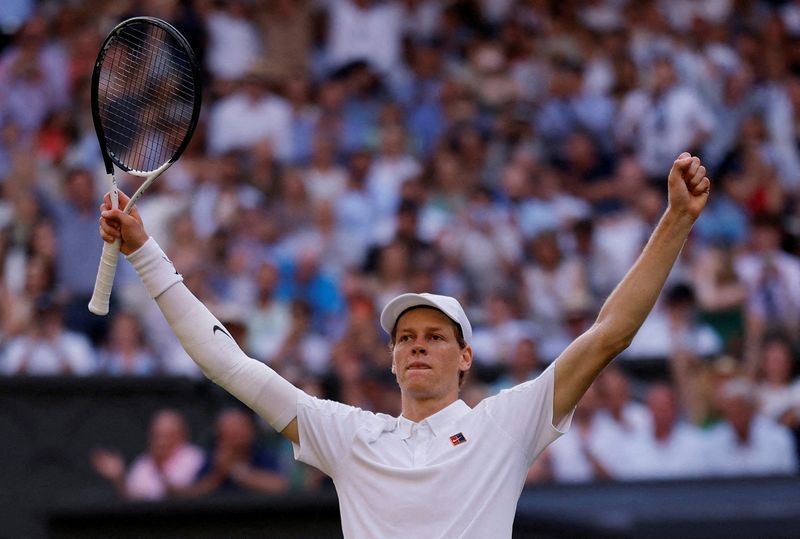
Jannik Sinner arrives at Wimbledon this week as the defending champion and world number one, yet the Italian's customary aura of dominance has been noticeably diminished by recent setbacks that now invite genuine challenge from several quarters. The 24-year-old's run of invincibility—meticulously built through an imperious clay-court campaign—fractured dramatically at Roland Garros last month when unexpected physical difficulties ended a 30-match unbeaten streak in the second round. That collapse has cast a shadow over what should be Sinner's moment of consolidation at the All England Club, opening the door for rivals to sense vulnerability at precisely the moment when Grand Slam momentum might otherwise feel unshakeable.
The nature of Sinner's exit at the French Open raises substantive concerns about his ability to maintain peak performance across consecutive major tournaments. After two months of intensive competition with minimal recovery time before Roland Garros, Sinner found himself drained of the energy reserves essential for navigating the gruelling clay grind. Seven-times Grand Slam champion Mats Wilander, analysing the Italian's predicament for La Gazzetta dello Sport, attributed the breakdown to accumulated fatigue rather than any structural flaw in Sinner's game. Wilander noted that despite recent struggles, Sinner remains the tournament favourite given that injured rival Carlos Alcaraz's absence removes one of the few players capable of imposing complete dominance on grass courts.
Yet Wilander's assessment carries a cautionary note about the unpredictability of grass-court tennis, where traditional rhythms and patterns governing other surfaces frequently collapse. Sinner's decision to bypass warm-up tournaments before Wimbledon—a controversial choice potentially designed to maximise rest—will draw close scrutiny from opponents seeking confirmation that the Italian remains genuinely vulnerable or merely recalibrating. The grass surface offers Sinner genuine opportunity for psychological and physical reset, a chance to demonstrate that his clay-court excellence translates across different terrains. However, the very fact that such questions require answering at this stage of the season indicates how dramatically circumstances have shifted from the early-year narrative of Sinner's inevitable ascendancy.
Novak Djokovic emerges as perhaps the most dangerous challenger to Sinner's Wimbledon throne, and the Serb's grasscourt expertise has become suddenly, almost poignantly relevant. At 39 years old, pursuing both an eighth Wimbledon title to match Roger Federer's legendary tally and an elusive 25th Grand Slam crown overall, Djokovic confronts a rapidly closing window of elite opportunity. The Serbian veteran was himself an early casualty at Roland Garros, yet Andy Roddick, the three-times Wimbledon finalist, insists this setback paradoxically strengthens Djokovic's psychological positioning for the All England Club. Roddick's assessment on his podcast emphasised that Djokovic views Wimbledon as his singular realistic opportunity to achieve both remaining career ambitions during what remains of his playing span—a concentration of purpose that historically translates into formidable competitive intensity.
Djokovic's movement and exceptional return-of-serve capabilities have always made him a grasscourt nightmare for opponents, skills that appear undimmed despite his advancing years. His 2020 Wimbledon triumph—his most recent—demonstrated that even with reduced recovery windows between tournaments, the Serbian can elevate his game at this venue. The absence of Alcaraz, who has dominated Wimbledon in recent years through superior serve-and-volley execution, effectively removes the primary obstacle to Djokovic's path. Roddick suggested that any member of Team Djokovic could realistically construct an optimistic case for a run to the title, arguing that even if the Serb is no longer operating at peak capacity, the general competitive standard at this year's tournament has sufficiently contracted to make his victory plausible.
Alexander Zverev represents another significant challenger, buoyed by his long-overdue breakthrough Grand Slam victory at Roland Garros that finally ended the German's persistent major-tournament drought. The 29-year-old's French Open triumph provides genuine momentum and psychological reinvigoration entering Wimbledon, where his powerful serving attack becomes an even more valuable commodity than it proved on clay. Boris Becker, the six-times Grand Slam champion and fellow German, elevated Zverev's title prospects in comments to Eurosport, specifically nominating him as favourite given both Alcaraz's injury absence and uncertainty surrounding Sinner's physical status. Becker emphasised that Zverev's elite serve—fundamentally essential to grasscourt success—already places him within touching distance of the semifinals, requiring primarily adaptation rather than complete recalibration of approach.
Zverev's pathway to a potential second major title suddenly appears more feasible than at any previous Wimbledon, circumstances amplified by the simultaneous absences and vulnerabilities affecting the title's presumed favourites. The German must navigate the mental transition from clay-court success to grasscourt tennis where different technical demands predominate, yet Becker's analysis suggests this represents constraint rather than insurmountable barrier. Should Zverev maintain even a fraction of the form that secured Roland Garros, he possesses sufficient weapons to trouble any player in the draw, particularly given the psychological uncertainty now surrounding both Sinner and Djokovic's genuine title prospects.
Alcaraz's injury-enforced absence represents a seismic disruption to the tournament's competitive structure, removing a player who has demonstrated near-complete mastery of Wimbledon through successive 2023 and 2024 triumphs. The young Spanish sensation's brief sabbatical opens the field wider than might otherwise occur in a season where one player's dominance might otherwise consolidate control. This disruption simultaneously expands opportunity for the secondary tier of contenders, players like American Ben Shelton whose powerful athleticism and diverse technical range equip him to trouble elite opposition on fast courts. Taylor Fritz and Frances Tiafoe, both American competitors with genuine grasscourt pedigree, similarly benefit from a draw that lacks the suffocating depth that Alcaraz's presence would impose.
French Open runner-up Flavio Cobolli represents the emerging wave of younger players positioned to capitalise on the transitional moment now occupying men's tennis. The Italian's progress through Roland Garros demonstrated technical completeness and mental resilience that potentially translates effectively to grasscourt conditions. For Malaysian and Southeast Asian readers, this tournament represents a crucial inflection point in which the sport's hierarchy receives potential reorganisation. Sinner's possible struggles—rather than predetermined dominance—and Djokovic's final realistic opportunity to append another chapter to his legacy create genuine dramatic tension rather than ceremonial formality.
The trajectory of men's tennis currently traverses contested terrain where established hierarchies face genuine challenge from emerging alternatives and veteran players recognising their final meaningful windows of elite competitiveness. Wimbledon 2024 will reveal whether Sinner's French Open collapse represents temporary anomaly requiring correction or symptomatic of deeper vulnerabilities that rivals can systematically exploit. Djokovic's ability to compete meaningfully at 39 years old carries implications extending beyond single tournament outcomes, potentially redefining realistic expectations about athletic longevity at professional tennis's highest levels. Zverev's emergence as genuine major-tournament winner after years of frustration similarly reshapes competitive dynamics for years ahead.
For fans across Southeast Asia tracking the sport's evolution, this Wimbledon fortnight promises genuine competitive uncertainty where multiple plausible outcomes exist simultaneously. The absence of Alcaraz, combined with Sinner's demonstrated vulnerability and Djokovic's final realistic opportunity, creates conditions where unexpected names might emerge triumphant. Zverev's form provides substantive foundation for believing that post-Federer, post-Nadal, fully post-Djokovic tennis might already be beginning its emergence—though the Serbian's potential Wimbledon run suggests such generational transitions rarely follow neatly predetermined chronology. The tournament commencing Monday will substantially clarify which narrative ultimately predominates.

