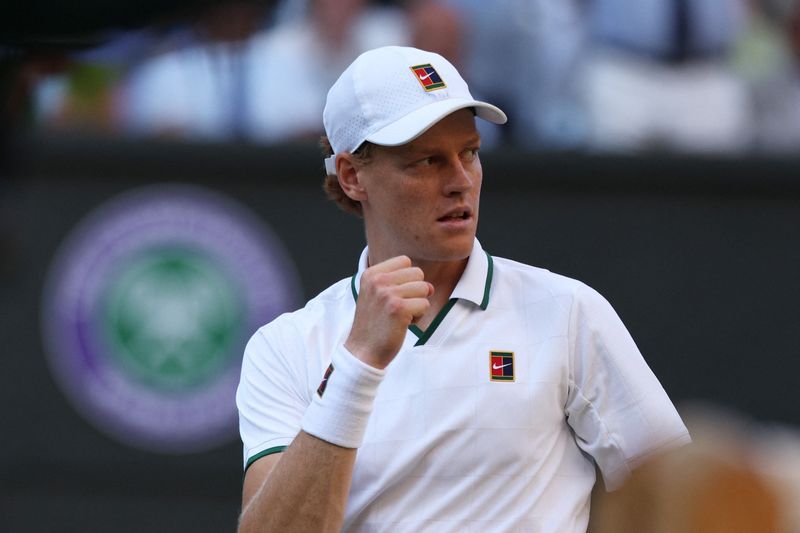
Jannik Sinner cemented his status as one of the game's elite performers by successfully defending his Wimbledon championship on Sunday, overcoming a determined Alexander Zverev in a final that tested his mental fortitude and technical proficiency in equal measure. The Italian triumphed 6-7(7) 7-6(2) 6-3 6-4 at the All England Club, claiming his fifth Grand Slam title while simultaneously extending an remarkable personal record against his German opponent to ten straight victories. The performance underscores Sinner's emergence as a dominant force in contemporary tennis, establishing him firmly within the sport's elite circle as he continues narrowing the gap on rival Carlos Alcaraz's major championship tally.
The significance of Sinner's achievement extends beyond the immediate victory, positioning him among an exclusive cohort of champions. By successfully retaining the Wimbledon title, Sinner became only the tenth man in the professional era to accomplish this demanding feat, joining a roster of legends who have demonstrated the capacity to maintain peak performance across consecutive seasons. This accomplishment carries particular weight given the gruelling nature of Grand Slam competition and the physical toll exacted by the grass-court surface, which rewards movement, serve-and-volley proficiency, and explosive first-strike capability. For Malaysian and Southeast Asian tennis enthusiasts, Sinner's sustained excellence offers a blueprint for understanding how modern champions construct their competitive advantage through consistency, resilience, and the capacity to elevate performance in the sport's most prestigious arenas.
The final itself unfolded as a compelling examination of both players' technical and psychological resources. The opening set developed into a marathon opening skirmish, with both competitors trading aggressive strokes across twelve games played under warm, windy conditions that added unpredictability to court positioning and ball trajectory. Zverev gained initial ascendancy in the tiebreak, executing powerful forehand winners with particular effectiveness and celebrating energetically as he secured the set. His clean ball-striking and aggressive approach suggested a player capable of challenging Sinner's established dominance, yet momentum shifted decisively through the second set as Sinner demonstrated the adaptability that characterises elite performers.
Zverev's frustration became increasingly apparent as the second set progressed toward its tiebreak conclusion. Sinner, conversely, channelled mounting intensity into his performance, capitalising on his opponent's momentary loss of focus to claim the tiebreak decisively and restore parity in the match. The psychological dimension of this reversal cannot be underestimated—Zverev's inability to convert his early advantage into sustained pressure created the mental aperture through which Sinner could reassert control. For regional audiences observing elite sports dynamics, this sequence illustrates how championship-calibre athletes navigate the emotional fluctuations inherent to high-pressure competition.
The third set witnessed a dramatic turning point that underscored both players' competitive commitment and the physical demands of professional tennis. Midway through the set, with Zverev having earned his maiden break point, the German attempted an aggressive approach to counter Sinner's drop shot. His forward momentum carried him beyond the optimal position, resulting in a tumble that produced an immediate and agonised response. As Zverev clutched his right knee whilst rolling across the Centre Court turf, the assembled spectators held their collective breath, momentarily questioning whether the champion's throne might change hands under circumstances no competitor welcomes. Demonstrating admirable resilience and perhaps aided by adrenaline, Zverev persevered beyond this injury scare, though the physical compromise appeared to compromise his movement patterns and tactical execution.
Sinner seized this psychological and tactical advantage with clinical precision. The very next game produced a break that positioned the Italian towards decisive control, with Sinner surging to a 5-3 lead and subsequently claiming the set after nearly three hours of contested tennis. Zverev's visible frustration—punctuated by racket-throwing gestures—reflected the mounting realisation that his championship ambitions were slipping from his grasp. The Centre Court crowd's energised response to Sinner's consolidation of this advantage demonstrated the spectator engagement that characterises Wimbledon's standing within tennis tradition and the broader sporting consciousness.
The fourth set proved less competitive, with Sinner breaking once more for a 4-3 advantage before Zverev's competitive level registered a temporary decline. The Italian's capacity to convert marginal advantages into match-sealing points reflected the clinical finishing characteristic of champions operating at the sport's pinnacle. Sinner ultimately secured the victory and subsequently collapsed to the turf in the emotional release customary among athletes achieving significant objectives. His post-match commentary captured the emotional resonance of defending a Grand Slam title, with Sinner acknowledging Wimbledon's unique standing within professional tennis culture and expressing gratitude toward the spectators whose support sustained his concentration and commitment throughout the fortnight's competition.
Zverev's defeat marked his fourth Grand Slam final loss, a statistic that carries particular poignancy given his evident quality as a competitor and his proven capacity to advance through demanding competition schedules. His gracious post-match remarks—delivered with self-aware humour regarding his loss of count in his personal winning streak against Sinner—reflected appropriate perspective regarding competitive outcomes and interpersonal sportsmanship. His acknowledgement that Sinner had demonstrated the superiority required to claim the title suggested acceptance of his opponent's current standing within professional tennis rankings, even as the German's continued presence in major final competitions indicates a trajectory toward potential breakthrough achievement.
The broader implications of Sinner's triumph for Southeast Asian and global tennis development merit consideration. The Italian's emergence as a sustained major championship winner signals the continuation of European tennis excellence and the shifting generational dynamics within the sport. For emerging tennis nations and regional development programmes, Sinner's path—combining technical proficiency, physical conditioning, mental fortitude, and access to world-class coaching infrastructure—offers instructive lessons regarding competitive excellence construction. The dominance he has established over previous generations' champions suggests that contemporary tennis places elevated premium on baseline consistency, movement efficiency, and the capacity to construct points strategically rather than relying upon singular explosive capability.
Looking forward, Sinner's championship retention positions him as a legitimate contender for major championship accumulation comparable to Alcaraz's current trajectory. The psychological advantage of defending successfully, combined with enhanced confidence arising from demonstrable supremacy over formidable opponents, typically generates upward momentum in competitive endeavour. For Malaysian audiences engaged with professional tennis, Sinner's sustained excellence offers compelling narrative development as successive seasons determine whether his current trajectory toward sustained dominance proves sustainable against the constant competitive challenges professional tennis demands. His Wimbledon defence represents not a culmination but rather a significant waypoint in what appears destined to become a distinguished championship resume.

