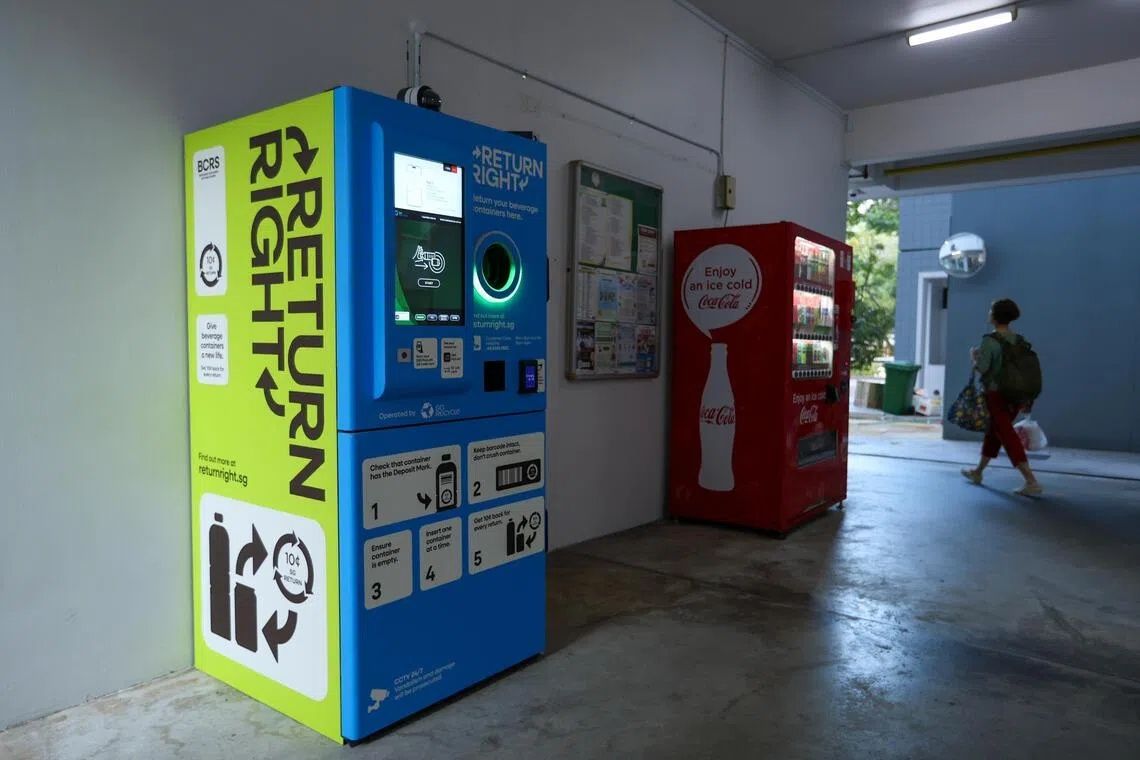
Singapore's National Environment Agency has emphatically denied allegations of corruption and financial misappropriation linked to its flagship beverage container recycling initiative, characterizing the accusations as fundamentally based on a misreading of official statistics. The agency issued its rebuttal through a Facebook statement on August 15, directly addressing online debate that had questioned how millions of returned containers had been processed relative to the number of refunds distributed under the Beverage Container Return Scheme.
The controversy emerged following a parliamentary update by Senior Minister of State for Sustainability and the Environment Janil Puthucheary, who reported on August 5 that reverse vending machines had processed over one million successful transactions between April and July, processing a total of 5.5 million used bottles and cans. His remarks inadvertently sparked public confusion, with some commenters interpreting the figures as suggesting that refunds were issued for only one million containers while 5.5 million were physically returned—a substantial apparent discrepancy that fuelled suspicions of fund mishandling.
The National Environment Agency moved swiftly to clarify the mathematical misunderstanding at the heart of the controversy. The agency explained that the statistics reflected two distinct metrics: the number of individual transactions at the machines versus the total volume of containers processed across those transactions. Crucially, multiple containers can be returned and credited within a single transaction, meaning the one million figure represented the number of separate refund operations rather than the number of containers compensated.
By performing basic arithmetic on the official data, the agency calculated that consumers returned an average of 5.5 containers per transaction, a reasonable average that would account for shoppers who accumulated multiple empties before visiting a recycling station. With Singapore's Beverage Container Return Scheme charging a mandatory 10-cent deposit on each eligible container, the mathematics yielded a total refund figure of approximately SGD 550,000 (US$429,822) distributed over the four-month pilot period, a sum the agency maintained fully reflected the volume of deposits collected and redeemed.
Singapore's approach to incentivizing recycling through deposit-return mechanisms places the city-state alongside international best practices in circular economy design. The scheme, which commenced on April 1, requires consumers to pay a small surcharge on single-use beverage containers, with the deposit reimbursed upon return of the empty packaging to networked reverse vending machines. The structure aims to simultaneously reduce litter, encourage participation in formal recycling infrastructure, and generate behavioural change by making waste reduction financially rewarding at the point of consumption.
While the agency's clarification addressed the immediate confusion over deposit accounting, the episode underscores the communication challenges inherent in rolling out public sector environmental initiatives, particularly when statistics are released without comprehensive contextual explanation. The initial parliamentary statement, though factually accurate, lacked the detailed breakdown necessary to prevent misinterpretation by observers unfamiliar with the scheme's transactional mechanics. This case offers lessons for regional governments contemplating similar deposit-return programmes, highlighting the importance of pairing numerical updates with clear methodological notes.
Since the scheme's April launch, the recycling initiative has encountered operational challenges beyond the accounting confusion. Early adopters reported technical malfunctions at reverse vending machines, including instances where deposits were not credited immediately to user accounts and situations where the machines rejected items that should have been accepted. Such friction points in automated systems can undermine public confidence in environmental programmes, particularly when consumers perceive barriers to accessing incentives they believe they have earned.
Janil acknowledged these technical difficulties during his August 5 parliamentary statement, characterizing them as isolated incidents rather than systemic failures. He noted that the scheme operator, BCRS, had collaborated closely with machine manufacturers and venue operators to diagnose and resolve the problems promptly, suggesting that most transactions had proceeded without complications. This response reflects a standard damage-control approach in public administration, though it sidesteps questions about what proportion of transactions experienced errors and what remedial processes exist for affected consumers.
The governance structure underpinning the Beverage Container Return Scheme includes oversight mechanisms designed to maintain accountability. BCRS is contractually obligated to submit annual financial reports to the National Environment Agency, providing transparency regarding the scheme's revenue collection, refund disbursements, operational expenses, and administrative costs. These reporting requirements theoretically create a paper trail for independent auditing, though public access to such reports may be limited, constraining external verification of the agency's assertions regarding deposit handling.
For Malaysian and Southeast Asian observers, Singapore's experience with deposit-return schemes carries relevance as regional governments consider environmental regulation strategies. Malaysia has previously explored deposit systems for specific beverage categories, and the practical implementation challenges emerging in Singapore's pilot phase—combining the financial accountability concerns highlighted in this episode with the technical glitches reported by users—warrant attention from policymakers designing similar programmes. The controversy also illustrates how environmental initiatives can become politicized when citizens distrust government institutions, even when mathematical clarification is straightforward.
Looking ahead, Singapore's resolution of this particular dispute relies substantially on public acceptance of the agency's explanation. The dismissal of corruption allegations as "misplaced" is categorical but somewhat defensive, and may not fully satisfy observers predisposed towards institutional skepticism. Building sustained public confidence in the scheme will require not only correcting technical issues and ensuring reliable machine performance, but also establishing a communication cadence that proactively explains programme metrics and financial flows before confusion accumulates in online spaces.

