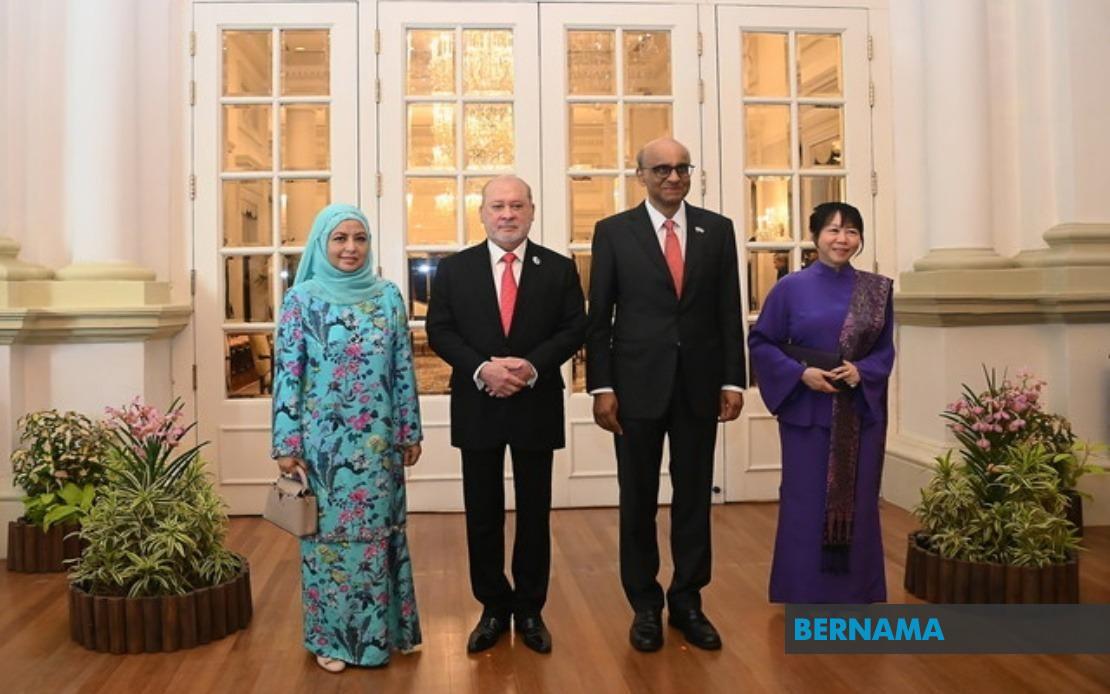
Singapore President Tharman Shanmugaratnam arrives in Malaysia this week bearing a message of deepened commitment to bilateral ties forged over six decades. Speaking ahead of his state visit at the invitation of His Majesty Sultan Ibrahim, King of Malaysia, the Singapore leader articulated a vision of the relationship that moves beyond conventional economic integration toward what he termed a partnership rooted in shared history, mutual respect, and accumulated trust that requires continuous renewal.
The foundation for this partnership rests on tangible and intangible elements that distinguish Malaysia-Singapore relations from typical international dealings. Beyond the practical reality of the Johor-Singapore Causeway serving as the world's busiest land border crossing, the two nations share interconnected populations, overlapping cultural identities, and economies so deeply integrated that developments in one inevitably affect the other. President Tharman emphasized that these connections evolved over centuries, creating a web of kinship ties and traditions that official agreements alone cannot replicate or replace.
Recognition of this shared cultural patrimony has taken on fresh international significance. The joint UNESCO inscription of the kebaya alongside Brunei, Indonesia, and Thailand represents more than a symbolic achievement. It reflects an intentional effort by both governments to preserve and celebrate traditions that bind their societies together while demonstrating to the world how neighboring nations can collaborate in safeguarding collective heritage. Similarly, ongoing efforts to secure UNESCO recognition for Chingay, the street procession that visibly demonstrates the multicultural character of both societies, underscore an understanding that cultural continuity serves as ballast during periods of political or economic turbulence.
President Tharman acknowledged an uncomfortable reality often unspoken in diplomatic circles: close neighbors inevitably experience disagreements. What distinguishes mature bilateral relationships is not the absence of friction but rather the capacity to address disputes directly while preventing them from contaminating broader cooperation. This approach, refined through successive governments on both sides, reflects a hard-won understanding that regional stability does not depend on eliminating all tensions but rather on managing them through dialogue, adherence to international law, and respect for each nation's sovereignty.
The economic dimension of the relationship appears poised for expansion beyond current arrangements. The Johor-Singapore Special Economic Zone (JS-SEZ) represents an attempt to create a model of genuine win-win cooperation by combining each nation's comparative advantages. Similarly, the Rapid Transit System Link, which will simplify daily commutes for hundreds of thousands of cross-border workers and travelers, addresses a practical need while symbolizing the permeability and interdependence that characterize the relationship. These infrastructure projects and economic initiatives matter not simply as commercial ventures but as tangible expressions of shared commitment to mutual prosperity.
Amid intensifying global competition and the fragmentation of multilateral trading systems, both nations recognize compelling reasons to strengthen regional integration. President Tharman emphasized that deepening ties within ASEAN and between close neighbors like Malaysia and Singapore serves as a counterweight to protectionist pressures and geopolitical tensions that threaten smaller economies. Collaborative efforts in renewable energy, where both tropical nations face similar climate challenges, offer practical opportunities for meaningful cooperation that advances shared sustainability and energy transition targets.
The digital economy presents perhaps the most significant frontier for bilateral expansion. ASEAN's Digital Economy Framework Agreement, concluded recently and scheduled for signature at the 49th ASEAN Summit in Manila in November 2026, projects dramatic growth potential. Current projections suggest the ASEAN digital economy could reach US$1 trillion by 2030 under baseline assumptions, but a high-quality implementation of the digital framework could potentially double that figure to US$2 trillion. For Singapore and Malaysia, positioned as regional technology hubs with complementary capabilities, this represents an extraordinary opportunity to shape the region's economic future.
The relationship between these two nations carries particular significance for ASEAN itself, which continues to navigate an increasingly complex geopolitical environment. Malaysia's 2025 ASEAN Chairmanship, conducted under Prime Minister Datuk Seri Anwar Ibrahim's leadership, achieved multiple significant milestones including the welcome of Timor-Leste as ASEAN's 11th member, advancement of trade agreements, and substantial conclusion of the digital economy framework. As Singapore prepares to assume the chairmanship in 2027, cooperation between these two founding members becomes essential to maintaining ASEAN's centrality and coherence amid great-power competition and regional tensions.
Yet President Tharman identified a dimension of bilateral relations that requires deliberate cultivation: people-to-people exchanges, particularly among younger generations. What came naturally to earlier generations—informal connections, cultural familiarity, spontaneous dialogue across borders—now requires proactive encouragement and structured support. Enhanced bilateral exchange programs, joint internships, youth leadership forums, and collaborative community projects represent investments in the social infrastructure that sustains long-term relationships. The vitality of Singapore-Malaysia ties ultimately depends not on government officials and high-level meetings alone, but on a generation of citizens who understand through direct experience why the relationship matters.
This emphasis on human connection reflects a sophistication about international relations often absent from purely transactional approaches. President Tharman argued that trust accumulated over 60 years serves as the bedrock upon which nations can deepen cooperation across economic, environmental, and technological domains. In an increasingly troubled world where regional stability cannot be taken for granted, the discipline both nations have developed to manage disagreements responsibly while pursuing substantive cooperation offers a compelling example for others navigating similar tensions.
The state visit itself carries symbolic weight beyond the official programs and bilateral discussions it encompasses. It continues a longstanding tradition that demonstrates the importance both nations place on maintaining understanding at all levels of government and society. For Malaysian readers, President Tharman's emphasis on the partnership transcending narrowly defined national interests—instead embracing regional stability, climate cooperation, and shared prosperity—suggests that Singapore views the relationship not as a zero-sum competition but as a foundation for mutual advancement in an uncertain world.

