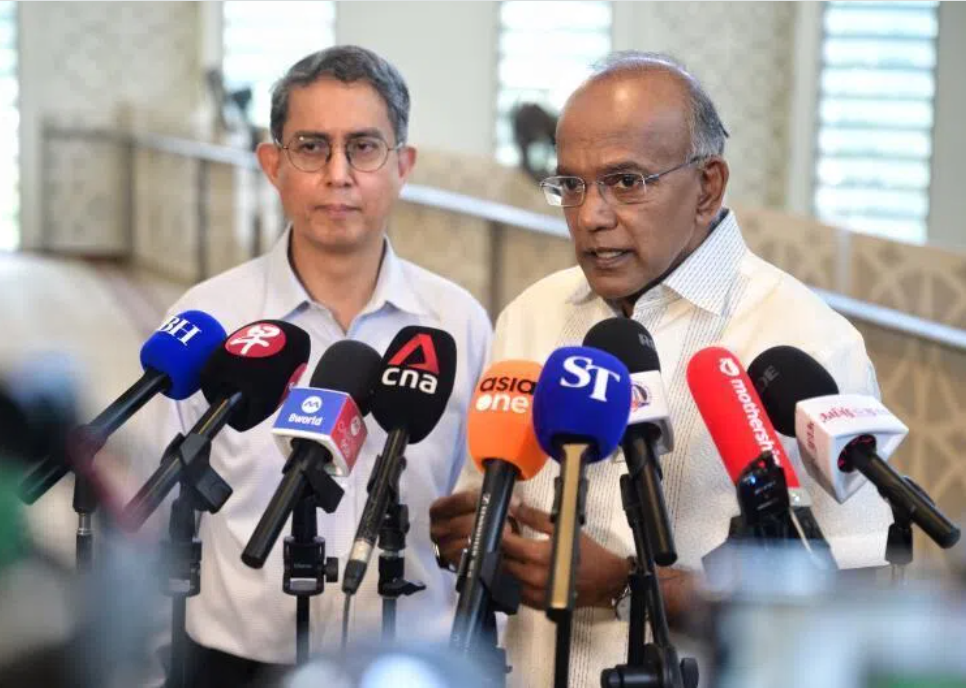
Singapore's Home Affairs Minister K Shanmugam has publicly defended the government's management of former Minister-in-charge of Muslim Affairs Faishal Ibrahim's sudden resignation, describing the online exchanges that prompted the departure as objectively inappropriate while acknowledging that Ibrahim himself recognised the position had become untenable. Speaking on Wednesday, Shanmugam sought to clarify the circumstances surrounding Ibrahim's decision to step down from both his ministerial and parliamentary roles following a complaint lodged directly with Prime Minister Lawrence Wong.
The resignation followed a series of digital communications between Ibrahim and an unnamed member of the public over what Shanmugam characterised as an extended period. According to the Home Affairs Minister's account, Ibrahim's responses to the woman's messages created an impression of reciprocal engagement, leading her to interpret his conduct as encouraging continued interaction. Shanmugam emphasised that regardless of Ibrahim's stated intentions, the objective assessment of the messages revealed conduct that fell below expected standards for a public office holder, establishing a factual basis for concern independent of what either party claimed to intend.
The situation escalated when the woman attempted to disengage with Ibrahim, who subsequently sought to terminate the exchanges. Her response was one of anger, prompting her to escalate the matter by contacting Prime Minister Wong directly and providing him with documentation of their interactions, including photographs. This shift from what might otherwise have remained a private dispute transformed the nature of the complaint, moving it from a personal matter into one involving allegations against a sitting government minister. The complainant's decision to involve the Prime Minister's Office effectively elevated the issue from the realm of private conduct to that requiring official consideration of propriety.
Shanmugam articulated a principled framework for evaluating such situations, drawing on standards established by Singapore's founding Prime Minister Lee Kuan Yew and reiterated by Senior Minister Lee Hsien Loong. Under this framework, conduct that remains entirely private and ceases following counselling may be handled discreetly. However, once a matter enters the public domain through formal complaint or public disclosure, the government must examine the facts and apply appropriate consequences if impropriety is established. This approach reflects a distinction between purely personal matters and those affecting public confidence in government officials.
Ibrahim's own acknowledgement played a decisive role in the resolution. Rather than contesting the assessment of his conduct, Ibrahim accepted that he should not have permitted the online exchanges to continue unchecked and that establishing clear boundaries from the outset would have been appropriate. Recognising that his position had become compromised, he determined that resignation represented the correct course of action, a conclusion that Prime Minister Wong accepted without apparent delay. This voluntary acknowledgement and withdrawal contrasts with disciplinary processes that might otherwise have been initiated.
The substance of the online interactions reportedly centred on messages transmitted through digital platforms, supplemented by meetings that occurred during public events. The relatively informal nature of these encounters—the woman was not a government official or politician—underscores that the concern centred not on abuse of ministerial authority but on the inappropriate personal conduct of a public figure. Ibrahim's explicit denial of any physical relationship and assertion that he had not intended for interactions to develop romantically provided context for the exchanges, though Shanmugam made clear that intentions alone could not excuse the objective character of the messages.
Ibrahim's political career had spanned nearly two decades of steady advancement within Singapore's governing People's Action Party. Entering Parliament in 2006 as part of the Marine Parade Group Representation Constituency team, he successfully contested multiple elections and served in increasingly senior roles. His promotion to senior minister of state and acting minister came only months earlier, following Prime Minister Wong's Cabinet reshuffle in May 2025. Prior to his political career, Ibrahim held an academic appointment at the National University of Singapore, specialising in real estate, a background that lent him credibility across policy domains including transport, education, and social affairs.
Shanmugam's public remarks also functioned as a character assessment, describing Ibrahim as conscientious, committed to public service, and someone whose contributions to his constituency had been substantial. The Home Affairs Minister characterised him as possessing genuine commitment to serving the community, noting the rarity of encountering individuals of comparable dedication in government and wider society. This testimonial aspect of Shanmugam's statement suggests that Ibrahim's resignation, while necessary given the circumstances, was not understood as reflecting broader character flaws but rather as a response to a specific lapse in judgment regarding personal conduct standards.
For Malaysia and the broader Southeast Asian region, this episode illustrates the heightened scrutiny that contemporary digital communication subjects public figures to and the mechanisms by which governments manage reputational crises involving their own officials. The episode also demonstrates how social media and messaging platforms create permanent records of interactions that were historically ephemeral, complicating the boundary between private and public conduct. In Singapore's case, the resolution through resignation rather than investigation or prosecution signals a preference for preserving the dignity of officials while maintaining standards of conduct.
The case also reflects evolving expectations regarding appropriate boundaries between public figures and members of the public, particularly in an era of digitalised communication where the informality of messaging platforms can obscure professional distance. Shanmugam's articulation of the government's position emphasises that while conduct may be motivated by consideration for another party's feelings, the objective impact of messages must be the primary consideration for those in positions of authority. This utilitarian approach prioritises outcomes over motivations, a principle with implications for how public sector conduct is assessed across the region.
The rapid resolution of the matter—from complaint to resignation within days—suggests that Singapore's government machinery is equipped to respond swiftly to misconduct allegations involving senior officials, avoiding prolonged periods of uncertainty or distraction from governance priorities. Ibrahim's decision to step aside also prevented a potentially more contentious investigative process, allowing both the government and the individual involved to move forward without protracted public scrutiny. His Marine Parade GRC team won uncontested in the 2025 General Election, indicating that local voters had not yet registered concerns about his fitness for office when balloting occurred.
Shanmugam's careful delineation between Ibrahim's intentions and the objective character of his conduct establishes a template for future deliberation on similar matters. This approach acknowledges human fallibility while maintaining institutional standards, suggesting that governments need not view all lapses as evidence of fundamental unfitness but may instead calibrate responses proportionately. For observers across Southeast Asia, the Singapore case provides insights into how developed administrative systems manage the intersection of digital communication, personal conduct, and public accountability, offering a model that emphasises both fairness and swift resolution.

