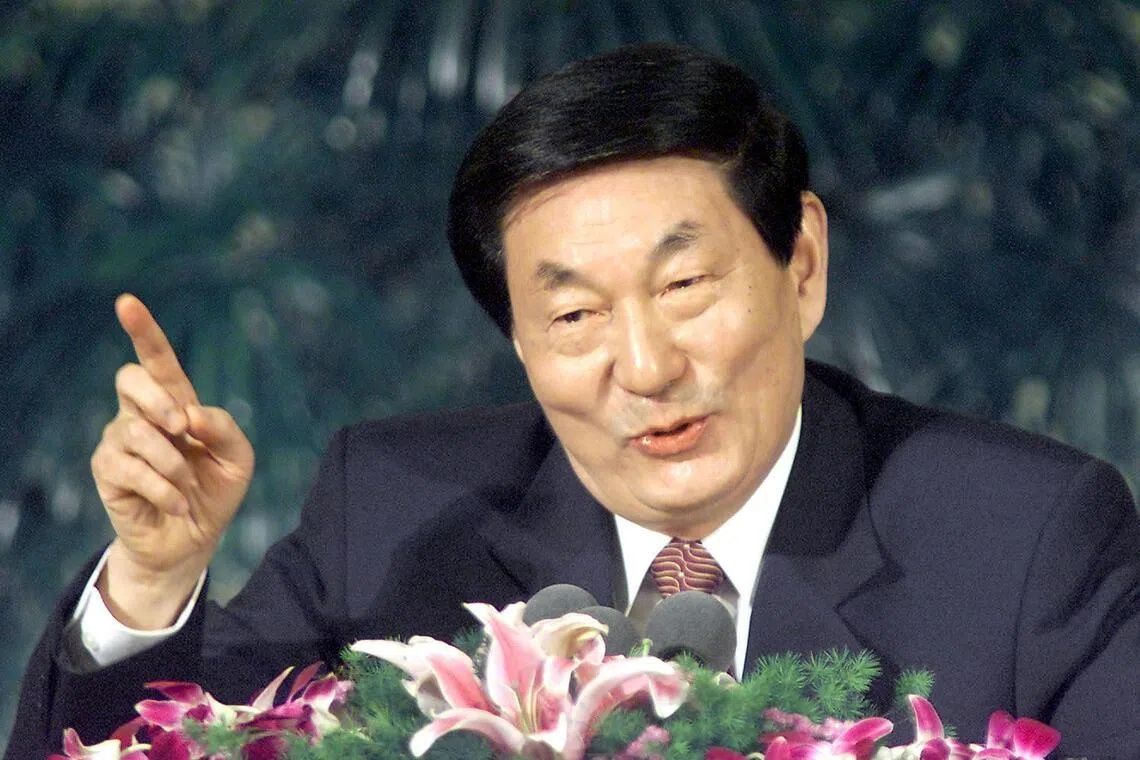
Singapore Prime Minister Lawrence Wong has conveyed formal condolences to Chinese Premier Li Qiang following the passing of Zhu Rongji, the former premier who died in Beijing on Wednesday, August 12, just weeks before what would have been his 98th birthday. The diplomatic gesture, delivered through a letter dated August 13, reflects the deep respect Singapore's leadership holds for a figure who profoundly shaped China's modern trajectory and the nation's place within the Asian region.
Zhu's tenure as China's premier from 1998 to 2003 was marked by transformative economic decisions that positioned China as a major player in global commerce. In his tribute, PM Wong specifically highlighted Zhu's instrumental role in steering China through critical economic reforms and, perhaps most significantly, orchestrating the country's accession to the World Trade Organization in 2001—a watershed moment that irreversibly integrated China into the international trading system and set the stage for decades of growth that would reshape Asia's economic landscape.
The Singapore leader's characterization of Zhu as "an old friend of Singapore" underscores a relationship that transcended typical state interactions. This personal dimension is substantive: Zhu had engaged multiple times with Singapore's founding Prime Minister Lee Kuan Yew and his successor Goh Chok Tong, establishing bilateral rapport at the highest levels. Such sustained personal connections between leaders are rare and carry outsized influence in shaping long-term diplomatic trajectories, particularly in a region where historical relationships between leaders often determine the texture of state-to-state engagement.
A particularly telling measure of Zhu's regional influence was his delivery of the Singapore Lecture in 1999, organized by the ISEAS – Yusof Ishak Institute. This prestigious platform, reserved for prominent world leaders and intellectual figures to expound on global and regional affairs, had not previously been occupied by a Chinese leader. Zhu's appearance signaled China's growing confidence and desire to articulate its strategic vision to an audience of Southeast Asian policymakers, business leaders, and academics—a region acutely sensitive to the trajectory of Chinese power.
The substance of Zhu's 1999 address carried particular prescience for Southeast Asia. He articulated a vision in which China's economic expansion would generate prosperity across the broader Asian region rather than operating as a zero-sum competition. More concretely, he proposed the establishment of a free trade area between the Association of Southeast Asian Nations and China, an idea that seemed ambitious at the time but eventually materialized as the ASEAN-China Free Trade Area, formally established in 2010. This proposal revealed Zhu's understanding that China's long-term interests lay in binding the region through economic interdependence rather than pursuing dominance through other means.
For Malaysia and other ASEAN nations, Zhu's vision has indeed borne fruit in ways that have reshaped regional commerce over the past two decades. China has become the largest trading partner for much of Southeast Asia, and the frameworks Zhu helped conceptualize have channeled billions in investment and trade flows throughout the region. The prosperity generated has been uneven and has created dependencies that some analysts view with caution, yet the economic integration Zhu envisioned has materially improved living standards across the region and created powerful constituencies for stable China-ASEAN relations.
Beyond grand strategic vision, Zhu also invested in the practical mechanics of bilateral relations between Singapore and China. As Shanghai's mayor before his elevation to the premiership, he actively cultivated exchanges and mutual learning between Shanghai officials and their Singapore counterparts. More substantially, he was an early and committed supporter of the China-Singapore Suzhou Industrial Park, a flagship government-to-government infrastructure project that symbolized the possibilities of Sino-Singapore cooperation and served as a model for subsequent joint ventures across the region.
The Suzhou Industrial Park represented more than bricks and mortar; it was a testbed for how Chinese and Singaporean expertise could be combined to create modern industrial zones that attracted multinational investment. The project's relative success—it has grown into a major hub for electronics, pharmaceuticals, and advanced manufacturing—validated Zhu's bet that economic cooperation could flourish between countries with vastly different political systems and development trajectories. For Malaysian policymakers observing similar bilateral projects, the Suzhou model offered both inspiration and practical lessons about negotiating infrastructure partnerships with China.
PM Wong's emphasis on how Zhu's efforts "laid a strong foundation for the close ties and extensive exchanges that our two countries enjoy today" acknowledges a debt that extends well beyond his individual lifetime. The institutional relationships, business networks, and diplomatic channels that facilitate Singapore-China cooperation today were substantially shaped during Zhu's premiership. In this sense, Zhu's passing represents not merely the loss of an individual leader but the departure of someone who left an indelible imprint on how an entire region relates to and engages with China.
For Southeast Asia more broadly, Zhu Rongji embodied a particular vision of Chinese leadership—one that emphasized economic development, pragmatic engagement with the international system, and the belief that China's rise could be compatible with regional prosperity. As China's role in Asia continues to evolve and sometimes generate friction, Zhu's legacy as an architect of economic integration and a proponent of multilateral frameworks like ASEAN-China cooperation remains relevant. His death marks the passing of a generation of Chinese leaders who helped engineer China's emergence as an economic superpower, a process that has fundamentally reshaped the Asian century in which Malaysia and its neighbors operate.

