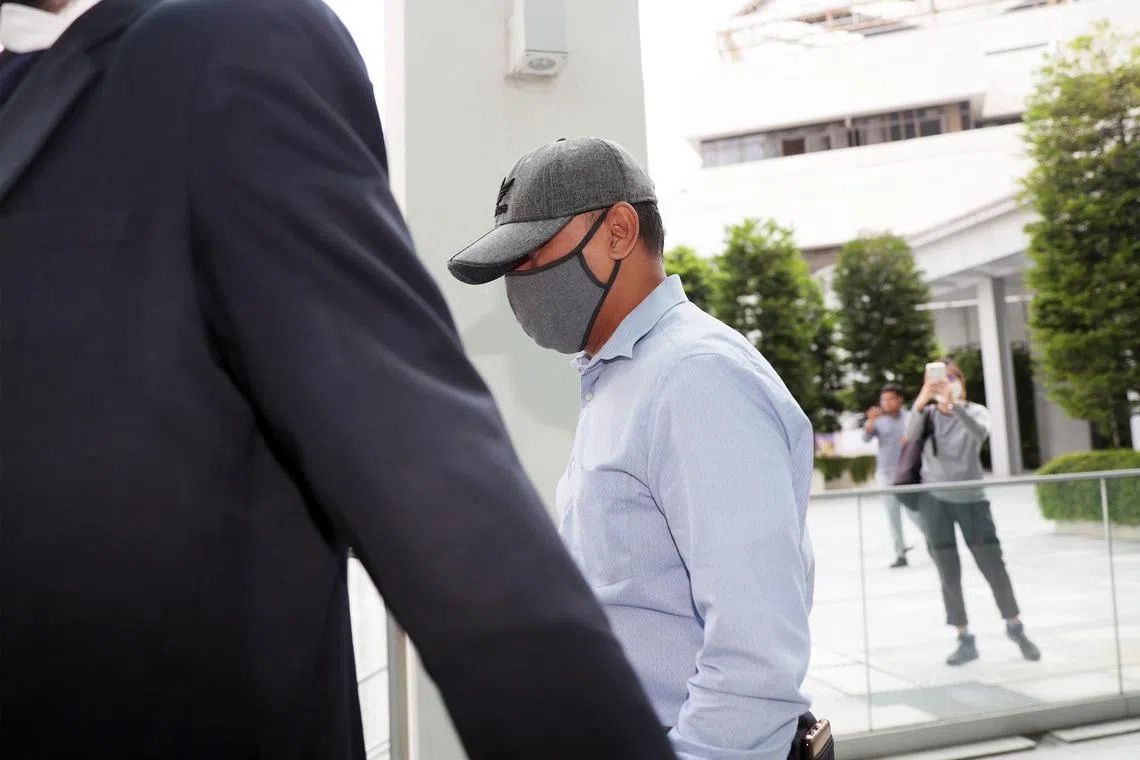
A former executive chairman of two Singapore mosques has received a 14-month prison sentence for corruption offences involving construction contracts worth S$223,000. Abdul Rahim Mawasi, 59, was convicted after providing insider price guidance that improperly enabled his friend's company to win lucrative building projects at Darul Aman Mosque and Sallim Mattar Mosque, undermining the integrity of the competitive bidding process.
At the time of the offences, Mawasi held significant institutional authority as executive chairman of both mosques while simultaneously serving as a senior officer with the Islamic Religious Council of Singapore (MUIS), to which he had been seconded. This dual position placed him in a position of trust and responsibility for managing the mosques' finances and procurement decisions. His involvement in approving and overseeing construction projects made his breach of faith particularly grave, as he exploited his position to benefit a personal acquaintance rather than acting in the organisations' best interests.
The scheme emerged from a business proposal between Mawasi and Mohd Mustaqim Kam, also known as Kam Hock Beng, whom he had known for over a decade. In July 2018, the two men agreed to establish a travel company focused on pilgrimage trips. The arrangement was notably unequal: Mawasi would contribute no capital of his own, while Kam, a director at construction firm Zeal-Con Engineering, would use profits from mosque construction projects to fund the venture. This arrangement essentially converted public sector contracts into private investment capital, a textbook abuse of procurement authority.
The corruption manifested through a series of strategic interventions during contract bidding. When Darul Aman Mosque sought construction services for yard improvements in 2018, Zeal-Con submitted an initial quote of S$128,600 on 20 August. Subsequently, on 12 September, the company submitted a revised bid of S$118,000—significantly undercutting the next closest competitor at S$125,500. Court evidence revealed that Mawasi had conducted extensive discussions with Kam about the bidding price and provided crucial price guidance that directly influenced Zeal-Con's competitive positioning. On 26 September 2018, the mosque's management board awarded the contract to Zeal-Con for S$118,000, unaware of Mawasi's role in determining the outcome.
A similar pattern of manipulation occurred at Sallim Mattar Mosque. In September 2018, Zeal-Con quoted S$115,700 for roofing and reception area improvements. By July 2019, the company had substantially reduced this quote to S$105,000 for identical work. Mawasi explicitly advised Kam to lower the company's bid to secure the contract, according to Deputy Public Prosecutor Bryan Wong. The following month, Sallim Mattar Mosque issued contract awards to Zeal-Con based on the revised pricing, cementing the corrupt arrangement.
To conceal his financial interest in the scheme, Mawasi orchestrated an elaborate cover-up through his family. Before November 2019, Kam converted an existing shell company into Amal Travel and Tour (ATT), capitalising it initially at S$37,500 before increasing paid-up capital to S$100,000. Critically, in November 2019, Kam allotted 25,000 ATT shares—each valued at S$1—to Mawasi's son, effectively transferring the corrupt proceeds to the next generation while maintaining plausible deniability. Mawasi failed to disclose his indirect interest in ATT to MUIS, violating conflict-of-interest protocols and institutional governance standards.
During trial proceedings, Mawasi denied any involvement with ATT, and it remained undisputed that he held no shares directly. However, the prosecution demonstrated that the share allocation to his son was designed as a deliberate stratagem to obscure his beneficial interest in the joint venture. This arrangement reflected sophisticated awareness of potential legal exposure, suggesting Mawasi understood the illegality of his conduct and took calculated steps to evade accountability. His legal representatives argued for leniency based on his clean criminal record, but the court deemed the gravity of public sector corruption prohibitive of lenient sentencing.
While the prosecution acknowledged that Zeal-Con had satisfactorily completed the construction work—thus the mosques did not suffer tangible physical losses—Deputy Public Prosecutor Wong emphasised that Mawasi had committed a serious offence against public trust for private financial gain. The distinction between contract quality and corruption integrity is crucial: even if services rendered were adequate, the integrity of the procurement process had been fundamentally compromised. This separation of outcomes from corruption is significant for institutional reform, as it establishes that corruption remains gravely culpable regardless of whether victims ultimately received acceptable performance.
Mawasi's co-conspirator, Kam Hock Beng, aged 66 at the time of sentencing, received a lighter six-month jail term in February 2025. The disparity in sentencing reflects Kam's lesser institutional authority; while he initiated and benefited from the scheme, Mawasi held the authoritative position that enabled the corruption. This sentencing hierarchy reinforces that public officials bear heightened responsibility for breaching institutional trust, particularly in organisations such as religious councils that depend on community confidence.
The case carries significant implications for governance in Singapore's Islamic institutions and broader Southeast Asian religious organisations. MUIS and mosque management boards rely on accurate, competitive procurement processes to allocate community resources fairly. The Mawasi case demonstrates how institutional gatekeepers can weaponise their authority to redirect public assets into private ventures, eroding stakeholder confidence. For Malaysian readers, the case offers instructive lessons regarding procurement oversight at religious institutions, which typically operate with substantial autonomy and limited external scrutiny compared to government agencies.
Mawasi's sentence commenced on 10 July following bail arrangements of S$30,000. The conviction serves as a cautionary precedent for senior officials across religious and non-profit sectors throughout Southeast Asia, signalling that institutional position does not insulate individuals from criminal liability for corruption. The case also underscores the importance of robust internal controls, transparent bidding procedures, and conflict-of-interest declarations—governance measures that strengthen institutional legitimacy and protect community assets from authoritarian exploitation.

