A 29-year-old man in Singapore faces five serious criminal charges stemming from a chaotic predawn incident on March 6, 2024, during which he drove recklessly while under the influence of alcohol, ultimately colliding with a bus carrying schoolchildren and leaving a trail of destruction across multiple roads. Aaron Tan Yao Cong was charged on Thursday, June 18, with drink driving, dangerous driving causing hurt, leaving a vehicle in a position likely to cause danger, failing to cooperate with a breathalyser test, and driving against the flow of traffic. The cascade of charges reflects the gravity of his actions and the potential harm created by his driving decisions that morning.
Court documents reveal that Tan's blood alcohol level was measured at 148 milligrams per 100 millilitres of blood, substantially exceeding Singapore's legal driving limit of 80 milligrams per 100 millilitres. Notably, when arrested, Tan refused to submit to a breathalyser test at the scene, a refusal that itself constitutes a separate offence under Singapore traffic law. His refusal to cooperate with police procedures reflects the nature of his conduct that morning—one marked by defiance of rules and an apparent disregard for the safety of other road users.
The incident unfolded in the early morning hours when Tan disregarded a straight-only traffic sign along Cavenagh Road near Bukit Timah Road at 5:50 a.m. Rather than proceeding straight, he negotiated a left turn and drove directly into oncoming traffic lanes. He came to a temporary halt on the left side of the two-lane Cavenagh Road, positioned towards Buyong Road. At this critical juncture, he had three passengers in his vehicle who would narrowly escape serious injury.
Within minutes, as police officers approached the stationary vehicle at approximately 6 a.m., Tan accelerated away from the scene. What followed was a dangerous high-speed pursuit through residential and commercial areas of Singapore's central region. Between 6:16 a.m. and the collision, Tan drove along Bukit Timah Road toward Upper Bukit Timah Road, weaving erratically through traffic and maintaining an average speed of 114 kilometres per hour—well above safe limits for urban driving in built-up areas.
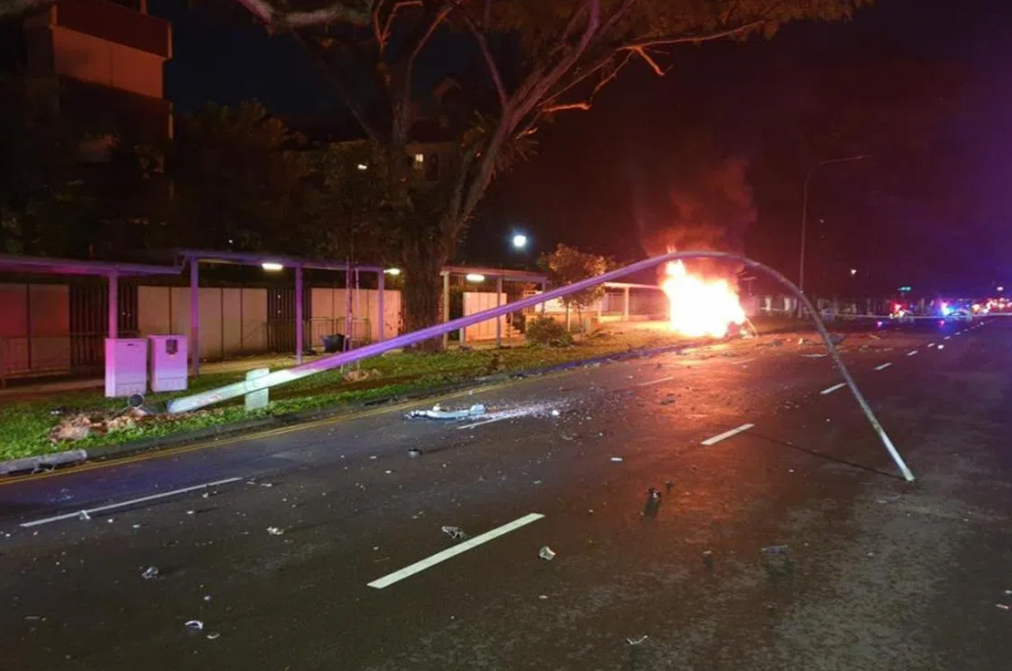
The reckless driving pattern continued as Tan approached the junction of Sixth Avenue. There, disregarding a red traffic light signal, he collided violently with a private bus that was executing a legal U-turn. The impact was severe enough to send Tan's vehicle careening into a lamp post, the force of the collision causing the car to catch fire. Emergency services responded to find a burning vehicle with occupants requiring rescue. Tan and his three passengers managed to escape the flames, though all required medical attention for injuries sustained in the crash.
The bus presented a more dire situation. In addition to the driver, two young passengers aged nine and ten were aboard and required hospital treatment following the collision. These children—likely travelling to school given the early hour—became victims of Tan's decision to drive while impaired and reckless. Their involvement transforms this from a case of traffic violation into one affecting vulnerable road users with potential long-term consequences for their safety and wellbeing.
Tan's criminal history compounds the seriousness of his current charges. He was previously convicted in 2019 of drink driving and driving without due care and attention, demonstrating a pattern of irresponsible behaviour behind the wheel. That prior conviction means he faces significantly enhanced penalties as a repeat offender under Singapore's traffic laws. The authorities have clearly signalled through the charging decision that repeat drink-driving represents a grave threat to public safety warranting stringent legal consequences.
The sentencing framework for his various charges underscores the judicial system's commitment to deterrence. For drink driving as a repeat offender, Tan faces imprisonment for up to two years and fines reaching S$20,000. The dangerous driving charge carries potential imprisonment of up to two years and fines up to S$10,000, with repeat offender penalties doubling the fine amount. Additional charges relating to allowing an unsafe vehicle position, failure to provide a breath specimen, and driving against traffic flow carry progressively shorter sentences but collectively demonstrate the multiple layers of lawbreaking that occurred.
Tan is scheduled to return to court on July 16, where the case will progress toward trial or potential plea negotiations. He has not yet indicated whether he intends to plead guilty to any of the five charges. The decision to proceed with trial versus admission of guilt will significantly impact the legal process and timeline, though the evidential basis appears substantial given police documentation and the multiple charges filed.
The case resonates beyond Singapore's borders as a cautionary example of the cascading consequences of impaired driving. For Malaysian motorists and residents, the incident underscores how alcohol-impaired driving represents not merely a personal risk but a clear and present danger to innocent bystanders, particularly vulnerable groups such as children. Singapore's robust legal framework and serious penalties reflect a regional approach increasingly adopted across Southeast Asia to combat drink-driving and protect public safety on roads that grow busier each year.
The collision also highlights systemic risks created when drivers ignore traffic signals and lane markings. Each violation—the initial left turn against a straight-only sign, the driving against oncoming traffic, the failure to comply with red lights—created escalating opportunities for catastrophic harm. Had any of these breaches been prevented through better driver decision-making or enforcement, the subsequent collision might have been avoided entirely. For road safety advocates across the region, the case demonstrates the importance of sustained campaigns against impaired driving and the vigorous prosecution of traffic violations that endanger public safety.